Kevin Silva Interview

Kevin Silva is the starting goalkeeper for the US U17 national team. Kevin played in the Nike Friendlies this past December, a tournament that featured the U17 national teams from US, Portugal, Brazil, and England. Silva was awarded the Golden Glove for only giving up two goals in the tournament. I talked to Kevin about how he got into goalkeeping, what it's like being at Bradenton, and what it was like to be on the field against a team who didn't move for the last six minutes of the game.

How'd you introduced into playing goalkeeper?

It was probably my dad. Growing up, he would play in this league and I would usually see him in goal. I always had an interest but I didn't play goalkeeper in little leagues. It wasn't until after a little while I tried it and I started enjoying it a lot. And I saw that I had a little bit of natural talent for it.

And how'd you get introduced to the US youth programs?

They saw me play on my club team, PDA, and they told me about the academy. They talked about the opportunities that would be coming along because how the national team is more involved than the academy league. So they brought me in and I tried out. They liked me a lot. The ID camp in Cali, which was two and half summers ago is where it all started for me.

You started residency this last fall. What were some of the aspects that played into your decision to go down to Florida?

Just knowing how training would be. I really fell in love with the fact that we would train every day with good competition and actually work hard. I could really start to see myself improve. I talked to some guys who were here last cycle and that really helped make the decision about it too. My parents were really concerned about the school and once we found out I was going to a good school and getting a good education that eased my parents into it.

What are some differences, either major or minor, between your club back home and Bradenton?

Training every day and how the players down here treat the training sessions. Back in PDA, we had very good coaches and very good sessions, but sometimes the players don't feel like playing and the training level wasn't so high. I'm not complaining, PDA is a great place, but I know I've improved a lot down in Bradenton because of the competition level. We're all fighting for a spot and we all understand what it means to train like young pros every day.

This might not have been on your mind at all but you weren't able to play for a high school team. Was there any regret there?

I don't really regret it. [Playing for a high school] seemed like a really cool experience but when you look back on it, not that many players get to say that they played in the Nike Friendlies and against other countries. That was an experience that I always thought of growing up. But when the national team came along, there wasn't much regret.

What's something about residency that someone from the outside wouldn't know of?

They work on every aspect of your game from mental to nutrition. It's not all about going to school and playing soccer. It's also about being mentally tough and eating right. Every day they're creating a different environment for you to adapt to.

Is there anything you would change about it?

*thinks* I wouldn't really say because they give us every opportunity to get better. It's all in front of us and it's all a matter if we want it or not.

You talked about the Nike Friendlies, the last game against Brazil. I'm sure you remember this but they just stood on the field for the last six minutes to end the game. [Video here] Right at the whistle y'all rushed to celebrate winning the tournament but was there any conversation at all about it? Either between yourselves, coaches, or with the other team?

[Coach] Richie [Williams] said after the game that he was really shocked what they did because it's really… not them. Brazil wouldn't really do that. They were really mad and didn't believe the second red card was a red card but obviously it was. They didn't like that we had outplayed them and they had enough. The coach even yelled from the sidelines to tell them to stop playing and just stand there. But Richie didn't really say much about it. He said don't juggle the ball and to just hold the ball and be professional about it.

I know you're still a little ways from this decision but is there any sort of pressure on you now about college? Do you feel there's pressure on you to go play abroad? Are you leaning one way or the other?

It's tough because the age I'm now. My mom wants me to do college but my dad wants me to overseas. As of right now, if an opportunity overseas opens up I'm obviously taking that advantage but if something doesn't work out overseas, I’ll look back at college and play there.

Last question, what's the difference in your game now versus two years ago? So from 14 to 16, how are you different as a goalkeeper?

Physically, I've gotten a lot stronger and taller. Also, maturing has helped a lot. At 14, I wasn't very brave coming off my line, command my box, or communicate as much as I do now.

MLS Goalkeeper Review - Week 1

If you're new to the site or don't know how to pronounce "GSAR", check out my goalkeeping stat, Goals Saved Above Replacement.

One week through MLS and we saw many high and lows. Everyone was excited about the number of goals on the opening weekend but goals come from goal scoring opportunities and goal scoring opportunities lay the foundation for saves. And who doesn't like a good save? Chumps, that's who.

MLS actually did a decent job of picking the Save of the Week candidates, something they didn't do last year. On principle, I don't vote for a penalty save unless it was really outstanding for some reason. So I went with Penedo's flick of the wrist. I thought that was the most display of skill, even if the other saves (specifically Rimando's and Johnson's) had a higher impact on their GSARs.

If you're new to the site, I'm continuing my GSAR campaign for MLS goalkeepers this season. I almost completed the project last year but didn't quite make it. (You can click the 2013 tab to see the mostly completed project.) Below are everyone's GSAR. Rimando, Shuttleworth, and Seitz all had great days despite giving up a total of six goals between them and Seattle's Stefan Frei had a negative GSAR even though he had a shutout.

In an attempt to be more transparent for 2014 (my new year's ghost-inspired resolution), here are the game-by-game results for the first week of the MLS season. Going left to right by columns are

  • date - What the date was.
  • gk - Who the relevant goalkeeper is.
  • versus - Who are they playing?
  • GAs - How many goals allowed? This might increase as the game goes on.
  • shotlocal - Shot location based off of American Soccer Analysis's grid although I split the second grid in half. 2A is in front of the penalty spot, 2B is behind it. (For penalty kicks I just listed it as 2A.) I did this because I noticed a lot of shots come from the second grid and wanted to be more precise.
  • speed - 0-5 rating on how fast it was. This is a shot in the dark to see if it'll show some results. It might turn out to be nothing.
  • balllocal - If you keep scoring to the right in the spreadsheet you'll see a goal lined in x's with six grids inside. This is where the shot enters, facing the goal. The sixth grid is the top right corner (if facing front of goal).
  • situation - Any relevant information on the play.
  • defense (0-2) - 0-2 rating on the defense on the play. 2 is great, 1 is average, 0 is bad.
  • GSAR - Goals Saved Above Replacement, which you should know about now.

Five Plays From Week 1

5. I was really impressed with Shuttleworth this past week. After an up and down season in 2013, where New England sat Shuttleworth for Matt Reis late in the season, New England brings in Brad Knighton to compete for the spot. Shuttleworth gets the nod for opening day and his first three encounters with the ball all result in goals. Yet he finishes the game very strong (even though another goal was scored) with a +.73 GSAR on the day, including a 1v1 stop and this nice upper ninety save.

4. Sean Johnson made the highlight reel with his nice free kick save (+0.59 GSAR) but still ends up negative on the day because of the second and third goal he conceded against Chivas. On the second goal, his hands jump up above his head when the shot slips in past his heels. This is not ideal. He needs to react to the play and not guess. The third goal is more criminal when the ball slip past his hip. It's hit with such power, it's easy to let Johnson off the hook but this is definitely his to claim.

3. Sporting Kansas City gives up a goal in stoppage time when Eric Kronberg plows through Matt Besler. It's a fine line between trusting your defenders and being scared but Kronberg is too aggressive here. Even after the collision he takes way too long to get up and can't get to the ball because of this.

2. After having a quiet day and with his team up 4-0, David Ousted rushes out for a ball that he thinks he can catch but doesn't see Bradley Wright-Phillips until it's too late. I'm alright with his decision to come out, but this is a textbook punch situation.

1. In the first half of the game, Jaime Penedo makes a diving save that I think is a little overplayed. There's no shuffle when he has the time to do so. I think he could hold on to this if he moves his feet just a little bit. But like I said before, I really like this save by Penedo. It's quick, and one he shouldn't give up, but it's a hard, rising shot from a close angle. Honestly, this save is much tougher than the diving one.


Notes

  • Multiple keepers struggled in the air last weekend. We saw Kronberg's collision but Seattle's Stefan Frei didn't look confident here and Tally Hall had a really bad miss on a throw-in that should have resulted in a goal if not for the smart defense to guard the line. This may be an issue with these keepers for the season.
  • Chris Seitz did well coming off the bench for FC Dallas when Raul Fernandez injured. I said it all last season that Seitz was the best backup in the league and I still think he could start at a number of teams now. However, he almost gave up a bad goal with this five hole slip up. Somehow he redeems himself on the play by getting a paw on the rebound.
  • Crew goalkeeper Steve Clark (who was traded by Seattle) may have a quiet season in Columbus. +0.05 GSAR in a shutout.
  • Julio Cesar should start for Toronto on Saturday against Seattle. I'm looking forward to seeing what the World Cup vet can do.
  • Matt Reis is hiding outide in Los Angeles.
  • Donovan Ricketts showed us how to not defender a header. Goodness gracious...

International Rankings Royale - 2013 Results

For some history of the International Rankings Royale, take... a look... at this.

The Combatants (OR Can Robots Fight?)

Yes, 2013 has ended some time ago so it's far time that we take a lot at how each international rankings system did. Just a reminder of the contestants:

  • FIFA Rankings - Important for any major competition to sort teams into correct pots. These rankings are used to seed for the FIFA World Cup Qualifying but also (I think) every confederation's continental cup. So these rankings are clearly the most important. But are they the best?
  • ELO Rankings - A ranking system expanded from the chess rankings. I don't really know how it works but it obviously has a lot of math. But is math good?
  • SPI Rankings - Nate Silver's brainchild is used to give odds and neat graphics like these. But can we trust robots?

The old link at the top gives the methodology of it all (and you can look a the results from all 921 games from this past year here) but basically it came down to goal differential. I put each ranking system on the same playing field of saying that every 20 spots in their rankings meant the two teams were separated by one goal differential. I froze the rankings at the start of every month to make it fair (ELO, SPI update daily) and capped the goal difference at four. So a 6-0 win still only counted as a 4-0 win in these rankings. I know there a lot of variables like teams sending reserves or home field advantage but every ranking system is at an equal disadvantage in those situations.

Results Backed by "Math"

So which rankings system was the most accurate over the 921 games? Well it was close. Each number below is the number of goals they were off the actual goal differential, or the goal difference difference (GDD), from the combined 921 games.

  • ELO - 1448 (1.572 per game)
  • FIFA - 1506 (1.635 per game)
  • SPI - 1519 (1.649 per game)

Over 921 games, the best and worst were only separated by 71 goals. I tried to find some discrepancies between the three rankings. Surely one is better, say, at predicting UEFA success while another overrates CONMEBOL. Right?

Below is a table (it's just a picture, don't get too excited) of how far off each system was from the correct ranking in each match. ["Else" includes any team not distinctly in FIFA but still plays matches. CONCACAF has a number of these with the Caribbean teams.]

Screen Shot 2014-03-07 at 5.03.00 PM.png

(I'm going to explain the math in this paragraph so if you hate math just skip this one.) We'll use the first game of 2013 as an example. Niger defeated Togo 3-1 despite being an underdog in each system. Specifically ELO said Togo was 103rd in the world going into the game while Niger was 122nd. The difference in rankings should have, by ELO's prediction, given Togo a +.9 GD. However since Niger won by two goals (giving us a 2.9 GDD, 2 + .9) ELO's rankings were significantly off. The two goal difference translates to a would-be 40 spot gap in the table. I combined the 40 would-be gap and the 19 actual gap to average a correct ranking difference but maintaining the same middle ground. Halfway between 103 and 122 is 112.5. (You don't need to check that on a calculator, I'm pretty sure that's right.) ELO should have said that Togo should have been ranked 132.5 while Niger should have been 92.5 because it's a 40 spot gap and halfway between 132.5 and 92.5 is still 112.5. (I told you it was a lot of math!)

The top row is the number of games each confederation appeared in for a total of 921 doubled, because there are two teams to each game. The next section is how far off each system was from was for each confederation. So for each Asian team (AFC), ELO was 18.91 spots off in their rankings every game, or almost a full goal. This is less than SPI and FIFA's misrank of around 23 and 25 respectively.

The next section tells us if they under or overrated those teams. ELO was fairly consistent with only a -0.95, rarely underrating teams while SPI consistently underrated Asians squads. For CONCACAF teams, however, FIFA and SPI typically overrated them.

Overall, they're all pretty similiar. ELO excelled at some but not by much. And everyone was a lot closer with CONMEBOL teams than the rest of the confederations. I thought that might be because of the minnows outside of the top 50. To test this, I sorted out any game where at least one system didn't have one of the teams in their top 50.

Not a huge change. FIFA and SPI was actually less accurate with the better AFC and CONCACAF teams. CONMEBOL didn't change at all except for a hundredths. I think that's an error on my end but I couldn't find out why the small change because the number of games stays the same. (Sorry.) And Martinique is the lone representative for the "Else" category, when they played Mexico and Panama in the Gold Cup this summer. It says FIFA was underrating them by 130.5 rankings but that is because Martinique isn't in theirs so I just listed them last, 210th.

I didn't differential between friendlies and more important games because I forgot to label them as I started and it'd be a bit of work to do that. But I didn't feel too bad about this as all these teams still uses friendlies to find out their rankings. If someone wants to go back and figure it out by labeling all 921 games, be my guest.

Conclusion

There's not that much of a difference between the three. I think we get tripped up on one system being flawed because they ranked X team ten spots lower than we would. We rarely consider the strength of a ranking system by surveying the bottom 150 teams. But if you had to say one was the best, I suppose you could lean towards ELO.

The FUTURE

For 2014, we have a new face: We Global Football. Like SPI and ELO, they update daily and even go as far to predict every game's goal difference. We had a number of matches in 2013 but it won't hold up to last year's near millennium mark with qualifying and confederation cups on their off year. Already through early March, 2013 has doubled the number of matches that 2014 has. Here are the standings through 84 matches:

  • SPI - 123 (1.468 per game)
  • ELO - 127 (1.507 per game)
  • FIFA - 128 (1.520 per game)
  • WGF - 139 (1.652 per game)

(View the complete game-by-game results here)

But since I was paying attention, I marked all the non-friendlies for 2014. So far there have only been fourteen and they've all been in the AFC with the 2015 WAFF Championship and qualification for the 2015 Asian Cup. We need more games but I did think the results were interesting.

  • ELO - 20.2 (1.443 per game)
  • WGF - 20.5 (1.464 per game)
  • SPI - 23.1 (1.650 per game)
  • FIFA - 25.1 (1.789 per game)

Again, it's very early, but SPI's GDD per game jumped from 1.468 to 1.650 when we only counted non-friendlies. FIFA makes a similar jump and WGF and ELO are actually more accurate.

Lastly, here are the three biggest misses by each system at this point in 2013. I judged them on how far off the other three systems were from guessing.

date - (rank) nation at (rank) nation [score:score] (GDD, how far off the other three's average)

ELO

1. March 5th - (77) Uganda at (89) Zambia [1:2] (1.6 GDD, +1.28 off average)
2. March 5th - (154) South Sudan at (130) Botswana [0:3] (1.8 GDD, +1.22 off average)
3. February 19th - (191) Pakistan at (114) Lebanon [1:3] (1.9 GDD, +1.22 off average)

FIFA

1. January 18th - (54) Norway at (78) Poland [0:3] (4.2 GDD, +1.58 off average)
2. March 5th - (66) Finland at (46) Hungary [2:1] (2.0 GDD, +1.47 off average)
3. March 3rd - (106) Kuwait at (34) Iran [2:3] (2.6 GDD, +1.30 off average)

SPI

1. (101) United Arab Emirates at (53) Uzbekistan [1:1] (2.4 GDD, +2.27 off average)
2. (25) Ghana at (90) Montenegro [0:1] (4.3 GDD, +2.23 off average)
3. (172) Malaysia at (152) Yemen [2:1] (2.0 GDD, +1.38 off average)

WGF

1. (180) Faroe Islands at (60) Gibraltar [4:1] (7.0 GDD, +5.78 off average)
2. (110) Estonia at (60) Gibraltar [2:0] (4.5 GDD, +2.58 off average)
3. (155) Rwanda at (105) Burundi [1:1] (2.5 GDD, +2.32 off average)

We Global Football had the most atrocious misrank with Gibraltar 120 ranks above Faroe Islands (an equivalent of a 4-0 win) but lost by three goals giving WGF not only a 7.0 GDD but almost six goals off the average. Out of fairness, Gibraltar tied Slovakia back in November 0-0 so I suppose we can understand the high rank. Gibraltar is now 189th on WGF.

I'll try to update again in the summer some time so see how these systems are doing going after the World Cup. If you want to watch them continue to duke it out, keep an eye on the 2014 Royale Google doc. I'll be updating that monthly.

Tim Howard vs. Ukraine - 03.05.14

I would have a lot of pity for a goalkeeper who was faced with more 1v1 situations than Tim Howard. Finding this collage was relatively easy:

Mexico - August 15, 2012

Mexico - August 15, 2012

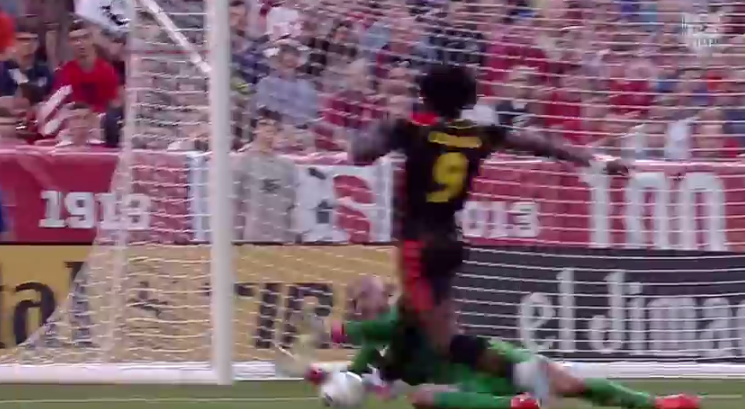
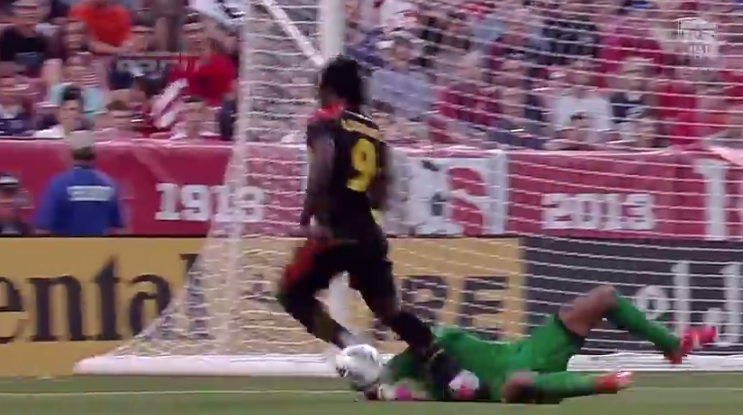
Belgium - May 29, 2013

Belgium - May 29, 2013

Bosnia and Herzegovina - August 14, 2013 

Bosnia and Herzegovina - August 14, 2013 

Chelsea - February 22, 2014

Chelsea - February 22, 2014

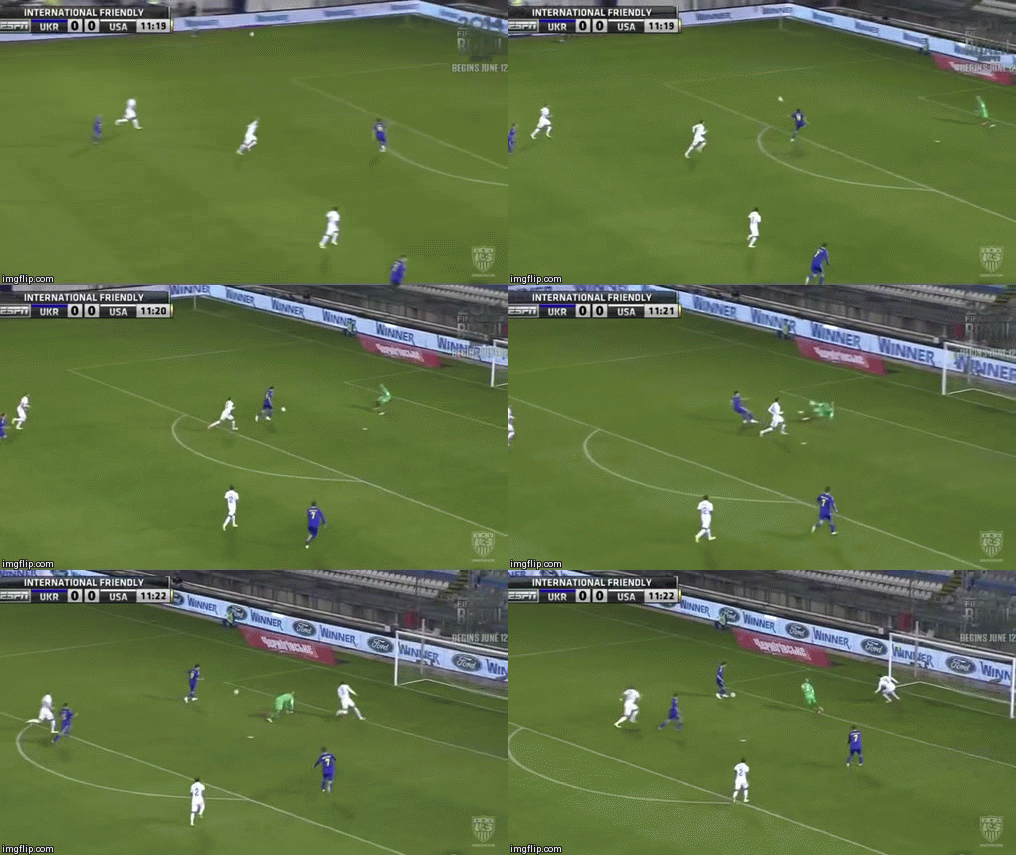
Ukraine - March 5, 2014

Ukraine - March 5, 2014

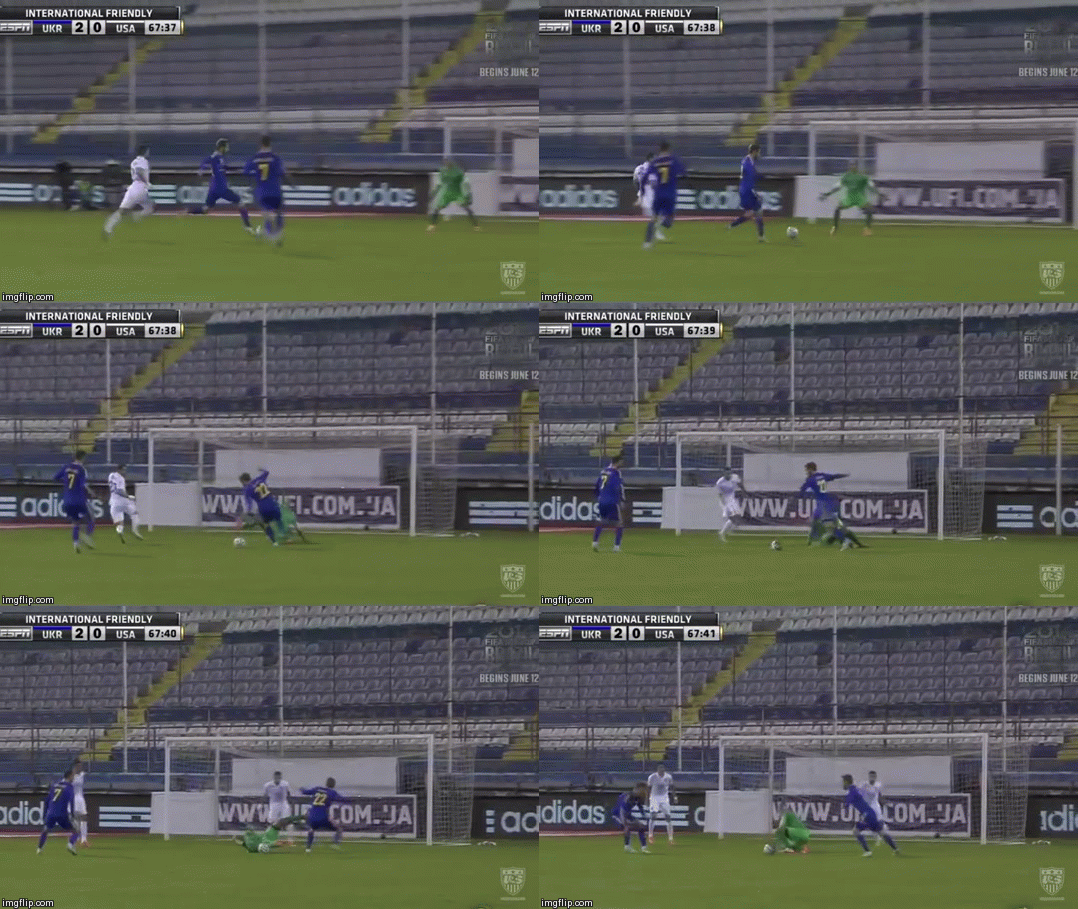
Ukraine - March 5, 2014

Ukraine - March 5, 2014

If those gifs don't sorrow your soul then you are likely a robot and I think I've made myself clear about how I feel about robots. And there were more I considered but I didn't want to highlight the end of Bob Bradley's career with the US team.

You may notice something similar about all these gifs. No, they are not all goals because I managed to cut it before it got that far on just about all of them. It's that in each gif Howard makes a save but the ball doesn't go where Howard expects. They are all different circumstances, yes, but in each one, Howard is put in a squeeze, makes a save, yet the ball is still in play. Is there a pattern we can find here?

No. (Haha got you.) I realize I set myself up to not answer my own question but I do have a hypothesis that I can't prove. That is why it is a hypothesis. But first you must understand some goalkeeping philosophy. Walk with me.

When a goalkeeper is in a 1v1 situation where he cannot slide to challenge the striker with the ball and he has to stay on his feet he turns into a wall of sorts. He is in a unfavorable situation but he will make the most of it by covering as much of the goal that he can. He does not cover the upper 90s but the center of the goal because a goalkeeper covers the high percentage shot areas. (A lot of you are saying "duh" right now. Keep walking with me.) In addition to being in the center of the goal, his body shape is important too. He wants to be as big as possible without giving away gaping holes between limbs. (So this hilarious piece of art would not be good goalkeeping because of the gaps between the arms and thighs, and his feet are too far apart or too close.) If the striker hits the cobwebs in the corner, then good for them that is a great goal. But the ball should not enter the goal down the middle of the lane. Or, the ball shouldn't enter the goal by passing through a goalkeeper's grasp. So they are as big as possible without holes in their defense.

The above paragraph is easier said than done. The realization that it is only you to stop a favorable goal scoring opportunity does weird things to the body. If you are doubtful, have a friend kick a ball at your face as hard as they can then try to stop a 1v1 situation. (Spoiler alert: your face does not like this.)

But being a wall is not enough because a wall predictably returns what it is given. So a goalkeeper must quickly transform from a wall to a different shape to ensure he does not simply give the shooter another chance on frame. Pushing a shot wide is the first choice but a kick save usually redirects the shot up and away.

All of this to say, I do not think Howard is changing his body shape enough to make sure he isn't allowing a second chance. Looking at the six examples above, I'm going to walk through why this may be true. All the examples have links to videos of the save/goal and on some of them you can slow it down to see intricacies. (There is a popup settings panel on the bottom right corner of the video.)

1. Mexico - August 15, 2012 - Some may remember this as the historic win with one of the more lucky goals I've seen where three offensive players half-accidentally/intentionally scored. Howard was Man of the Match for his two heroic saves at the end, including the first gif where he dives to his left to save a header from five yards away. But the ball does not characteristically continue going to Howard's left. Instead it redirects to the middle of the box. This occurs because his palm hits the ball and allows it to roll off of his hand and to the middle. Think of catching a basketball. The change in hand position is minute from catching it versus palming it away. (Please air-catch a basketball so you know what I am talking about. Now turn your fingers back to the point where your palm would hit it first. It's not that much, right?) The save is at 5:20 but on the slowmo replay, look at the spin of the ball. That is created from the palm slapping at the ball. It is such an immense redirection that Howard's left foot has to then kick it out to stop an own goal.

2. Belgium - May 29, 2013 - This probably isn't the best example so I won't spend a lot of time on this but his hand positioning is interesting. His elbows aren't extended all the way out to make himself as long as he can because he is trying to slap with his hands on the ball again. I would like to see him either go long (almost completely extended elbows) or using a Z arm shaped approach that this site calls the "Double Cobra" which is pretty cool. But basically Howard is only trying to hit the ball away. Can he hold it? Maybe, maybe not. But he's not trying to. Scroll through the pictures below to see how wide his hands are attacking the ball and how just his fingers hit the ball.

3. Bosnia and Herzegovnia - August 14, 2014 - Oof Eddie Johnson. Anyway, Howard gets the skate save but returns it to sender. Slowly watch 0:19-0:20 where Howard moves his foot up and over to make the save instead of just over. Doing so, Howard gets more contact on top of the ball and can't get enough leverage to hit it up. Also he doesn't redirect it out for a corner. Instead he basically traps it for Dzeko who puts it away with his next touch. This is very harsh critique as the power of the shot can't be understated so Howard's reaction time is even less than what one would expect in such a small area. 

4. Chelsea - February 22, 2014 - Return of the palm. Howard palms this into the goal because... Well I'm not exactly sure why but he does. I think he is a little rattled with the superb free kick and onrushing John Terry so he doesn't want to hold the shot but it's too close to his body to fingertip it away. Thus, the untrusty palm returns.

5. Ukraine - March 5, 2014 - (Everyone blasts Brooks here but it's Castillo's player that scores, which is even more embarrassing in my book.) Look at Howard's body shape. He is leaning very far back and lets the ball hit him. This is good that he doesn't go to the ground early but he doesn't try to redirect it any certain way. He throws his body up (not the vomit kind) and the inside of his left palm catches the ball. With his arm going up but only catching a side of the ball, the ball bounces down with a weird spin and ends back at the striker. If Howard moves his arms out on the contact instead of up, maybe there isn't a second chance.

6. Ukraine - March 5, 2014 - Howard loses his balance because he is leaning back so far. He gets up to make a big save. However the ball hits his palms again and spins back into his body, deflecting off his thigh and returning back to the shooter for a second time in one day. The shot is hit hard so I'm going to give his palms a break on this one. But right after making a stellar save he wildly kick at the second shot. Skip to 0:34 in the video to see the angle perfectly. If he just stands up he blocks the second shot Instead he gives a huge gap between his feet for the ball to roll under.

As the ball passes Howard.

So how do we rate Howard on the Ukraine game? (First, take a moment to be thankful you are in a country that allows you to post whatever player ratings you want on the internet.) It should be positive but with caveats that Howard could have been better. I realize these six situations are spread out over a year and a half but I think the idea holds some weight. Howard is very good at getting to the ball, there is no doubt about that, but in certain spots it appears he is not thinking a step ahead to avoid more catastrophe, like he is more intent on predicting the play than reacting to it.