International Rankings Royale (Pre-World Cup)

Welcome back to the Royale. The summer is a little more busy for me so this will be one of the few posts over the next couple months. If you're looking for a little bit more Bill Reno, take a look at my article that somehow ended up on Paste Magazine's new online soccer site, The 10 Best Goalkeepers at the World Cup. I know, I know, Howard didn't make the list but I make a good argument why he doesn't. So feel free to read that first before you send rude tweets my way.

Last year after May, there were 329 games and this year with the World Cup on the horizon, it's no surprise that we've only seen 216 at this point. We don't have any qualifiers this year and the only tournaments pre-World Cup are teams not attending. Still, that gives us enough games to take a look at the ranking systems. A little bit of a refresher of what last year's results looked like.

2013 Results
921 matches

ELO - 1448 (1.572 per game)
FIFA - 1506 (1.635 per game)
SPI - 1519 (1.649 per game)

For a more complete look at the stats and history behind this project, check out the 2013 results.

2014 Results (so far)
216 matches

SPI - 327 (1.514 per game)
ELO - 333 (1.544 per game)
WGF - 360 (1.667 per game)
FIFA - 362 (1.676 per game)

If you forgot, We Global Football has now entered the scene.

SPI has really upped its game, dropping their GDD by 8%, and even the newbie WGF is doing a little better than FIFA's system. But all these games include friendlies when managers are tinkering with changes. Or perhaps a team didn't send their first team selection so they're playing with their B team. I've been tracking the tournament games, typically more competitive, but oddly enough the rankings are less accurate in 2014.

2014 Competitive Results (non-friendlies, so far)
65 matches

ELO - 106 (1.633)
SPI - 108 (1.664)
WGF - 115 (1.766)
FIFA - 129 (1.984)

I didn't keep track of competitive games for 2013 and it'd be a real pain to go back and label each 2013 match one-by-one. Instead I just labeled intra-confederation games (i.e. UEFA vs UEFA). The intra-confed 2013 results were fairly close to all matches for 2013.

2013 Intra-Confederation Results
774 matches

ELO - 1213 (1.567)
FIFA - 1250 (1.615)
SPI - 1257 (1.624)

My best guess for why the competitive results for 2014 are so off is because the main teams playing competitive matches this year are non-World Cup teams, which are weaker, more erratic teams with a wider talent gap between their opposition. We'll see relatively closely ranked teams compete at the World Cup (most teams being within 30 ranks) but the results of the 2014 Caribbean Cup qualification could be anyone's best guess.

All that to say, the winner of the 2014 International Rankings Royale will likely be based on which system is more accurate with the minnows than the World Cup nations.
Top 100 American Goalkeepers (May 2014)

Cover photo belongs to Philly Soccer Page

Goalkeeper spotlight is on John McCarthy this month. I interviewed McCarthy about the upcoming MLS draft back in January. Although he went undrafted, McCarthy was signed by the Rochester Rhinos (USL Pro). Recently he has fought up the depth chart to capture the number one spot and earned two back-to-back shutouts in his two starts. McCarthy and the Rhinos play tonight (Friday, May 2nd) at Richmond.

There was a good deal of movement in this month's top hundo. A quick roundup of where some notable goalkeepers stand.

  • The US Open Cup starts on the seventh. This is a great chance for young, aspiring goalkeepers. McCarthy and other college players played for several PDL teams last year and we should see that again.
  • Both Tim Howard and Brad Guzan stand in the way of Manchester City's hopes of winning the league. Howard and Everton play Man City this Saturday and Guzan and Aston Villas follow up on Wednesday.
  • Chris Seitz jumped eight spots to crack the top ten. He has been an excellent fill-in for Raul Fernandez as he is having a slow return from injury.
  • Dan Kennedy and Sean Johnson have grown increasingly sloppy with their positioning and technique. (See GSAR stats at bottom of the page.)
  • French-American goalkeeper Quentin Westberg helped Luzenac earn a promotion to France's second league. Huge congratulations to him.
  • LA Galaxy have been very quiet on Brian Rowe's situation. His form has dipped from last year's and now he is not even making the bench for the reserve squad. Apparently he has been dealing with some back issues.
  • I wasn't a huge fan of John Berner when he was drafted this past January but he has done well given the circumstances. Clint Irwin went out with an injury early in the season and Berner found himself starting for Colorado as a rookie. Irwin is now back but Berner is definitely improving in the reserve league.
  • If you're in the midwest and uninterested in Sporting Kansas City or FC Dallas, keep an eye on Oklahoma City Energy FC. Awful name, I know, but their goalkeeper is USYNT Jon Kempin. He's on loan from SKC and at 21, he's already starting for a USL Pro side.

Top 100 American Goalkeepers
** - on loan

1. Tim Howard (Everton FC) - 77.8 (35.2)
2. Brad Guzan (Aston Villa) - 77.7 (29.7)
3. Brad Friedel (Tottenham Hotspur) - 75.9 (43)
4. Nick Rimando (Real Salt Lake) - 71.9 (34.9)
5. Steve Clark (Columbus Crew) - 71.3 (28.1)
6. Luis Robles (New York Red Bulls) - 69.7 (30)
7. Troy Perkins (Montreal Impact) - 69.5 (32.8)
8. Chris Seitz (FC Dallas) - 69.2 (27.2)
9. Joseph Bendik (Toronto FC) - 69.1 (25.1)
10. Andy Gruenebaum (Sporting Kansas City) - 68.9 (32.4)
10. Tally Hall (Houston Dynamo) - 68.9 (29)

12. William Yarbrough (Leon) - 68.7 (25.2)
13. Jon Busch (San Jose Earthquakes) - 68.7 (37.8)
14. Bobby Shuttleworth (New England Revolution) - 68.6 (27)
14. Dan Kennedy (Chivas USA) - 68.6 (31.8)
16. Stefan Frei (Seattle Sounders) - 68.5 (28.1)
17. Tyler Deric (Houston Dynamo) - 68.3 (25.8)
18. Brian Perk (Los Angeles Galaxy) - 68.2 (24.8)
19. Clint Irwin (Colorado Rapids) - 68.2 (25.1)
20. Bill Hamid (DC United) - 68.1 (23.5)

21. Zac MacMath (Philadelphia Union) - 68.1 (22.8)
22. Matt Pickens (Tampa Bay Rowdies) - 68 (32.1)
23. Eric Kronberg (Sporting Kansas City) - 67.9 (30.8)
23. Andrew Weber (Portland Timbers) - 67.9 (30.8)
25. Joe Willis (Richmond Kickers) - 67.8 (25.8) **
26. Quentin Westberg (US Luzenac) - 67.8 (28.1)
27. Diego Restrepo (Tampa Bay Rowdies) - 67.7 (26.3)
28. Matt Van Oekel (Minnesota United FC) - 67.6 (27.7)
29. Alec Kann (Chicago Fire) - 67.5 (23.8)
30. Brad Knighton (New England Revolution) - 67.5 (29.3)

31. Andrew Dykstra (DC United) - 67.4 (28.3)
32. Brian Rowe (Los Angeles Galaxy) - 67.3 (25.5)
33. Caleb Patterson-Sewell (Gil Vicente FC) - 67.3 (27)
34. Tim Melia (Chivas USA) - 67.3 (27.2)
35. Jeff Attinella (Real Salt Lake) - 67.2 (25.7)
36. Joe Nasco (Colorado Rapids) - 67.2 (29.9)
37. Ryan Meara (New York Red Bulls) - 67.2 (23.5)
38. Sean Johnson (Chicago Fire) - 67.1 (25)
39. Evan Bush (Arizona United) - 67 (28.2)
40. Marcus Hahnemann (Seattle Sounders) - 67 (41.8)
40. Chris Konopka (Toronto FC) - 67 (29.1)

42. David Yelldell (Bayern Leverkusen) - 66.9 (33.3)
43. Joe Cannon (Free Agent) - 66.7 (39.3)
44. Kevin Piedrahita (Itagui FC) - 66.7 (22.9)
45. Alex Horwath (Ljungskile SK) - 66.7 (27.2)
46. Akira Fitzgerald (Carolina Railhawks) - 66.7 (26.8)
47. Matt Pyzdrowski (Angelholms FF) - 66.6 (27.8)
48. Brock Duckworth (Charlotte Eagles) - 66.5 (25.1)
49. Kyle Reynish (Chicago Fire) - 66.4 (30.5)
50. David Bingham (San Antonio Scorpions) - 66.2 (24.6) **

51. John Berner (Colorado Rapids) - 66.1 (23.3)
52. Devala Gorrick (Ottawa Fury) - 66.1 (26.8)
53. Sheldon Parkinson (Arizona United) - 66 (23.8)
54. Brian Holt (Philadelphia Union) - 66 (25.5)
55. Josh Ford (Seattle Sounders) - 65.9 (26.5)
56. Matt Lampson (Columbus Crew) - 65.9 (24.7)
57. Jon Kempin (Oklahoma City Energy FC) - 65.9 (21.1) **
57. Nick Noble (Harrisburg City Islanders) - 65.9 (29.7)
59. Jimmy Maurer (New York Cosmos) - 65.9 (26.6)
60. Patrick McLain (OC Blues FC) - 65.9 (25.8)

61. Austin Guerrero (Estudiantes de Altamira) - 65.8 (25.2)
62. Charles Sanders (Waterford United FC) - 65.7 (24.5)
63. Phil Tuttle (Wilmington Hammerheads) - 65.7 (26.6)
64. Evan Newton (Arizona United) - 65.7 (26.1)
65. Mitch Hildebrandt (Minnesota United FC) - 65.6 (25.5)
66. Chase Harrison (Free Agent) - 65.5 (30.1)
66. Josh Saunders (Real Salt Lake) - 65.5 (33.2)
68. Lance Parker (FC Edmonton) - 65.4 (28.8)
69. Michael Abalos (Free Agent) - 65.4 (24.5)
70. Hunter Gilstrap (Pittsburgh Riverhounds) - 65.1 (31.1)

71. Andrew Fontein (Tampa Bay Rowdies) - 65.1 (24.2)
72. Brandon Miller (Rochester Rhinos) - 65.1 (24.4)
73. Sean Kelley (Orlando City SC) - 65.1 (26.1)
74. Bryan Meredith (San Jose Earthquakes) - 65.1 (24.8)
75. Jeremy Vuolo (San Antonio Scorpions) - 65.1 (26.7)
75. Josh Wicks (AFC United) - 65 (30.5)
77. Paul Rachubka (Oldham Athletic) - 64.9 (33)
77. Nicolas Platter (Carolina Railhawks) - 64.9 (32.5)
79. Nick Shackelford (Los Angeles Galaxy II) - 64.9 (23.6)
80. Ryan Taylor (Richmond Kickers) - 64.8 (23.9)

81. John McCarthy (Rochester Rhinos) - 64.8 (21.8)
81. Dominik Jakubek (Sacramento Republic) - 64.8 (34.7)
83. David Martin (Free Agent) - 64.8 (26.3)
84. Patrick Wall (Notre Dame) - 64.7 (22.7)
85. Carl Woszczynski (Orlando City SC) - 64.7 (26.1)
86. Nathan Sprenkel (Indy Eleven) - 64.6 (24.1)
87. Tom Al Madon (Bnei Yehuda Tel Aviv) - 64.5 (29.5)
87. Steve Gonzalez (Free Agent) - 64.5 (33.4)
89. David Meves (Portland Timbers) - 64.5 (24.8)
90. Cody Laurendi (Los Angeles Galaxy II) - 64.3 (25.8)

91. Patrick Lane (Karlstad BK) - 64.3 (25.8)
92. Alex Bono (Syracuse) - 64.2 (23.1)
92. Humberto Soriano (Arizona United) - 64.2 (23.1)
92. Brad Stuver (Dayton Dutch Lions FC) - 64.2 (23.1) **
95. Spencer Richey (Washington) - 64.1 (22)
96. Matt Glaeser (Wilmington Hammerheads) - 64.1 (29.1)
97. Lionel Brown (Fort Lauderdale Strikers) - 64.1 (26.7)
98. Sean Teepen (Dayton Dutch Lions FC) - 64 (23)
100. Carlos Rojas (CD Cruzl Azul) - 64 (24.2)
100. Trevor Spangenberg (Chivas USA) - 64 (23.1)

Top Drawer Soccer published their top ten collegiate goalkeepers going into this next fall. Since I'm not a subscriber of their content I couldn't see the list :( and my top hundo only holds two collegiate goalkeepers, I wanted to give some face time to the top goalkeepers in the NCAA. Here are my top fifteen (ooooo) collegiate goalkeepers. Some of these goalkeepers on here still have eligibility but are (or would be) fifth years. Those goalkeepers are designated with an asterisk as I'm not 100% they're returning. I know Wall and Richey will be back but but outside of that I'm not positive.

1. Patrick Wall - Notre Dame *
2. Alex Bono - Syracuse
3. Spencer Richey - Washington *
4. Phil Saunders - UMBC *
5. Tom Serratore - Valparaiso *
6. Adam Grinwis - Michigan
7. Omar Zeeni - UC Davis *
8. Tyler Miller - Northwestern
9. Travis Worra - New Hampshire *
10. Brendan Moore - UNC
11. Earl Edwards - UCLA *
12. Oliver Brown - Denver *
13. Paul Blanchette - Loyola Marymount
14. Chris Glodack - Clemson
15. Alex Bolowich - Creighton

Lastly, I've been swapped so don't pay no attention to how behind I am but here is the running for MLS Goalkeeper of the Year, based off of GSAR.

Seitz takes number one with Rimando missing a couple of game. The total GSAR for the season is -8.43 so you could say I've been unimpressed. Hopefully I'll be caught up to date soon.

Nick Rimando vs Mexico (04.02.14)

Wow did that feel like the 2011 Gold Cup final to anyone else?

Nick Rimando started for the US while Sean Johnson and Bill Hamid watched from the bench. It is almost certain that Rimando will be the third string for the World Cup as Klinsmann isn't splitting halves anymore.

For this review, I'm going to include the US's goals against Mexican goalkeeper Moisés Muñoz just so this post will have a little more depth.

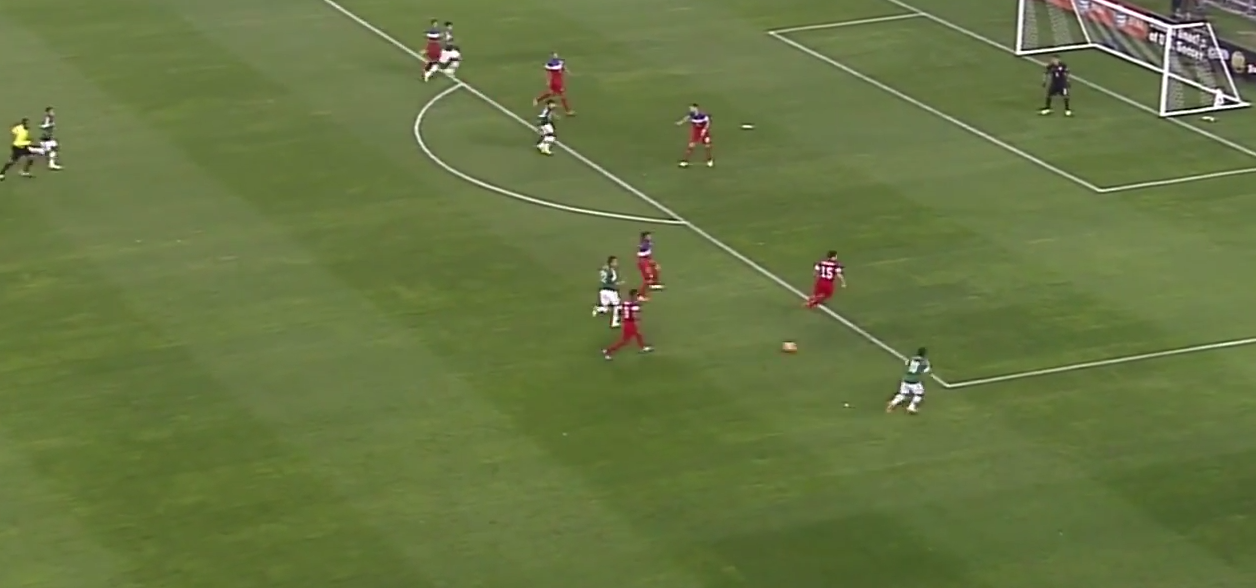
15' - Michael Bradley goal (1-0 US)

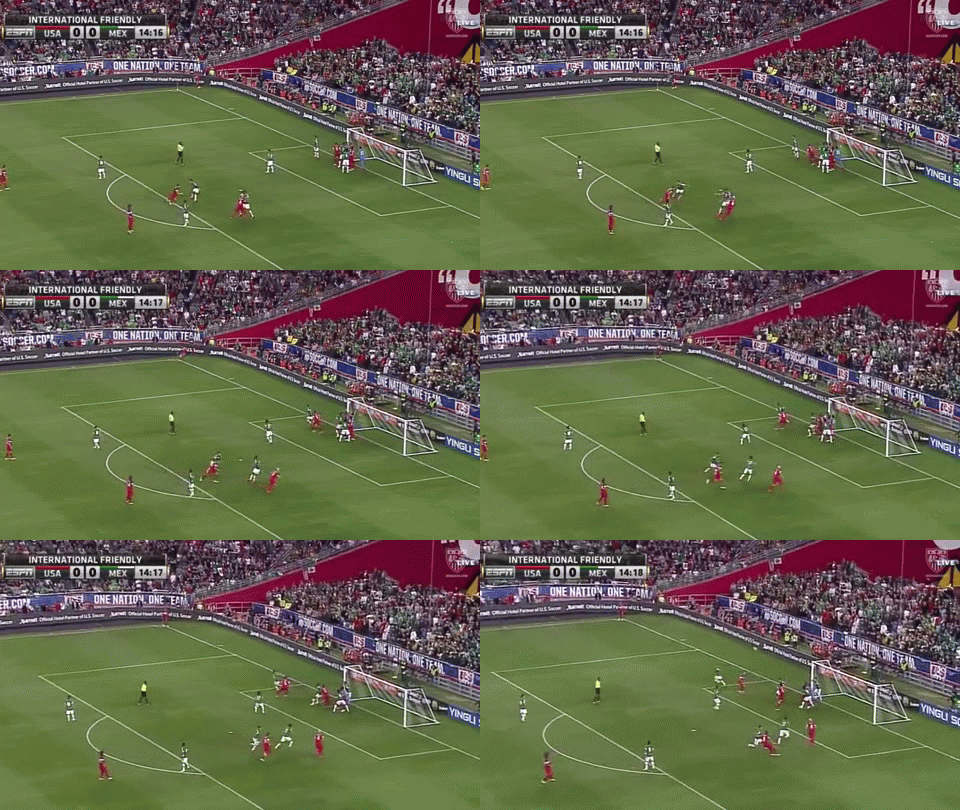
Before Bradley gets anywhere near the ball, Muñoz is trying to draw a foul by running into Omar Gonzalez and then getting stuck on Chris Wondolowski.

This is pretty dumb. And I'm not just saying that because he's the opposition as I'm clearly an American fan. I'm saying that because he has removed himself from the play and his defense for stopping the goal is hoping for a call from the ref. Omar Gonzalez actually starts moving away from Muñoz when he makes contact on him. Good no call by referee Roberto Moreno. Muñoz needs to focus on saving the ball here.

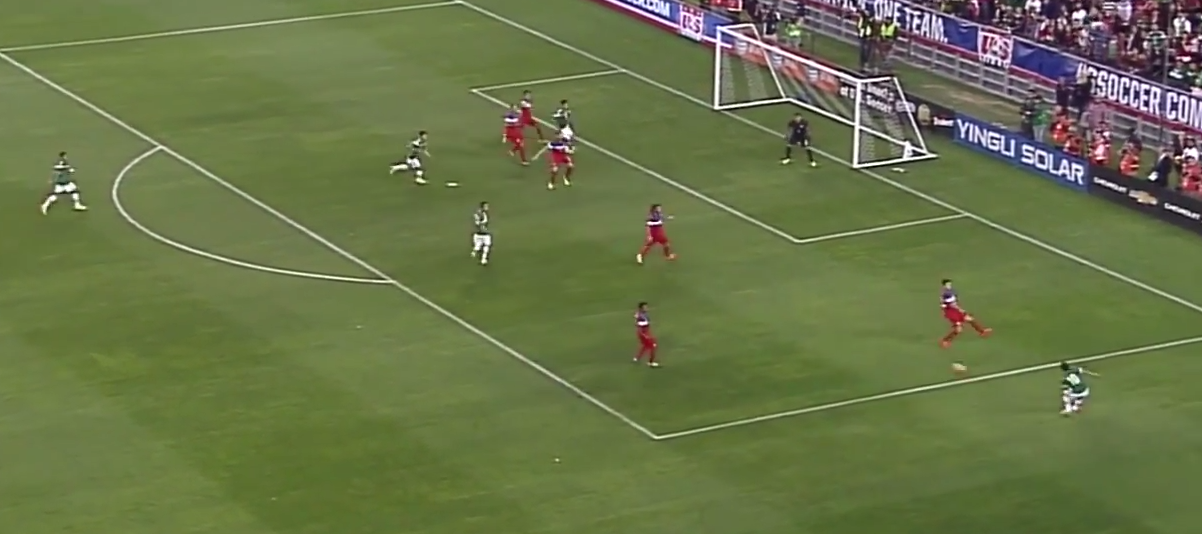
28' - Chris Wondolowski goal (2-0 US)

Muñoz does a good job of recognizing the danger and unfortunately for Mexico the ball drops in an excellent place for Wondolowski. Check out Muñoz's head check.

It's easy to get tunnel vision on the upcoming cross but Muñoz picks a good time to peek to the middle as it's a couple bounces until Beltran whips it in.

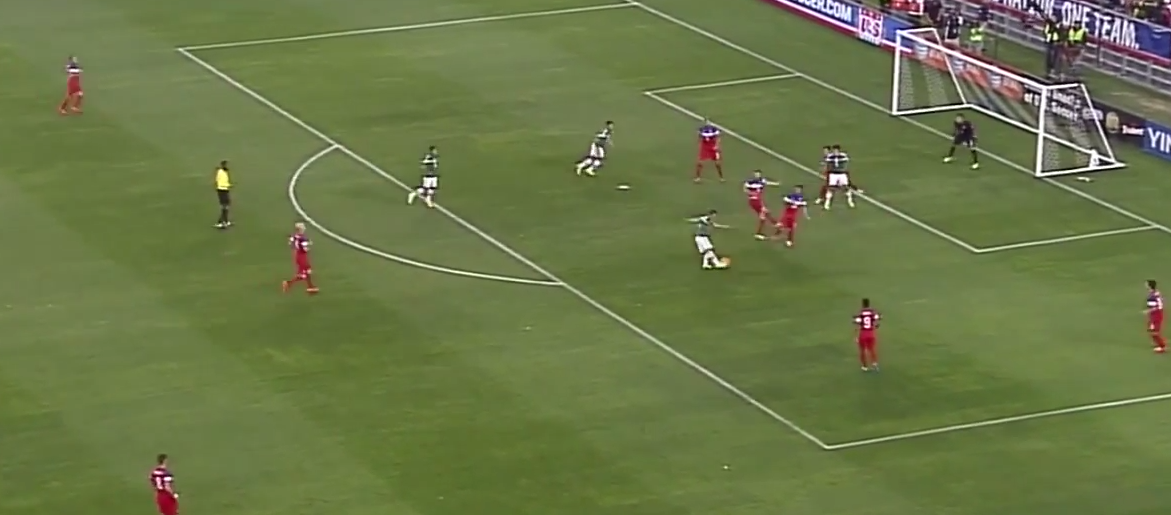
49' - Rafael Marquez goal (2-1 US)

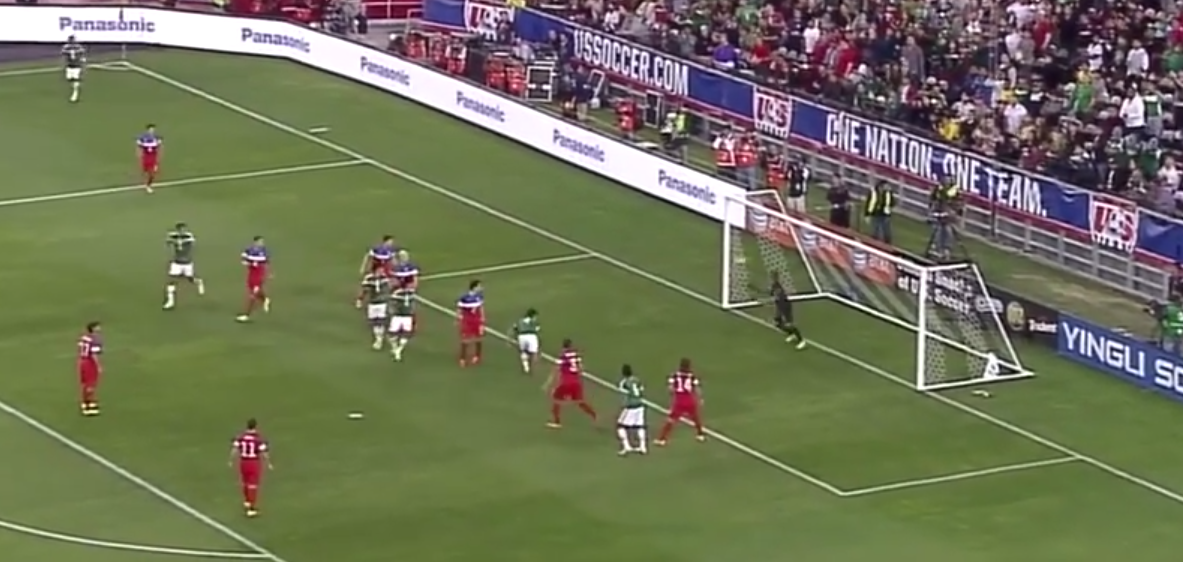
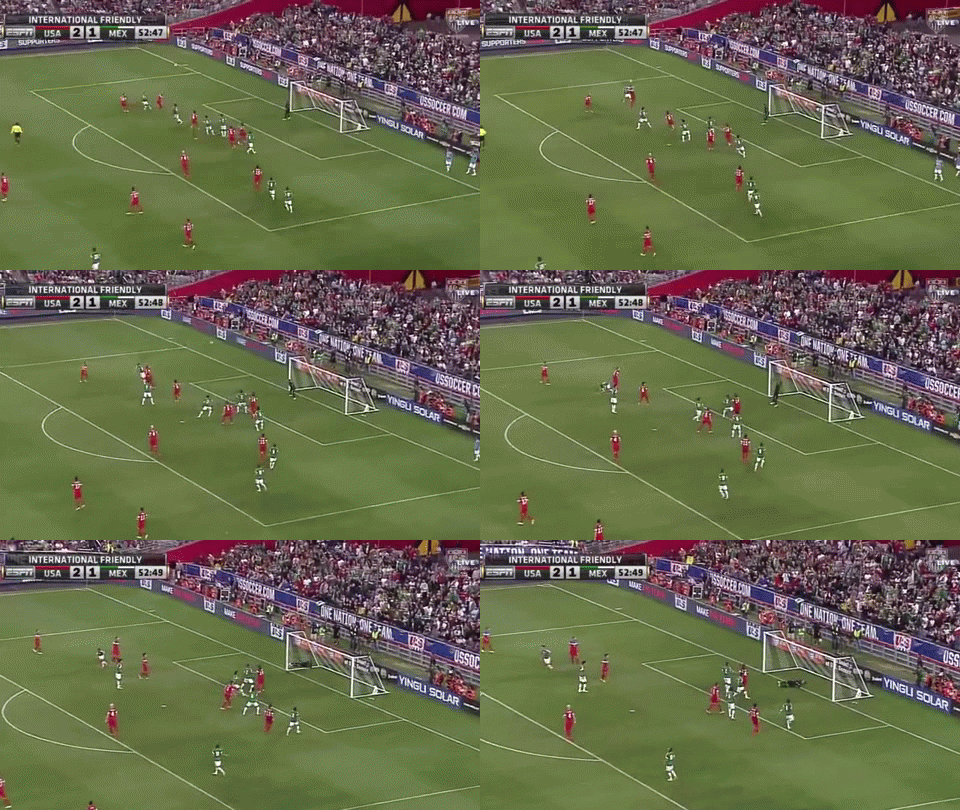
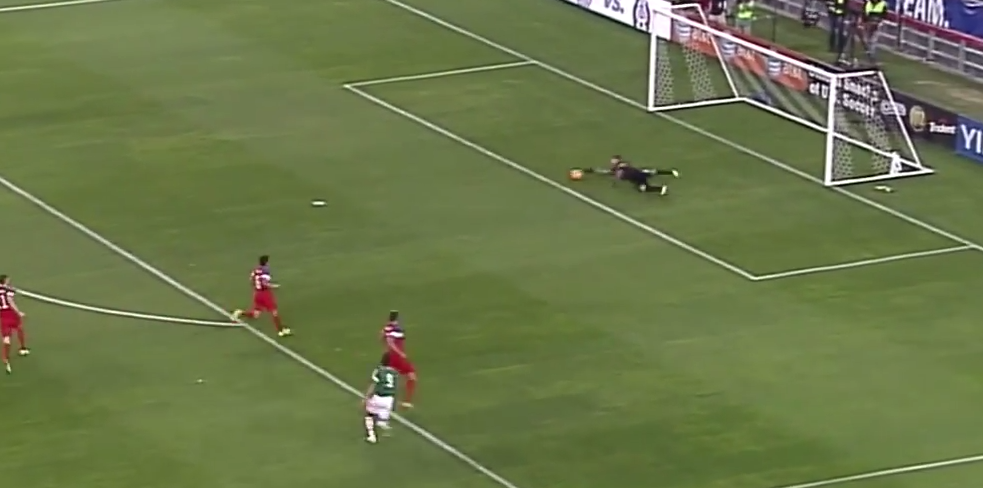
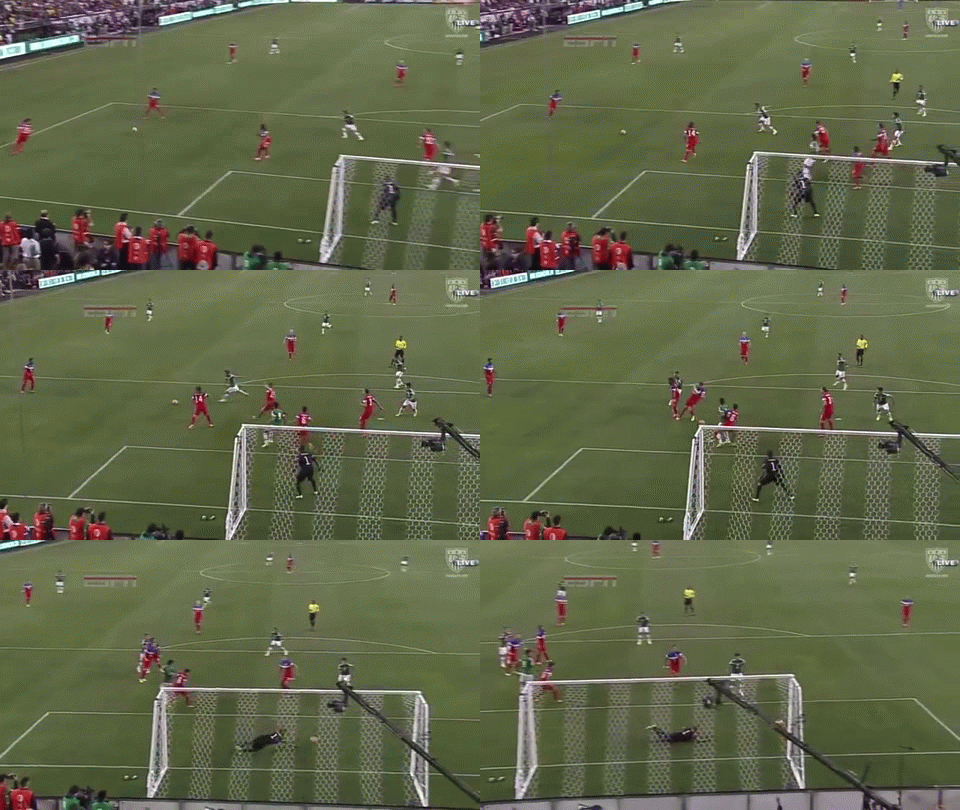
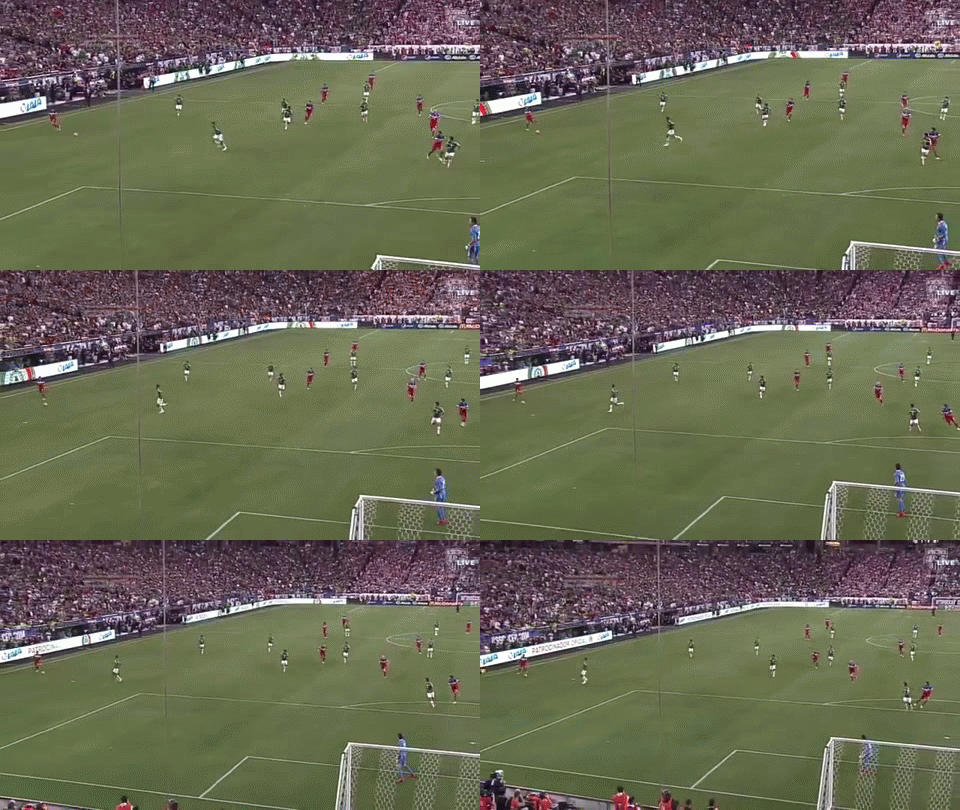
Déjà vu? Poor marking leads to another goal in the Battle of the Rio Grande (patent pending). At first glance, Rimando makes little effort to save the shot but look how far it is from Rimando.

As the ball is crossing the line

As the ball is crossing the line

Of course we'd always like to see the effort but Rimando would need to know where that shot is going ahead of time to make that save. So we're going to give Rimando a pass there.

53' - Nick Rimando tip over

Tip overs look cool because the goalkeeper goes from stationary to a full extension save but I wouldn't go as far to praise him as Ian Darke did, "a very, very fine save"

Yeah, that's just him doing his job. Nothing to glorify.

61' - Nick Rimando save

A low shot from distance on a counter.

Rimando once again doing his job but slightly more challenging than the previous tip over. He gets low to push it out. But if he were taller...

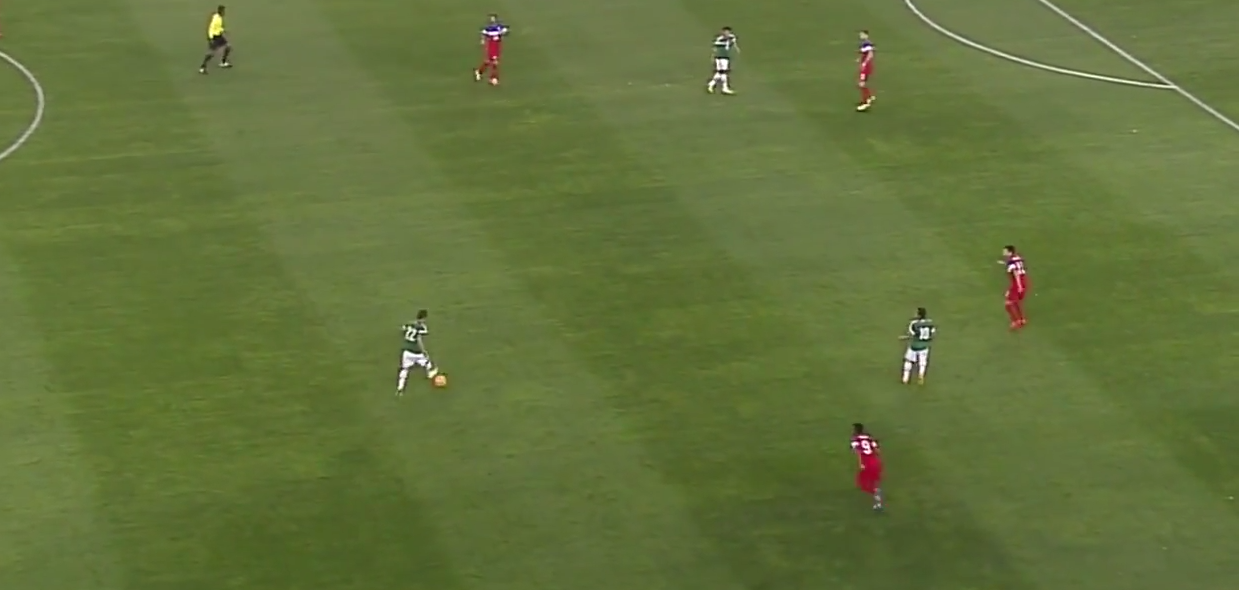
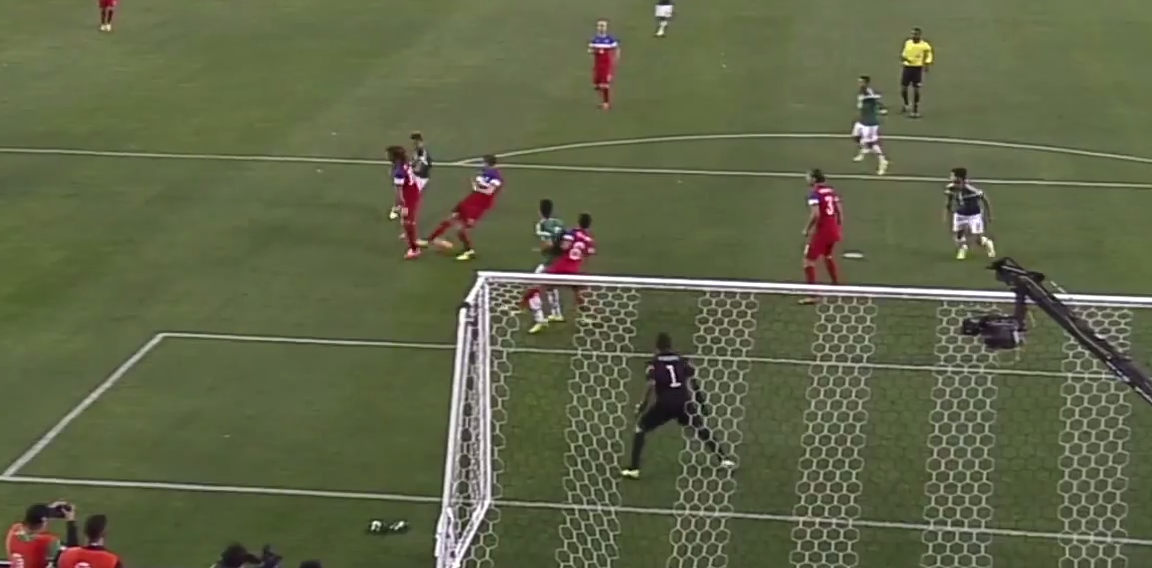
67' - Alan Pulido goal (Tied 2-2)

A colossal failure on the defense's part. Julian Green heads the ball to Mexico to set up a counter. Kyle Beckerman doesn't follow his man. Nick Rimando makes little or no communication about the transition. Clarence Goodson gets 'megged on the shot. Rimando's stance is too wide to shuffle then dive. Omar Gonzalez isn't paying attention back post. Gonzalez is the easy goat here but I'd blame any of those previous four over Gonzalez. 

But since we're focusing on goalkeepers, let's look at Rimando's footwork. His jump set has his feet far too wide to be able to move to the ball. He has the time to shuffle and then dive but his wide stance removes that opportunity. It's tough to do but that's what needs to be done to get a fingertip on the ball.

Rimando is a good third string goalkeeper for the World Cup and Americans should be excited about his addition in Brazil, even though it is unlikely he'll see the field. This game doesn't exactly highlight his strengths but he is deserving of the spot.

Goalkeepers "Protecting" Themselves

Goalkeeper coaches will often tell their goalkeepers to protect themselves when dealing with crosses. But what exactly does this entail? How can a goalkeeper be more protected than he already is? We have seen countless times where a goalkeeper recklessly flies into a crowd and takes out a number of players, including his own teammates. But if a striker sneezes on a keeper he is called for a foul. So what is he protecting himself from?

The rise of the knee acts as a buffer to steady the goalkeeper mid-flight. If a goalkeeper is hit in the knee, he is still steady enough to make the catch. If he is hit in the chest or arms he could misplay the ball, resorting in a conceded goal. So protection is centered around protecting the goalkeeper from making a mistake. The raised knee will not protect the goalkeeper's safety. Only a careless challenge by the goalkeeper or opposition will endanger one another. If everyone goes up smartly, the risk of injury is minimal. I suppose one could argue that raising your knee would protect you from a maniac rushing in, but that is not only such a rare occasion but it will not save you. If you are to be bulldozed you will be bulldozed.

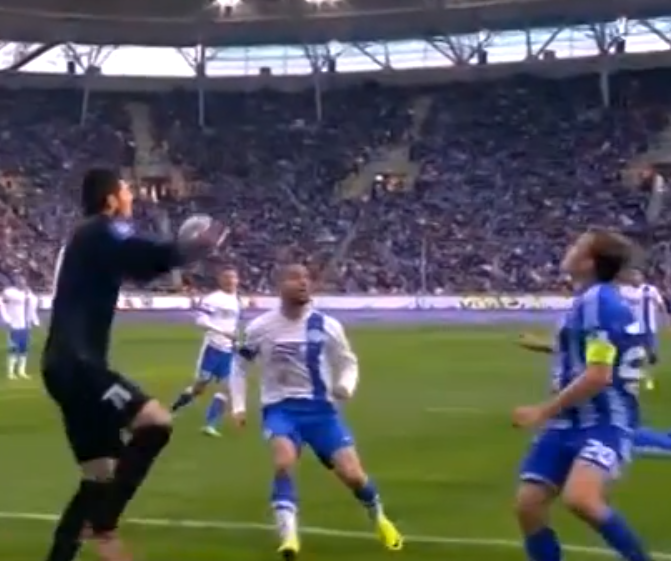
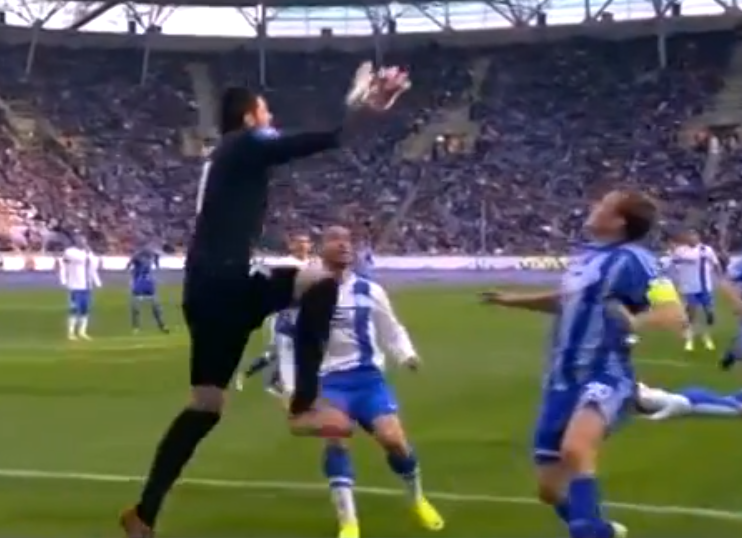
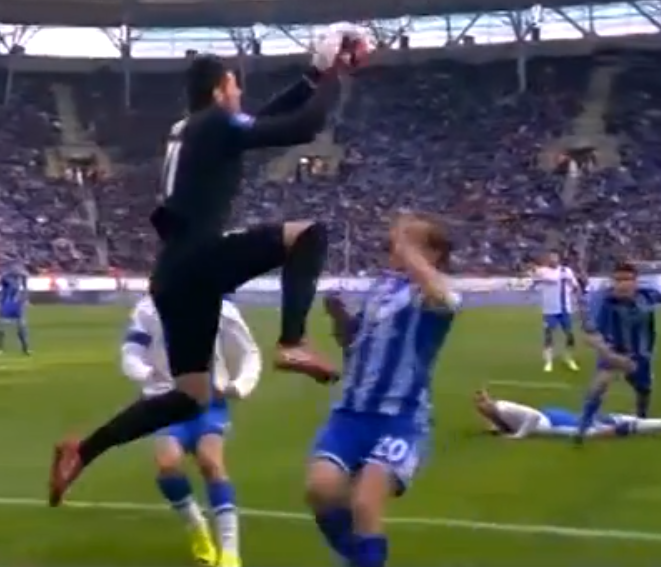
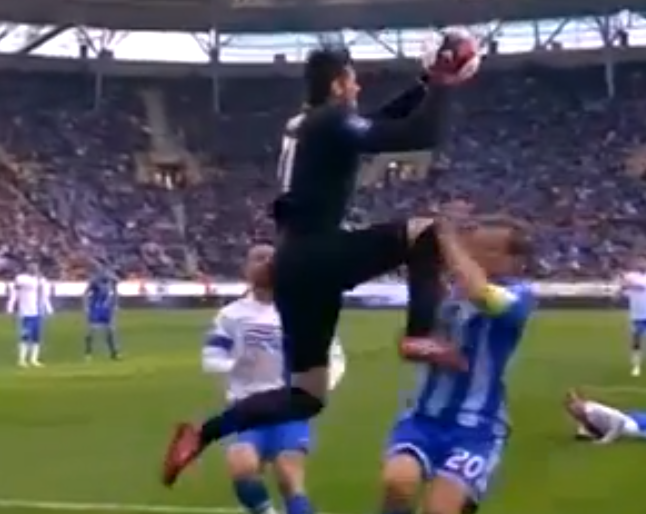
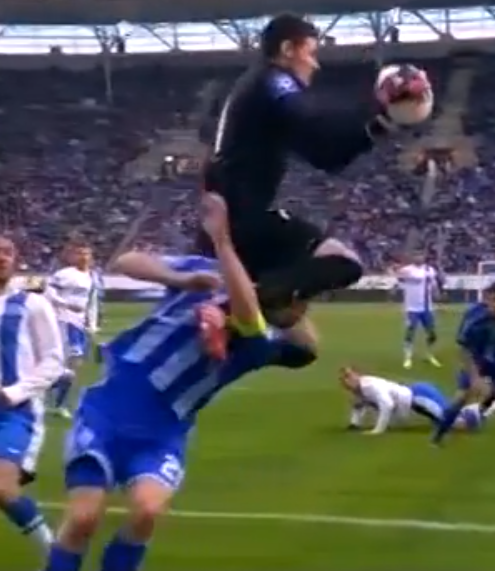
This past week, Ukraine witnessed a horrible collision in the Dnipro and Dynamo game.

This is not a freak accident. This is careless and extremely dangerous play by the goalkeeper. For those who say this is fair play, albeit incredibly unfortunate, they are ignorant of why a goalkeeper brings up his knee to attack the ball in the air.

If you google image "goalkeeper cross" you will see most of the time a goalkeeper does not raise his knee that high when going for a ball in the air. Bringing up a knee is a luxury that goalkeepers do not often have. Perhaps the ball is moving in the air, the goalkeeper misreads it, maybe he simply does not need to bring it up. On top of that, raising your knee helps you jump vertically. Yes, it helps you jump out, but it is aimed at getting the ball at the highest point in stride.

Bringing your knee up to waist-level is in a very specific situation.

  1. The goalkeeper is in a crowd or is about to be challenged in the air for the ball.
  2. The goalkeeper is attacking the ball and not looking to punch, but catch the ball. Otherwise his knee would get in the way from getting to the ball first.
  3. The goalkeeper has lined up the trajectory with his run and with catch the ball in stride on a forward line. 

Let's revisit the collision.

You can see how out of the way Dnipro goalkeeper Denys Boyko goes to make the collision and how tense the thigh is to drive through Oleg Gusev's head. This has clearly gone past the line of protecting the goalkeeper and becoming a weapon. How could Boyko avoid this? By either twisting his body (preferably to the left) so his knee doesn't his Gusev's head or by not bring his knee up past his belly button. 

A goalkeeper's technique should mimic that of a shinguard. The shinguard not only protects the shin of the person wearing it but the person who is kicking the shin. Obviously we could just wear metal plates and never have to worry about shin-related injuries but then every field player would constantly be breaking their foot on 50-50 challenges. A goalkeeper must protect himself as well as the other twenty-one players on the field.

Imagine if a striker did this to a goalkeeper. There would be outrage and likely paired with more than just a one game ban. Smashing a knee into someone's head is more dangerous than a two footed tackle. The responsibility of protecting the safety of others on the field belongs to everyone, including goalkeepers.