Michael Abalos Interview

What was your high school experience like?

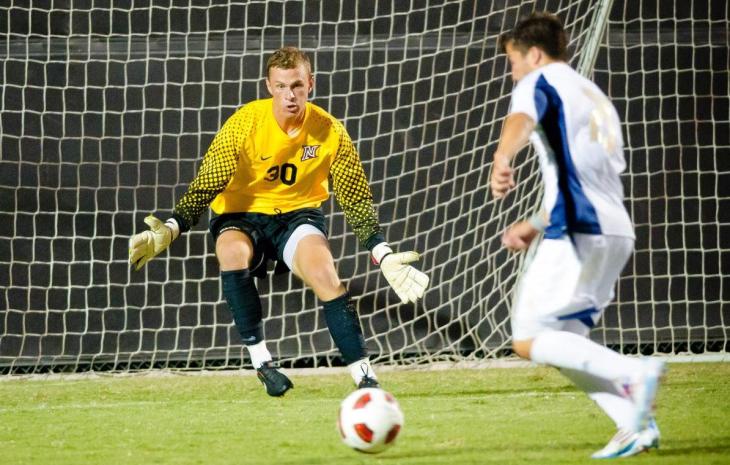
I played high school soccer at Santa Margarita Catholic High School under coach Curt Bauer. There have been a good amount of goalkeepers that have gone on to play professionally that came through Santa Margarita and it has always been a dream of mine to play professionally. I was fortunate to have a great coach there who created a positive environment and happened to win back-to-back CIF Championships (2006-07). The players there wanted to compete for each other and it felt more like a brotherhood, which is what coaches should aspire to teach their players.
Abalos_Michael_Save_Akron_Rotator.jpg

You were a four year starter at California State Northridge. Looking back, what stands out?

I played there from 2009-13 under coach Terry Davilla and Yossi Raz. We had a lot of big games since we were a team that was on the cusp of becoming a legitimate program. I'm glad to be apart of the first CSUN team to get a victory at UCLA as well as starting a trend of NCAA appearances. I had great teammates at CSUN, the likes of Chad Borak, Dylan Riley, and Rafa Garcia. Playing in the Big West you were bound to come across some quality players like Luis Silva (UCSB), Junior Burgos (Cal Poly), and Miguel Ibarra (UCI). I can proudly say all those standouts have scored on me during my career.

What are your thoughts on NCAA as a tool for developing goalkeepers players?

The thought is there, nothing bad can come from being in a positive environment where players want to compete at. It is a matter of players and coaches coming into accordance to pursue a common goal. I think the result of this latest MLS Draft shows that the talent is being produced. And [Syracuse Junior goalkeeper] Alex Bono was recently called into the USMNT camp. It is all about the athlete and how much they want to invest in themselves as an athlete. For me, I learned how much of a commitment it is to play in D1. On and off the field you are thrown all types of responsibilities. Most importantly you are forced to police and discipline yourself.

Photo belongs to Ian Billings

Photo belongs to Ian Billings

Where did you play after graduating?

I was invited twice to Seattle Sounders Combine, one in Las Vegas and another in Seattle. I also was invited to join The Nike Chance Global Tour and then to The Nike Academy in the UK under coach Jimmy Gilligan and John Goodman. The tour was making a stop in Los Angeles, they had a game against Chivas USA Academy and the US U18s, I believe it was. They were traveling without a goalkeeper and I was fortunate enough to have a connection that put me in contact with the coach. I was invited to train with them and play the two games. I made my case for the position in the game against US U-18’s where I saved a PK and played well.

The coach initially said they were unable to bring me along with them to their next stop in Torino Italy to train at the Juventus facilities. A week went by and then coach Jimmy Gilligan invited me to join them in England. This is still one of the best experiences of my life. I was the only American on the team besides Brian Iloski, who is at UCLA currently. There were so many highlights. We competed against Manchester United reserves and I swapped jerseys with Ben Amos. I was in training sessions ran by English National Team Coach Roy Hodgson and England Assistant Stuart Pearce. We were staying at St. Georges Park, England’s national team training ground. I walked out for practice and there was Roy Hodgson. Nike had set up a surprise training session with Roy. The hour and a half I spent with him was 100% soccer. His attention to detail probably stood out the most. (Watch Nike Football's training video with Hodgson here.)

But all that to say, graduation for me is still on hiatus. When I was invited to the Nike World Tour, I was already a couple weeks into the semester and was passed up in the draft so I was looking for any opportunity to pursue soccer as a profession. I got the call from Coach Gilligan late in the night before the last day it was possible to drop classes with receiving a fail. I jumped at the opportunity and was on a plane a day later to Heathrow. [CSUN] Coach Davilla and my parents was fully supportive of my decision so that was all the approval I needed.

Abalos, who kept a shutout in the game, is the goalkeeper in green in the video.

You landed at Chivas after the tour. Talk about your time there. Could you tell Chivas was close to folding then? And, of course, where are you now?

I was in the Chivas system for about a year from 2013-14, which included being with the U23s, reserves and first team. I never got that sense that the club was about to fold, especially considering the history the Chivas Guadalajara has. I was happy to be a part of the club and was willing to fulfill my role for the club.

Traveling with the first team to Seattle and being able to be on the field for warm ups and on the bench in that environment was an amazing experience. [Starting Chivas goalkeeper] Dan Kennedy is a class act, all around professional. He never hesitated to offer advice. Getting to meet, travel and train with [Mexican striker] Francisco Palencia was an honor and to this day I still use technique tips that he had to offer.

After Chivas, I went up north to a couple Sacramento Republic trials and down south to trail with Orange County Blues FC. Nothing came of those. However I did play with Cal FC against Los Angeles Galaxy II in the Open Cup this past year. Unfortunately we got smashed 6-1. While I’m still trying to play professionally, I currently coach for Launch Soccer in Pasadena, something I enjoy doing more and more each time

End of Year NCAA Goalkeeper Rankings

Top 10 Goalkeepers by Class
#. Name (school)

Seniors

1. Adam Grinwis (Michigan)
2. Patrick Wall (Notre Dame)
3. Spencer Richey (Washington)
4. Andrew Wolverton (Penn State)
5. Tyler Miller (Northwestern)
6. Charlie Lyon (Marquette)
7. Ben Lockler (Virginia Tech)
8. Brendan Moore (North Carolina)
9. Earl Edwards (UCLA)
10. Travis Worra (New Hampshire)

Juniors

1. Alex Bono (Syracuse) **
2. Paul Blanchette (Loyola Marymount)
3. Devin Cook (Coastal Carolina) **
4. Matt Bersano (Oregon State)
5. Zach Bennett (Michigan State)
6. Ashkan Khosravi* (Iranian, UC Riverside)
7. Alex McCauley (NC State)
8. Connor Sparrow (Creighton)
9. Wade Hamilton (Cal Poly)
10. Ryan Herman (Washington)

Alex Bono was selected by Toronto FC in the college draft.
Devin Cook signed with USL's Austin Aztex.

Sophomores

1. Zack Steffen (Maryland) **
2. Grayson Rector (Belmont)
3. Alec Ferrell (Wake Forest)
4. David Greczek (Rutgers)
5. Matt Pacifici (Davidson)
6. Ricky Brown (Colgate)
7. Marco Velez (South Carolina)
8. Andrew Putna (UIC)
9. Nick Ciraldo (Cleveland State)
10. Andrew Tarbell (Clemson)

Zack Steffen has left early for SC Freiburg

Freshmen

1. Evan Louro (Michigan)
2. Jeff Caldwell (Virginia)
3. Paul Christensen (Portland)
4. Josh Weiss (Siena)
5. Ben Willis (Gonzaga)
6. Nils Leifhelm* (German, Rhode Island)
7. Elliott Rubio (Akron)
8. Eric Dick (Butler)
9. Aitor Blanco* (Spanish, Radford)
10. Andrew Epstein (Stanford)

High School

1. Yusuf Ozen* (Turkish, Memphis)
2. Carter Richardson (Wake Forest)
3. Cameron Keys (La Salle)
4. Charlie Furrer (Stanford)
5. Austin Aviza (Syracuse)
6. Tucker Schneider (SIU Edwardsville)
7. Justin Vom Steeg (UC Santa Barbara)
8. Nicholas Giordano (Loyola (MD))
9. Parker Siegfried (Ohio State)
10. Colin Hanley (Niagara)

Brian Billings Interview

Brian Billings graduated from Bradley University after starting four years at the Division 1 program. Despite having the tangibles to play at the next level, Billings went undrafted in the 2013 MLS SuperDraft and struggled with injures in overseas trials. Brian talked about his time at Bradley, leading up to the draft, the trip abroad, and where he is now in his search to become a professional.

Photo belongs to James Brosher Photography

Photo belongs to James Brosher Photography

How did you end up at Bradley?

I was originally getting recruited to many other schools that include Notre Dame, New Mexico, St. John’s, and some smaller schools like Adelphi, Jacksonville, and Oakland University. But I decided to go with Bradley because it was the closest to home and the nice scholarship that they gave me. Another big factor was because of my relationship with my father. He wanted me to go to a school that I would most enjoy and he supported my decision to go to Bradley. Throughout four years of playing there, he never missed one game. Also there was the passion coach Jim DeRose showed. He cares more about his players both on and off the field than any other coach that I have met.

What are your thoughts on NCAA as an outlet for developing players? Do goalies get more out of collegiate play than field players?

It is very difficult for goalkeepers. Many colleges don’t have goalkeeper coaches. It’s also difficult for the NCAA as an outlet for developing players because of the structure of the season. A small season crunched into three months doesn’t give a great chance for coaches to actually coach and help their players get better. When you are done with one game you have to quickly watch game tape, meet with coaches, and then prepare yourself for the next match.

Did you think about how much of a springboard Bradley would be for you to the next level? Were you worried about playing at a smaller school and lack of exposure?

Of course playing at a smaller school doesn’t help exposure but I wouldn’t think of Bradley as a smaller school. Throughout my four years of being a starter, we made the NCAA tournament three times, won the conference tournament, and beat many nationally ranked teams, such as UCONN at UCONN when they were the number one team in the country!

Playing right away was something that I really wanted to do and Bradley was a great chance for that. I was lucky enough to get my coaches’ trust and gained the starting job about five games into my freshman season. Bradley did help me gain a lot experience because of the style they play. I would occasionally have to make seven to twelve saves again where as goalkeepers at other schools would make just two or three.

Photo from BradleyBraves.com

Photo from BradleyBraves.com

What's crucial for players that are under the radar but want to keep going after NCAA? Where do they need to look?

The most important thing for a player that is under the radar is to never give up. Reach out to coaches and show interest because coaches don’t just want good players, they want players that are willing to work hard and strive to get better. For me, the best decision I made to try to play professionally was attend a small college prep school by the name of Shattuck St. Mary’s in Faribault, Minnesota. Tim Carter is the program director there and has done an amazing job developing players and helping them get to where they want to be as a player as well as a person.

Did you have any expectations when MLS draft time came around? Were in you in talks with any clubs?

I hoped to be drafted because throughout my junior and senior season I was getting a lot of exposure. I was a four year starter and Top Drawer Soccer had me ranked top five goalkeepers in my draft class. When the draft came around, many people told me they have been talking to a few MLS teams. The draft didn’t work out but that’s life. Everything happens for a reason.

Talk about your trials overseas. Where did you go? And of course talk about your injury. How severe is it?

I went overseas three times. Each time was successful except for the last one when I got hurt. I trained and played with Fenerbahce’s U18 youth academy. I trained with Galatasaray’s youth academy. I was on trial with Antalyaspor and also İstanbul Başakşehir Futbol Kulübü. Each club reception was nothing but great. Everyone was kind and very willing to try to talk with me but the language barrier was difficult. Not many people spoke English.

Photo belongs to Bob Hunt

Photo belongs to Bob Hunt

Antaylaspor was the best opportunity, after my sophomore year. They offered a six month youth contract where I would be paid an average week fee and they would house me as well. After those six months they would decide if they wanted to keep me or not. I chose to go back to Bradley for my junior and senior years because I thought MLS was an option. Looking back, if I could have that chance over I would take it in a heartbeat.

Unfortunately on this last trip, my hips weren’t 100% going into it. I had torn both hip labrums and the pain was too much to try and play. The doctor said that there will be pain when I’m older but getting surgery will help me in the long run.

After the trail you came back as a collegiate assistant coach. How did that unfold?

As soon as I came back from Turkey I was offered an assistant coaching position at the prestigious Macalester College. There was talk between the coach and I before I left for Europe. I let them know as soon as I got back and everything worked out to let me join their staff. Being around soccer is something that makes me feel at home. I love practicing and coaching and my main focus is to help people that want to get better. Having the feeling of people who appreciate what you are doing for them is the best feeling.

What’s it like being on the other side of the sideline now?

As a coach, my goal is to help players learn from what I have learned. But even if I know everything there is to know about the game, if I can’t relate with the players then teaching them becomes much more difficult. A coach has to be willing to learn from their players to help them succeed. Having an open mind as a coach is very important.

What are your professional aspirations now?

My professional aspirations are higher than ever. Being away from soccer and rehabbing my surgery makes me only want to play soccer more. It has been my dream to play professional soccer and I will try until my body can’t take it anymore. You hear plenty of great stories from time to time about players coming out of nowhere to being starters for their team and I hope one day that will be me.

Zack Steffen - U20 CONCACAF WCQ

Because we're going to get so many games, here is a compilation of any notable saves or goals that included the U20 goalkeepers. It's not to pick on Mr. Steffen but we don't have a ton of American goalkeeping at the moment so he's one of the few we have to scrutinize.

Game 6 - El Salvador - 01.24.15

Games 3, 4, 5 were skipped. The 8-0 win against Aruba, which featured Ethan Horvath's lone start for the tournament, the 2-0 win over Jamaica, and the 1-0 win against Trinidad and Tobago didn't exactly have a ton of goalkeeping highlights so we're jumping ahead here. Feel free to watch the highlights yourself though.

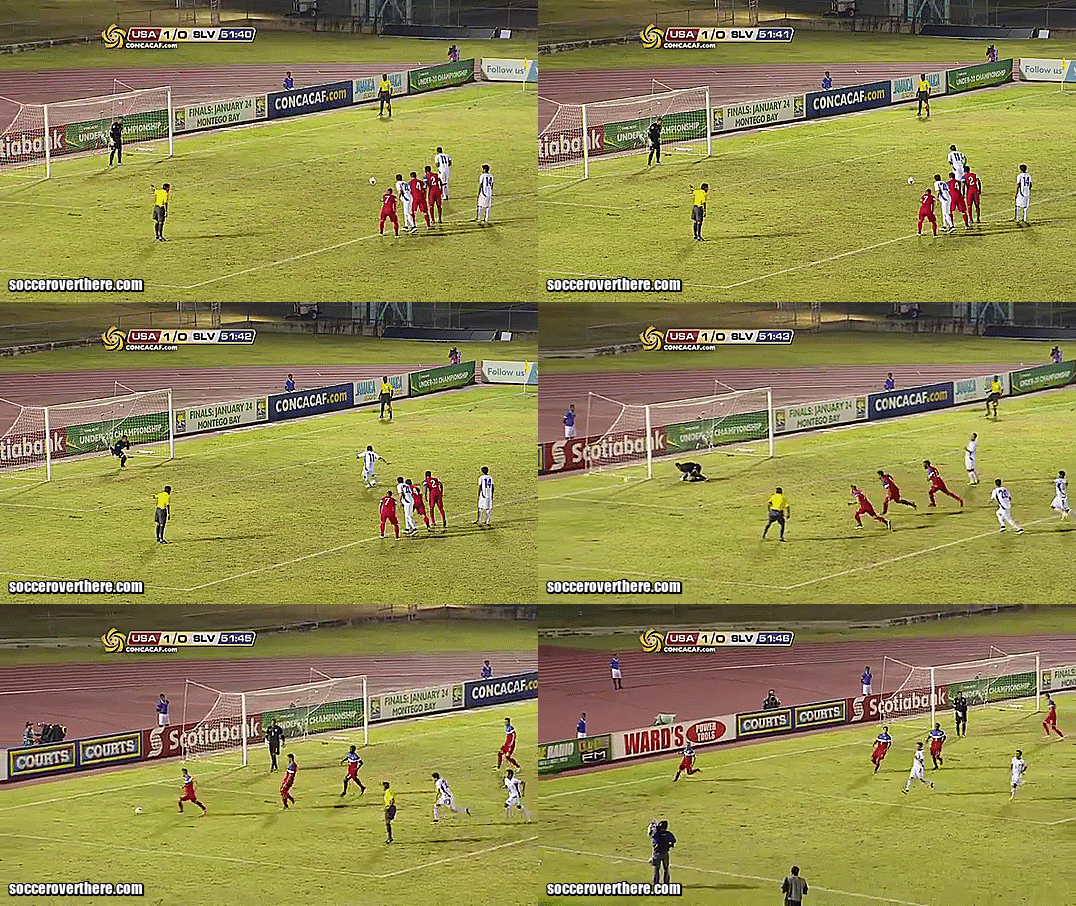
It's the last game; winner goes to the World Cup. The game has been pretty calm on Steffen's side, who is on the tail end of a standout defensive tournament. The US has only given up two goals in the six game stretch. However, a mildly questionable penalty is given to El Salvador and threatens the clean sheet. Steffen slowly steps up to the line in a manner that if he were to get scored on, you'd yell at him for being too passive.

You can see Steffen's reaction at the end. Hardly a celebration. Even walking up to the block the kick was so calm. He hops up with a "Yeah, I guess that was good" response. Genuinely one of the coolest USMNT moments as far as being truly cool goes.

The game was 1-0 and finished 2-0, pushing the US onwards to New Zealand 2015. But if this shot converts, which is actually taken very well, it's no pansy shot, it's a 1-1 game with 40 minutes to find a winner. Instead, Steffen casually sends the US to the World Cup.


Game 2 - Panama - 01.11.15

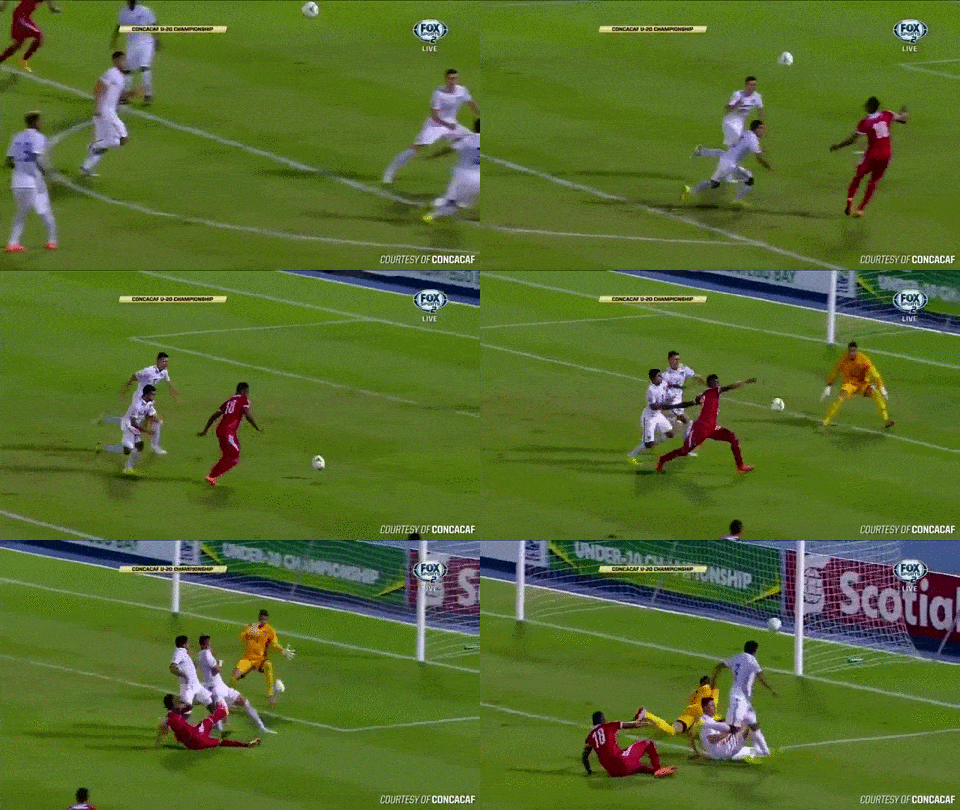
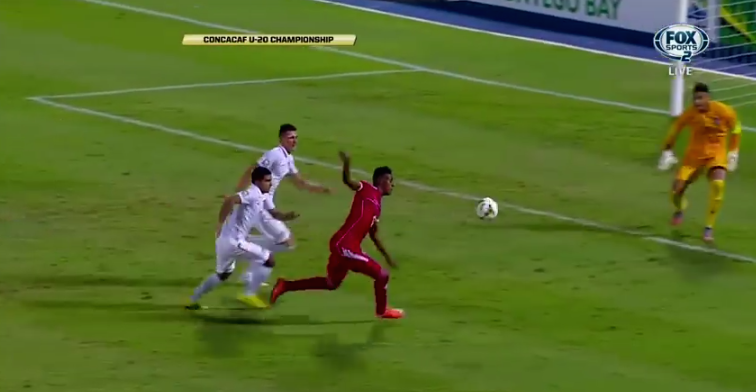
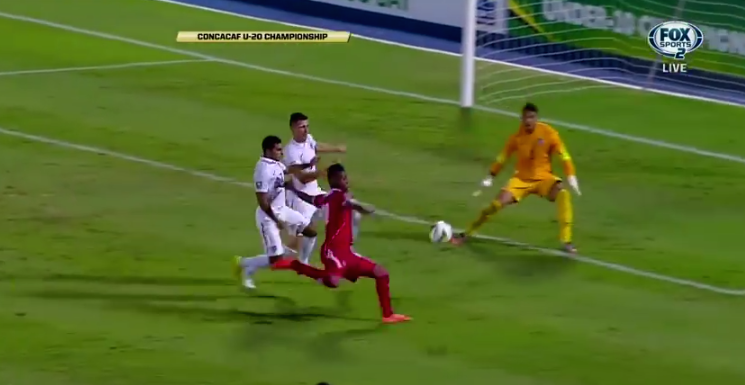
At first glance it looks nothing more than a tight 1v1 encounter that sometimes goalkeepers win and sometimes they don't. But we're always striving for improvement here at ES so let's see if Steffen could have done anything better.

  1. Steffen rushes forward on the chip. Good call. If there's a heavy touch, he wants to be ready to pounce.
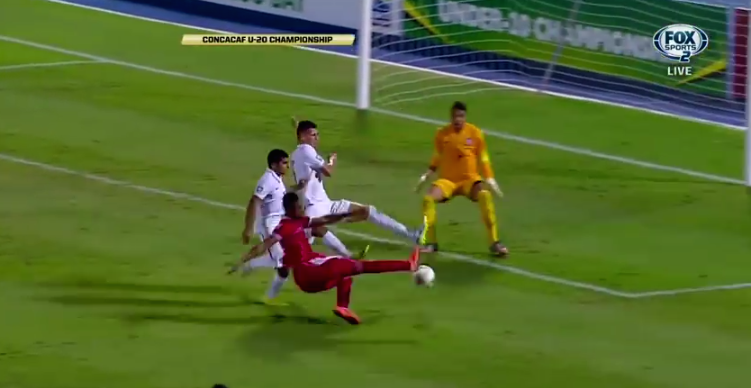
  2. Panama's Carlos Small displays a gaudy wind up and Steffen gets set but notice the hands! He does not have them palm-open to block but merely in the area to react. His stance is very wide as well which leaves the five-hole open and makes collapsing either side to make a save with his hands much harder.
  3. Ball has just made contact and Steffen shows his cards. He flinches his body in, pulling his hands closer to his body and leans back as if he was sitting in a chair. He has now penciled his shape, limiting his reach.
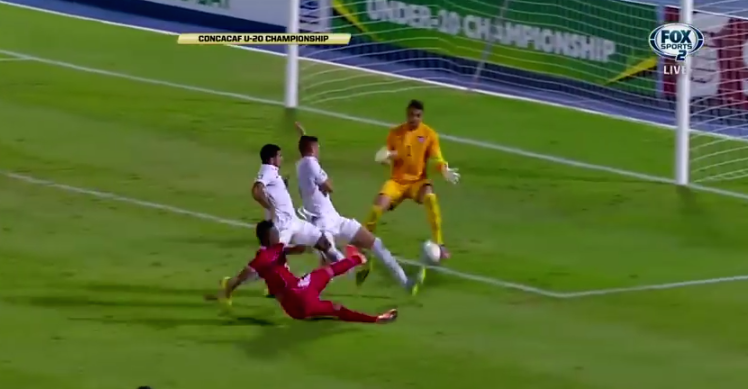
  4. Steffen's left knee raises along with his left hand, both poor moves. The kick save isn't an option because the ball is too far from his foot (as proven by the ball going in the goal) and Steffen misjudges how high the ball with bounce.
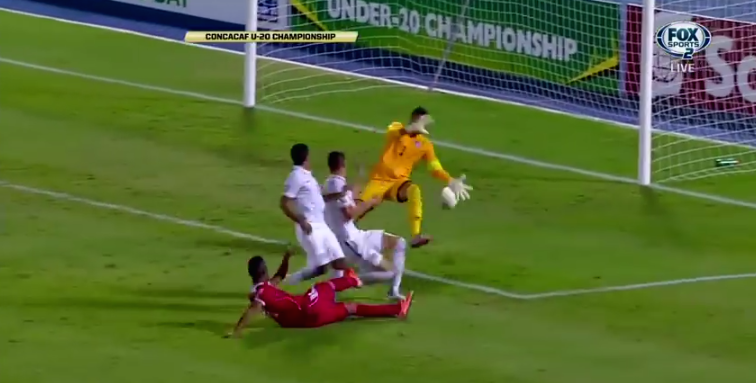
  5. The ball slips under Steffen's left hand after it flinches in then guesses too high. The attempted kick save is unsuccessful.

The reason the play is tricky is because of how close the shooter is and the bounce but If he gets shortens his stance and gets in his hands into play he'd be up for a very capable save of the tournament award.


Game 1 - Guatemala - 01.09.15

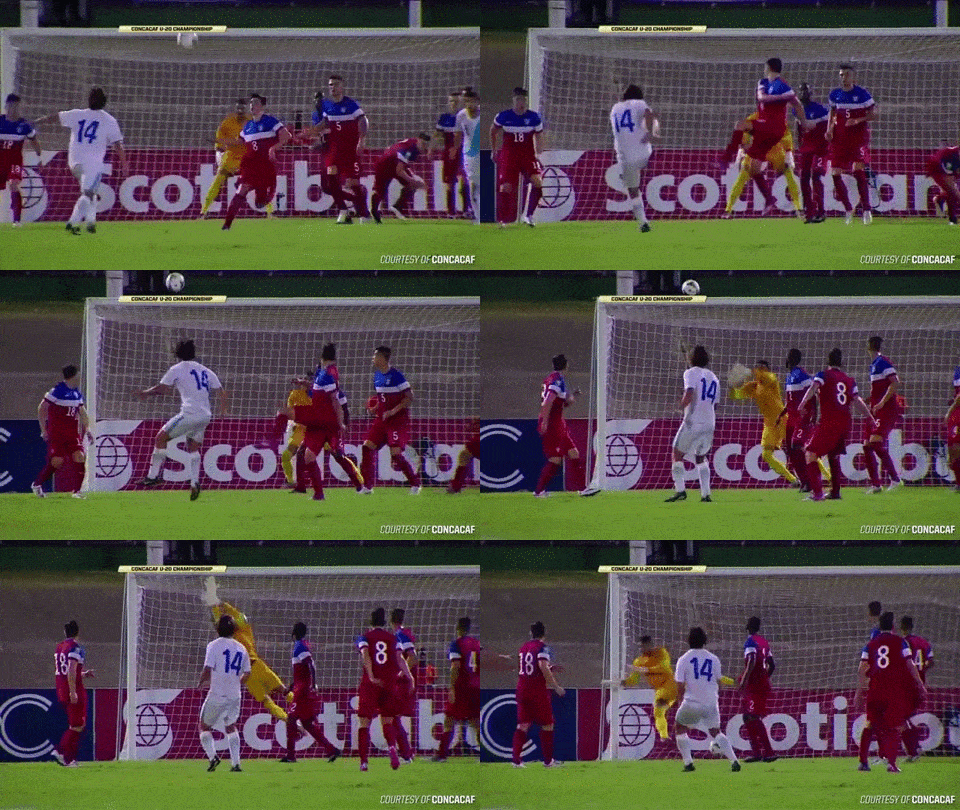
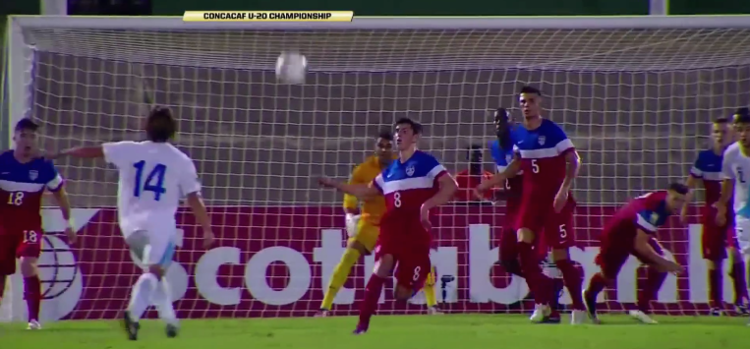
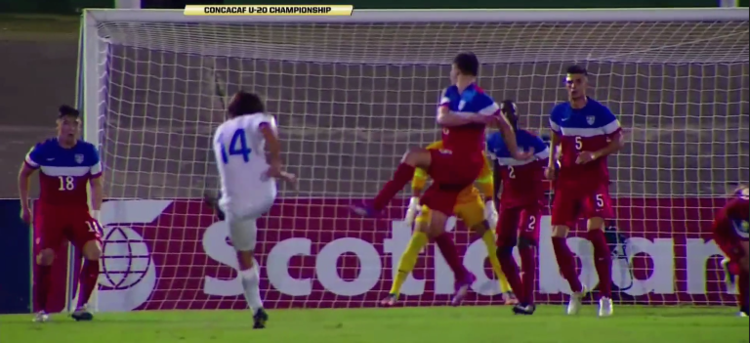
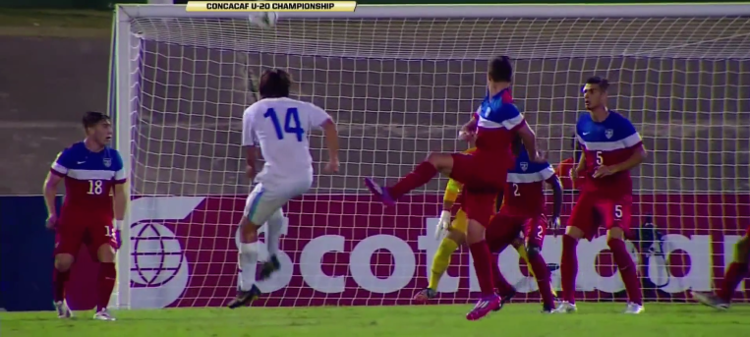
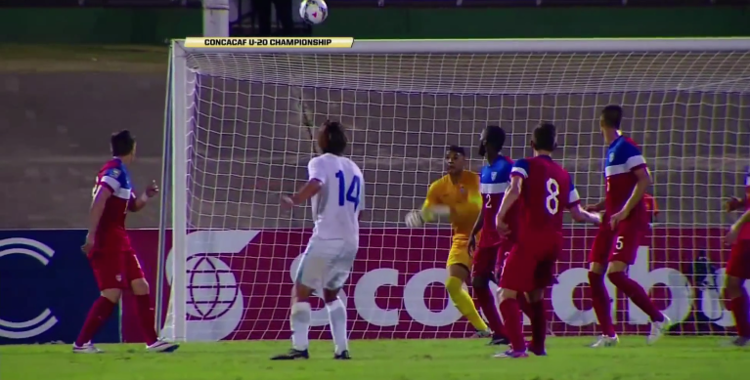
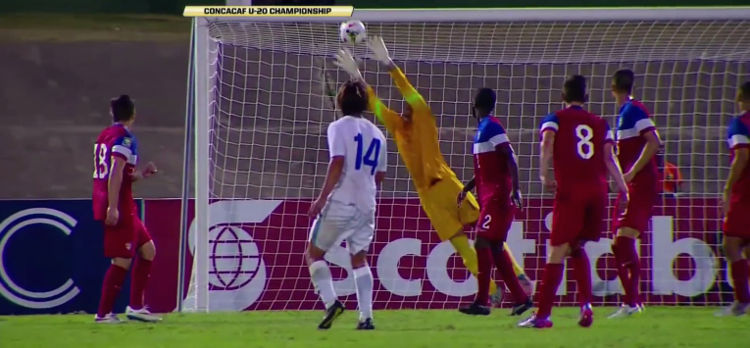
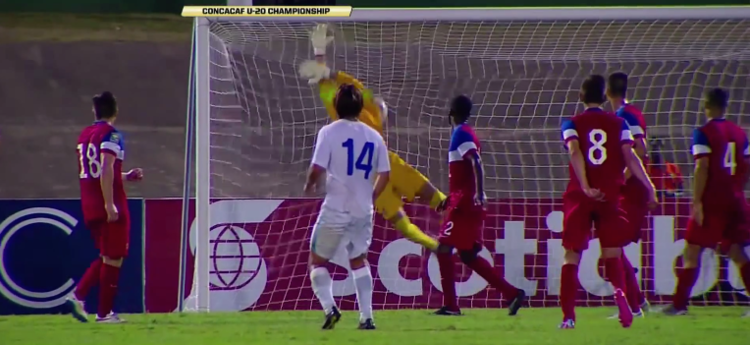
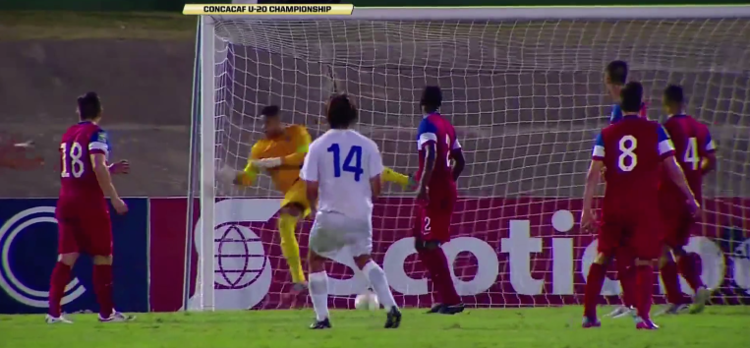
A great strike, no question about it. But could Steffen made the save? Here are seven shots of the play to analyze his movement. Special thanks to whoever was the camera man providing the great angle on the play.

  1. The ball has been headed out from a out swinging corner and falls to Andy Ruiz. The eventual shot goes in under the crossbar right above Ruiz's head in the picture, above the right side of the S in the Scotiabank advertisement in the background. Steffen has some ground to cover, around six feet with his right hand. He is already off to a bad start with his footing, which we'll see how that affects his dive.
  2. Ball has just been struck and notice how Steffen's stance has not only gotten wider but uneven. His right foot is higher off the ground and his legs are almost completely extended, with little bend in his knees.
  3. The ball is under the "CONCACAF U-20 CHAMPIONSHIP" label. Steffen's foot has touched the ground once in between the second and third picture but because all his weight is on his left foot, he can't move laterally. So he stutter steps.
  4. He has now transferred his weight to his right foot. The ball is over halfway to the goal but his feet are not any closer to the ball than they originally were.  At this point, he has picked up his right foot three times since the shot has been taken. (Re-watch the gif above to see his tapping foot.)
  5. What could have been a fingertip save is now a fingernail miss. Steffen is trying to save the ball with both hands, likely due to the ball's dipping motion. If he had just gone with his right hand he may have had a better play on the ball. Hard to say.
  6. Steffen has jumped vertically about six inches on the play. Look at the height of his right leg's sock in the fifth and sixth picture. His left hand has crossed over his right, like a wide receiver closing the gap between his hands after missing the pass.
  7. An almost scary moment. Steffen ends up sliding his leg out of the way but he comes close to landing awkwardly on his leg. Further proof that Steffen's explosion from his right leg wasn't 100%. If it was, his leg would be tucked behind his dive inside of sticking out in front of his body.

It's a memorable goal for Guatemala. Clearly a tough one to save. But Steffen doesn't help himself on the play as much as he could have. His stance kills his dive, almost getting him hurt in the end, and his hands aren't completely sorted out.