
Image by Adrian Ashford
The group stage had barely finished when the pattern showed up in the timeline. Somewhere between a clip of a fingertip save in Kansas City and a thread arguing about whether a keeper should have stayed on his line, the ads began arriving. Small green banners. Ten dollars here, fifty free spins there, no deposit required. If you spent June watching the 2026 World Cup with a phone in one hand and a group chat buzzing in the other, you saw them too. The soccer summer did not only bring goals. It brought a wave of casino promotions aimed straight at the people watching.
None of that happened by accident. Marketing money follows attention, and for six weeks this summer American attention pooled around soccer the way it almost never does. The offers that looked like background noise were a measured response to the largest sporting audience the country has hosted in a generation, with the United States staging 78 of the 104 matches, including the final at MetLife Stadium. Understanding why the promotions surged, and how to read one without getting fooled, turns out to be a small but useful skill for any fan whose feed filled up in June.
A no-deposit offer is roughly what the name suggests: a licensed casino hands a brand-new account a little bonus money or a batch of free spins before a single dollar changes hands. Plain-language explainers such as Bonus.com's no deposit bonus casino info lay out how the pieces fit together, which helps when the same three phrases keep flashing past between highlights. The free part is genuinely free. So is the fine print, and the fine print is where the whole thing lives or dies.
When the World Cup Turned the Ad Break Into a Promo Break
American soccer has spent decades as the sport that advertisers politely ignored. That changed the moment the tournament kicked off on home soil. Between June 11 and July 19, a competition that runs almost daily produced a rolling audience that no other event on the calendar can match, and every company that sells attention noticed at once. Airlines noticed. Beer brands noticed. And the online casinos that had quietly been growing in a handful of states noticed hardest of all, because their entire business runs on finding new players at the exact moment those players are already staring at a screen.
The mechanics are simple enough to sketch on a napkin. A tournament match pulls millions of eyes into the same window. Those eyes are disproportionately young, male, and comfortable spending money on a phone, which happens to describe the most valuable customer an operator can sign. So the ad budget that might normally trickle out across a whole quarter gets compressed into a six-week sprint. The no-deposit offer is the sharpest tool in that sprint because it removes the one thing that stops a curious viewer cold, which is the request to type in a card number before trying anything.
What No Deposit Actually Means on the Screen
Strip away the animation and a no-deposit offer comes in two common shapes. The first is bonus cash, usually a small figure like ten or twenty-five dollars, credited to a new account for signing up and verifying an identity. The second is free spins, a set number of turns on a specific slot game, where anything you win lands as bonus credit rather than money you can immediately move to a bank. Both cost the player nothing up front, and both are designed to get you past the hardest step in the funnel, which is opening the account at all.
Operators are not being generous for its own sake. A no-deposit credit is a customer-acquisition expense, the online-casino version of a free sample at a grocery store. The company is betting that a meaningful share of people who claim ten free dollars will enjoy the experience enough to deposit their own money later. That is the whole trade. You get a genuine try before you buy, and the casino gets your attention and your details.
Because the giveaway is a marketing cost, the amounts stay small and the conditions stay tight. That is not a scam. It is the reason the offer can exist at all. The controls that keep the free money from walking out the door are the same controls that decide whether your ten free dollars is worth the ten minutes it takes to claim.
The Playthrough Is the Real Opponent
If a no-deposit offer has a defender you have to beat, it is the wagering requirement, sometimes called the playthrough. This is the number of times you must bet your winnings before the casino will let you cash out. A common structure attaches a multiplier like 20x or 40x to whatever the free credit produces. Win five dollars from a free-spin bonus carrying a 30x requirement, and you have to place 150 dollars in total bets before that five dollars becomes withdrawable. Research on player behavior suggests most people now walk away from anything above roughly 35x, and it is easy to see why.

Image by Adrian Ashford
The playthrough is only the headline term. Sitting underneath it are three others that quietly decide the real value of any offer. A maximum cashout caps how much of your winnings you can ever keep, so a lucky run on free spins might be trimmed to a fixed ceiling. An expiry window gives the whole bonus a shelf life, often just a few days, after which anything unplayed disappears. And game weighting controls which titles count toward the requirement, because slots usually contribute full value while table games count for a fraction or nothing at all.
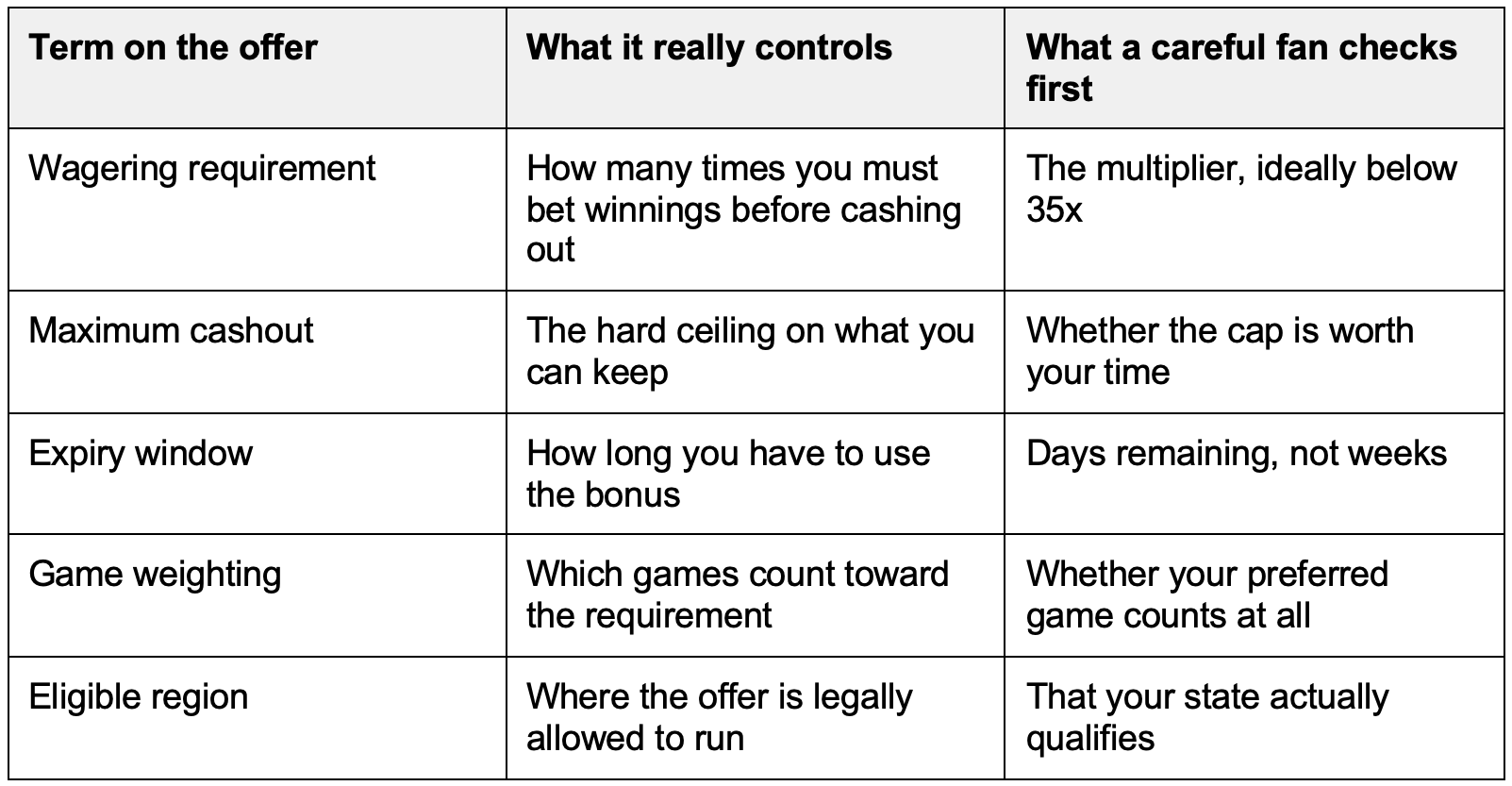
Read those five rows before you read the size of the bonus, and you will evaluate an offer better than most of the people it was aimed at during the tournament.
Why the Soccer Calendar Became a Promo Calendar
Big tournaments concentrate attention into predictable windows, and marketers plan around those windows the way a coach plans around a fixture list. A World Cup gives operators something a regular season cannot: a fixed start date, a fixed end date, and a guaranteed spike of engaged viewers in between. That predictability is worth a fortune. It lets a company pre-load creative, time its biggest offers to the knockout rounds, and know almost to the day when interest will peak.
The pattern is not new to people who study gambling advertising. Analyses of past World Cups have documented how sharply promotional messaging climbs during the tournament, with a large share of viewers recalling sign-up offers and betting inducements specifically. What was different in 2026 was geography. Previous tournaments reached American fans in the middle of a workday from time zones far away. This one played out in prime time, in home stadiums, with the host nation involved deep into the schedule. That combination handed operators the rarest thing in their calendar, which is a captive domestic audience that stayed captive for six straight weeks.
There is a seasonality to the giveaway itself, too. The most aggressive no-deposit terms tend to appear right when competition for attention is fiercest, then soften once the event ends and the audience scatters. Fans who noticed the offers getting slightly more generous as the tournament went on were not imagining it. They were watching an auction for their attention play out in real time.
The Money Trail Behind the Boom
The word booming deserves some numbers behind it, and the regulated states supply them. In 2025, annual online-casino revenue overtook the take from land-based casinos in both New Jersey and Pennsylvania for the first time, a genuine turning point for an industry that spent years treating internet play as a side dish. When a category grows that fast, the marketing spend behind it grows in step, and no-deposit offers are one of the most visible places that spending goes.

Image by Adrian Ashford
You can even see the giveaways as a line item. State regulators track what they call promotional gaming credits, and the reports filed each month with New Jersey's gaming authority list those credits as their own figure, running into the millions. Every free spin and no-deposit dollar that reached a fan during the tournament is, somewhere in a spreadsheet, a documented cost that an operator chose to pay in exchange for a shot at a long-term customer.
None of this means the offers are a trick. It means they are an investment, and investments come with expectations attached. A company spending real money to put ten free dollars in your account is not hoping you take the ten dollars and vanish. It is hoping the free sample turns into a habit. Knowing that is the difference between using an offer on your own terms and being used by it.
Can You Even See These Offers Where You Live?
Here is the part the ads rarely mention. Real-money online casinos are legal in only a short list of states, fewer than a dozen, which means a large share of the fans who saw those promotions in June could not legally act on them at all. A no-deposit casino offer that reached a phone in Texas or Georgia was, in practical terms, a message with nowhere to land, because the product behind it does not operate there.
California matters most to this story simply because so many soccer fans live there. Online casinos are not legal in California, full stop, and the presence of a slick promotion in a Los Angeles timeline does not change that. Some of what circulates in non-legal states is a different product entirely, which is where a lot of the confusion during the tournament came from. A fan who assumed every gambling ad they saw pointed to the same kind of site was, more often than not, mistaken.
The practical takeaway is unglamorous but worth repeating. Before clicking anything, a viewer should confirm that real-money online casino play is actually authorized where they physically sit, because a licensed operator will check location anyway and an unlicensed one is not worth the risk. The map is narrower than the advertising makes it look.
The Sweepstakes Lookalikes and the California Line
Plenty of the offers that reached fans in states without legal online casinos came from a different model altogether: sweepstakes, or social, casinos. These are free-to-play platforms that hand out virtual currencies, one of which can sometimes be redeemed for prizes, all built on the same no-purchase-necessary framing that has governed contests for decades. They look almost identical to real-money casinos on the surface, which is exactly why the two get tangled together in conversation.
The distinction is real and worth holding onto. A sweepstakes casino is legally a promotion, not gambling in the traditional sense, and it operates in many states where real-money play is off the table. That reach is precisely what makes it attractive to marketers during an event as national as the World Cup, and it explains why a fan in a non-legal state still saw casino-shaped ads all summer.
That model is also under fresh pressure. California's AB 831, effective January 1, 2026, restricts the dual-currency sweepstakes format that many of these platforms rely on, tightening what operators can offer in the state. For a fan trying to make sense of the promotions, the lesson is to notice which kind of product an offer actually points to. A free-to-play sweepstakes credit and a real-money no-deposit bonus are not the same thing, even when the banner art looks interchangeable.
Scouting an Offer the Way You'd Scout a Keeper
Soccer fans, and goalkeeper obsessives in particular, already own the exact mindset that reading a promotion requires. Evaluating a keeper is not about the one spectacular save in the highlight reel. It is about distribution, positioning, decision-making under pressure, and all the unglamorous inputs that decide whether the flashy moment ever mattered. The same discipline applies to an offer. The headline number is the highlight reel. The wagering requirement, the cap, and the expiry are the positioning and distribution nobody puts in the clip.

Image by Adrian Ashford
This site's deeper analytical work makes the point better than any lecture could. The recent ranking of America's greatest goalkeepers earns its conclusions by weighing decades of evidence rather than reacting to a single afternoon, and that is the temperament worth carrying into any casino promotion. Do not judge a no-deposit offer by the size of the free credit alone. Judge it by the full set of conditions, the way you would judge a keeper by a full season instead of one penalty shootout.
Put concretely, a good scouting routine for an offer takes about two minutes. Find the wagering requirement and reject anything punishing. Check the maximum cashout so you know the real ceiling. Read the expiry so the clock does not beat you. Confirm which games count. And verify your state qualifies before you invest a second of effort. Fans who already apply that patience to a depth chart have no excuse for switching it off when the promotion appears.
When the Final Whistle Blows
The offers were built for a moment of peak excitement, which is exactly why the calm afterward matters. Independent research is blunt on this point. A study of sports betting incentives found that bonus offers and free credits measurably shift how people bet, nudging players toward longer-odds, riskier wagers than they would choose without the incentive. The free part is not neutral. It is designed to change behavior, and it does.
That does not make a no-deposit offer something to fear. It makes it something to treat with the same clear head you bring to any other decision involving money. Set a limit before you claim anything, decide in advance what you are willing to lose, and treat a bonus as entertainment rather than a plan to get ahead. If a promotion ever feels like it is pulling you past those limits, that is the signal to close the tab. Help is available around the clock through the 1-800-GAMBLER helpline for anyone in the United States who wants it.
The World Cup gave American soccer a summer it will talk about for years, and it gave online casinos a once-in-a-generation shot at millions of new accounts. A fan who understood why the offers appeared, how to read one, and where the real limits sit walked away from the tournament with the goals, the memories, and none of the regret.
Frequently Asked Questions
Did no-deposit offers really increase during the 2026 World Cup?
Promotional activity from regulated online casinos clearly intensified around the tournament, in line with how gambling advertising has spiked during previous World Cups. The tournament concentrated a huge domestic audience into a six-week window, and operators timed their most visible offers to match it. The exact scale varies by state and operator, but the surge was real, not imagined.
Is a no-deposit bonus actually free money I can withdraw?
The credit itself costs you nothing, but withdrawing anything you win from it almost always requires meeting a wagering requirement first. That means betting your winnings a set number of times before the money becomes yours to cash out. Read the playthrough multiplier, the maximum cashout, and the expiry before assuming the free credit converts easily into a withdrawal.
Why did I see casino ads if online casinos are not legal in my state?
Many of those ads pointed to sweepstakes or social casinos, which are free-to-play platforms that operate in far more states than real-money online casinos do. They use a no-purchase-necessary model that is legally a promotion rather than traditional gambling. It is worth checking which kind of product an offer leads to before assuming real-money play is available where you live.
How is a sweepstakes casino different from a real-money casino?
A real-money online casino takes deposits and pays cash winnings, and it is legal only in a small number of states. A sweepstakes casino gives out virtual currencies under a no-purchase-necessary framework, with limited prize redemption, and reaches many more states. California's AB 831, effective January 2026, has tightened the rules on the dual-currency sweepstakes model specifically.
What is the first thing I should check on any offer?
Start with the wagering requirement, because it decides whether the bonus is worth your time at all. A multiplier below roughly 35x is generally reasonable, while anything much higher usually makes the free credit hard to convert into real money. After that, confirm the maximum cashout, the expiry window, and that real-money play is legal in your state.