Is the USWNT Avoiding the USMNT's Goalkeeping Problems?

For several decades, the starting goalkeeper for the US national team possessed a supernatural aura that convinced fans the US would always have a chance at a result, no matter how difficult the opponent was. From Borghi to Scurry to Howard, each goalkeeper provided iconic moments that now live on as some of the greatest performances by an American goalkeeper. However, the two national teams’ goalkeeping pools have diverged significantly in recent years. Whereas the USMNT’s goalkeepers have clearly failed to uphold their reputation as English Premier League-level talent, there’s some debate on whether the USWNT’s goalkeepers are still in the conversation for best in the world. So has the USWNT managed to avoid the USMNT’s woes? Or has the USWNT learned nothing from the USMNT’s problems?

How the USMNT Got Here

There are many factors that go into a country’s goalkeeping pipeline and the USMNT has unfortunately struggled to continue to execute on most of them in the 21st century. After the USSF decided to not replace Peter Mellor as the federation’s goalkeeping director in 2005 and continue on without anyone overseeing the goalkeeping department, the federation’s goalkeeping education decayed so badly that in 2015, they pulled it off the shelf. Although the USC would continue with its grassroots goalkeeping courses during this time, the federation would also pull back any serious goalkeeping focus on the common letter licenses (A, B, C, etc.) for aspiring head coaches.

On top of the removal of goalkeeping education, the distilling of traditional pathways like ODP in favor of MLS academies ended up outsourcing the position’s development to a handful of turbulent places, instead of being led by a clear governing body. MLS’s goalkeeper coaches arrived and left every 3-5 years, continually bringing new ideas and discarding old philosophies, making the American goalkeeping pipeline akin to a truck spinning its wheels in mud.

In an attempt to bolster the newly minted league, MLS Next started pulling in more clubs with the promise that the non-MLS-affiliated sides would receive solidarity payments, but only if they joined MLS Next. These efforts put young, talented goalkeepers in a bind, leaving them with essentially the choice of finding an MLS Next team in order to receive any investment from the federation or being left out in the cold. Fast-forward to 2025 and this half-baked effort led to a league that rarely produces American goalkeeping talent and plays more foreign than domestic goalkeepers, while the country faces a unique problem of a goalkeeping logjam where goalkeepers’ professional pathways get choked out, stifling their development at a crucial stage.
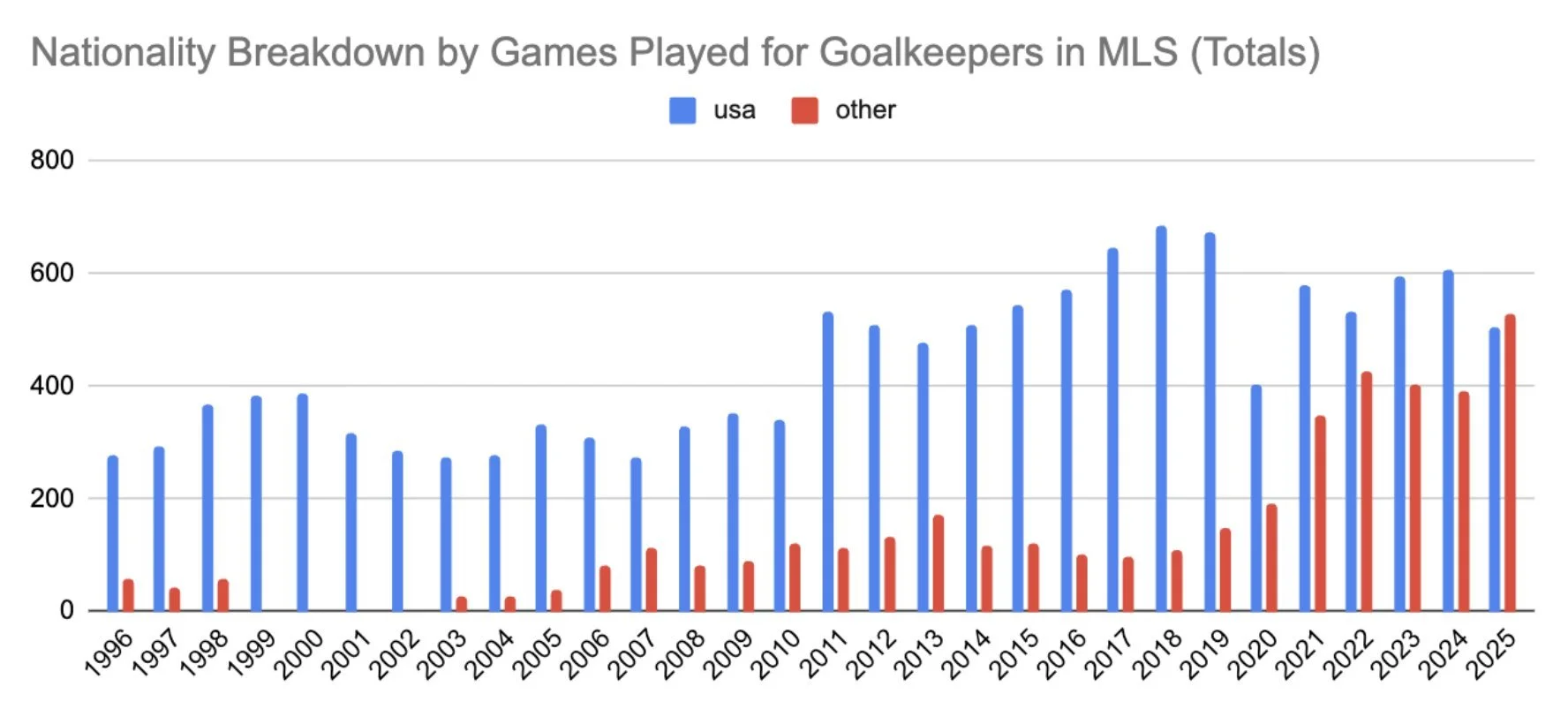
In 2025, MLS featured more foreign goalkeepers than American for the first time in the league’s history.

But what’s to say about the women’s setup? Four former professional goalkeepers from the women’s game weighed in on the current USMNT/USWNT goalkeeping situation: Saskia Webber (Rutgers, USWNT), Jill Loyden (Villanova, USWNT), Michele Dalton (Wisconsin, Chicago Red Stars), and Emily Armstrong (UConn, IBV).

Are the USWNT Avoiding the USMNT’s Potholes?

For most of its existence, the women have largely been forced to carve their own path as the federation would not treat the two national teams equally. As former NT goalkeeper Janine Szpara explained it, “US Soccer has a pattern of not supporting and giving the women what they need or what they deserve.” Even in more recent years, we’ve still seen an imbalance in investment. In 2018, when the USSF tried to kickstart a new goalkeeping license, it was MLS coaches, not NWSL coaches, who were invited to the pilot course.

So left adrift from the federation, the main saving grace for the women’s goalkeeping pipeline was that the US had the elite youth system in the entire world for the last 50 years, and, whenever afloat, a top professional league as well. The US enjoyed an early advantage in goalkeeping due to these investments. Emily Armstrong, who finished her career with UConn in 2016, spoke on her difficulty in going from the US to Europe when it came to what she expected to receive.

“While training with the Thorns and the Spirit, I had access to goalkeeper training on a daily basis, and even had opportunities for additional training outside of the daily practices. This was not the case overseas. In some situations, there was no goalkeeper-specific training offered, and I had to advocate for myself. At the time I was a little frustrated by this fact, but looking back on my experience, I am thankful that I was put into situations where I had to speak up, and find ways to improve my game without the routine goalkeeper training I was used to at UConn and in the NWSL. In Norway, I would train with the men’s keepers, because the women’s team did not have a goalkeeper coach of their own.”

But as the US gained a significant and early lead, with early stalwarts of Brianna Scurry and Hope Solo shining brightly on the world stage, these advantages started to erode. What Armstrong faced just ten years ago is now largely referred to as “back then” or a time that’s not really relevant to top European clubs. The US, in turn, didn’t do much.

“We haven’t put resources into education,” states Loyden. “Our goalkeeper coaches thought, ‘Oh, it’s a technical position.’ Coaches became overly technical and killed athleticism. Then the game evolved for goalkeepers to use their feet and we were even further behind.”

Exiting 2025, the NWSL’s top goalkeeper has now come from outside the US three out of the last four years and they’re starting to see a similar trend line that MLS faced just five years ago: games for Americans are going down while games for international goalkeepers are at an all-time high.
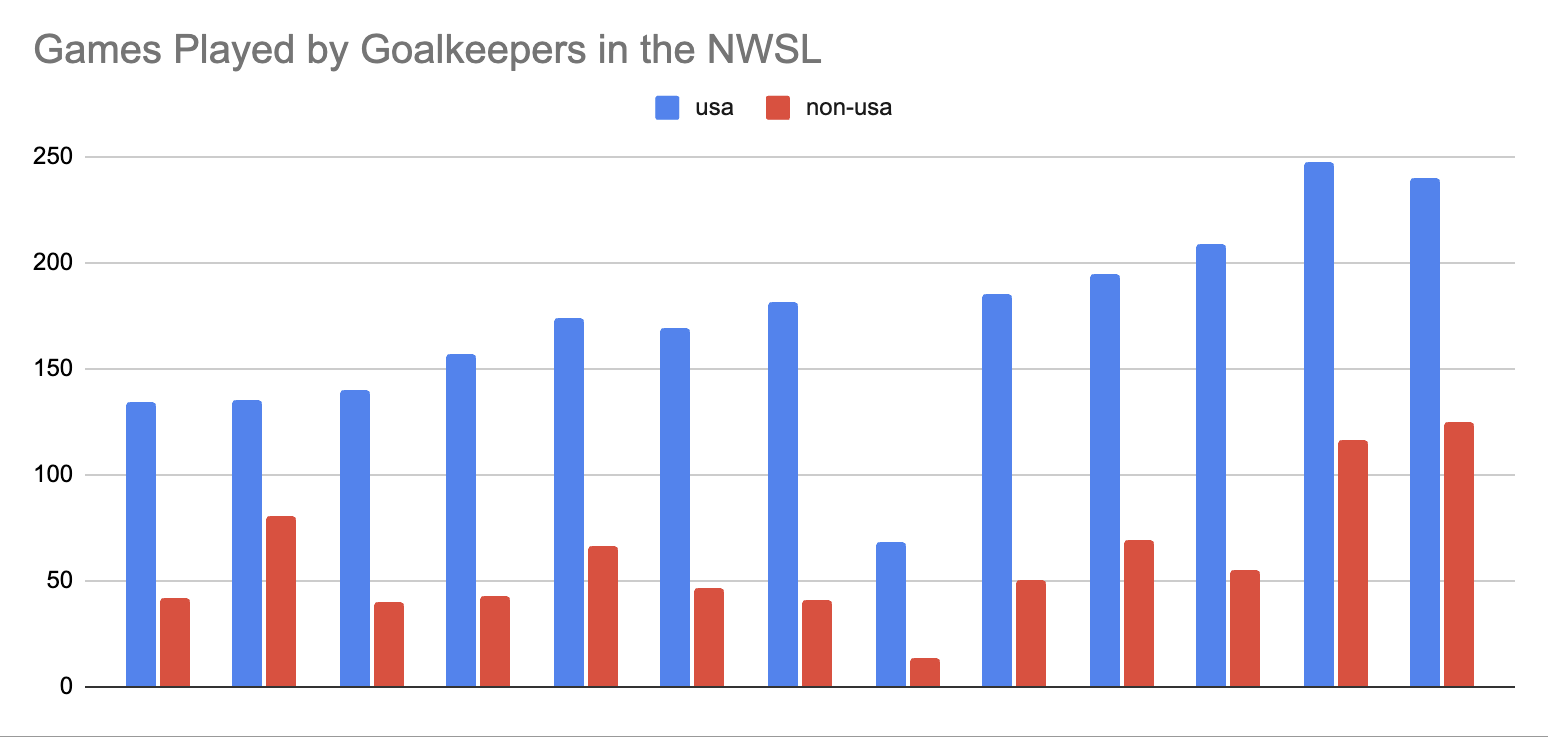
So while the US was once reaping the rewards of having the top league in the world filled with American goalkeepers, NWSL coaches are looking more and more overseas to find goalkeepers who are well-rounded out, having less trust in the underdeveloped American goalkeepers. Webber and Dalton express concern about the next steps for the USWNT when trying to replace Naeher.

“I don’t know if I would say [the USWNT] are having an easier time [than the men],” writes Webber, “None of the goalkeepers in the [USWNT] pool right now have enough experience or have proven themselves in a major tournament to grab the number one spot.”

“I actually don’t think the USWNT is having an easy time replacing Naeher,” echoes Dalton. “I do think Naeher replaced Solo pretty seamlessly. The men seem to always be behind the rest of the world, and instead of closing that gap, we continue to further ourselves. On the women’s side, more resources are becoming available to women internationally, so other countries have been able to close the gap.”

Substance Over Style

Continuing to invest in American goalkeeping poses a difficult question. “What exactly is American goalkeeping? What does it look like? How does one define it?” These questions are difficult to answer largely because it’s hard to find a consistent thread from the top. From Friedel to Howard to Freese, the USMNT has started three very different goalkeepers in a relatively short time. From Scurry to Solo to Naeher, again, three very different goalkeepers wore the number one shirt for the national team. And while the lack of a specific identity may not be met with a consensus, all four retired goalkeepers speak about the importance of a clear blueprint to uplift American goalkeeping, even if it is just a detailed approach for one specific individual.

“What is our identity?” asks Loyden. “I don’t know what that is. But I don’t think that’s necessarily a bad thing. We teach the ABCs at The Keeper Institute. Adaptable, brave, and consistent problem solvers. But consistent problem solvers can do that in a variety of ways.”

Loyden’s modern approach works well for goalkeeper coaches, as one team may have three vastly different skillsets that the coach must now work with collectively. And for the goalkeepers themselves, the intangible focus of the ABCs is a breath of fresh air, allowing the individual to figure out what works best for them, as opposed to shoehorning a calloused approach.

“I had goalkeeper coaches who worked with my style of play and made adaptations as needed,” said Armstrong. “I also had goalkeeper coaches who tried to change my style to fit theirs. I believe there is always room for growth, but I also think it’s important to meet the goalkeeper where they are, and progress from there. Every keeper has their own style, and there really is no ‘correct’ approach to the position. The goalkeeper coaches I appreciated most were those who would break down film and give me pointers, plus also listen to my perspective. I had the most growth with goalkeeper coaches who I could discuss both positive and negative plays in the game.”

Both Armstrong and Dalton now work with the next generation of goalkeepers and they haven’t forgotten what did and didn’t work for them in their playing careers. The intangible lessons learn are a signficiant compass in how their now coaching young, aspiring goalkeepers.

“An individual’s ability to take in new information while staying true to themselves is pretty paramount in being successful. I’m a big believer that instilling confidence and belief in a goalkeeper has to come above style. Maintaining consistent principles is key when styles vary,” says Dalton.

Tracking all the way back through playing in WUSA, Japan, and at Rutgers, Webber recognizes the problem young goalkeepers today face when they’re pulled in too many different directions. “The funny thing is all my coaches [across my career] had the same basic philosophies around the position and training. Possibly because they had all worked together. The problem today is that doesn’t happen as much, so young goalkeepers can be all over the place when they move from team to team or coach to coach.”

Optimistic Future

As we enter the next quarter of the century, our retired goalkeepers are still making positive impacts on the game, whether it is by becoming a goalkeeper coach themselves or offering insightful goalkeeping-specific commentary on nationally televised broadcasts. These efforts go a long way but the need for a federation-coordinated effort is still paramount. In Fall 2024, Jack Robinson was hired as Head of Goalkeeping after a nearly two-decade run through the highest ranks in England. Recently, Robinson talked about his efforts with the federation to help goalkeeping in our country, highlighting an expansion in goalkeeping education, more talent identification across the country, and the benefit of national team managers who want to utilize their goalkeepers as something more than a line sitter. These are encouraging signs, but for the last twenty years, American fans have been waiting on the federation to fulfill its promise that goalkeeping investment was on the way.

As of right now, the USWNT are still able to boast about having one of the top goalkeepers in the world between the posts. So things aren’t currently as dire for the women as they are for the men. However, when looking back to where the USMNT was with their 2002 and 2006 World Cup rosters - featuring Brad Friedel, Tim Howard, Kasey Keller, Tony Meola, and Marcus Hahnemann - Ernest Hemingway’s quote comes to mind. “How do you go bankrupt? Two ways, gradually. Then suddenly.”

Can the USWNT avoid the USMNT’s pitfalls? Time will tell. If we embrace the country’s strengths and continue ramping up investment into the position, the ceiling will skyrocket. On the other hand, unkept promises will only put the US further behind with its goalkeeping for not just the men, but the women as well.

“I don’t believe there’s one way to play the position,” Loyden says. “You can interpret it in so many ways. The more adaptable you are, the more solutions you have. If we’re not preparing goalkeepers for the demands of ten years from now, that’s a problem. We won’t know what they will look like [in ten years], but if we develop them to be adaptable goalkeepers, they’ll be able to play in that modern game.”

8 Goalkeepers We Could See in the USL Super League

The US enters a new era this fall with another division one league kicking up its inaugural season. The USL Super League will feature eight teams, with nine rumored expansion sides in future seasons. The new league has talked boldly about its future but it will need to set a high standard of bringing in serious talent to accomplish this. Here are eight goalkeepers who would be up to the task.

1. Catalina Perez, 29

After a strong showing at the 2023 World Cup, Perez is still unfortunately looking for a club team to champion as their starter. The Colombian goalkeeper has struggled to catch on overseas, currently with her fifth club in as many years. For teams looking for a talented and tested veteran, Perez would be a perfect pick. (Highlights)

2. Bridgette Skiba, 24

Skiba finished playing for Oregon State in 2021 and originally had a good first spell with Koge, finishing third in the Danish Women's League. However, she’s been relegated to the bench this season after her 3-1 victory over KI in Champions League play. Skiba has immense athleticism to help any professional side but could use a restart to her career. (Highlights)

3. Sham Khamis - 29

The 29-year-old Australian has bounced around the continent, both in the W-League and their second division (National Premier Leagues NSW). Although her window to join the national team is closing, Khamis has a scrappy approach to the game that attracts new buyers to bring her into their setup. For a league looking for players to handle an inaugural season that will inevitably bring bumps in the road, Khamis would be a great addition to bring in.

4. Makenna Gottschalk - 25

New Mexico State isn’t normally known for producing professional goalkeepers but Makenna Gottschalk has been plying her trade for Torreense this season. The midtable Portuguese club has struggled offensively, giving Gottschalk plenty of chances to showcase her talents. Gottschalk utilizes her mobility to cover the goal through extension saves and scrambles in the box. (Highlights)

5. Annalee Grove -22

Grove is in her third year as a starter in Australia’s W-League and is ready for a step up to the next level. Grove has already added international playing time to her resume with the Aussie U19s and has a realistic shot at a top, top league. For a goalkeeper looking to challenge for Australia’s future number one, Grove could use the USL to help propel her to a top league. (Highlights)

6. Emily Dolan - 29

Dolan has carved out a career for herself in Europe since joining Italian club Zaccaria in 2017. After playing in three different countries (Italy, Poland, Spain), Dolan has hit a bit of a wall with playing time with Espanyol. Dolan is a very technical goalkeeper who would be a prime veteran to help kickstart a new American club. (Highlights)

7. Abbie Faingold - 27

Faingold has circled the globe in order to continue her professional career. The 27-year-old has spent time in Japan, Israel, France, and Cyprus with Champions League-side Apollon Limassol. Faingold has most recently repped California Storm, a semi-pro team here in the US. Although there won’t be a USL California-based team in 2024, Faingold has shown the determination to maintain a professional career and wouldn’t be a stranger to traveling once again for a starting spot. (Highlights)

8. Glo Hinojosa - 24

Hinojosa has a strong “bet on me” attitude that mirrors Lindsey Harris’ style of play. Despite the lack of height, Hinojosa and UC Irvine played spoiler to number-one seed UCLA in the 2023 tournament through her gritty, never-say-die approach. Oh, and the year before? Hinojosa led UC Irvine in another upset over USC in the 2022 tournament. As far as young Americans who have a track record of proving doubters wrong, Hinojosa tops the list. (Highlights)

Scouting Potential Foreign Goalkeepers for MLS (Fall 2021)

cover photo belongs to Felipe Oliveira / EC Bahia

Following the previous summer report on potential signings for MLS, Everybody Soccer returns with another scouting report on possible foreign goalkeepers for MLS teams. The US’s top league has finally started to explore more avenues when it comes to buying and selling players, both domestic and foreign.

Eligible goalkeepers were limited to (1) being over 21 years old, (2) listed as having less than a $1,000,000 market value by Transfermarkt, and (3) ones that would have the highest possibility of being re-sold by an MLS team. Additionally, certain eligible goalkeepers were removed from inclusion, as moving to MLS didn’t make feasible sense for the stage they’re currently at in their career.

Matheus Teixeira - EC Bahia (22)

Photo: Felipe Oliveira/EC Bahia

Nationality: Brazil

Transfermarkt Listing: $550,000

MLS equivalent: Josh Cohen

After notching only three shutouts in 17 matches this season, EC Bahia pulled the plug on the young Brazilian in goal, opting for more experience in net. Teixeira picked up a couple of cup matches with the Brazilian club thereafter and, despite the depth chart shuffling, still ended up with 29 matches over the last 9 months. Teixeira doesn’t carry the same prestige as some other notable Brazilian goalkeepers in Europe but don’t mistake him for not having talent. The young keeper performed well in his first season as a starter at a first division club, especially considering how many shots his defense conceded. Teixeira has a bit of chaotic energy but he bottles it well until the time is right, displaying a good sense of patience vs. aggressiveness. Teixeira would do well with more playing time, not less, and MLS might be an appropriate home down the line. (Highlights)

Stefan Drljaca - Dortmund (22)

Nationality: Serbia

Transfermarkt Listing: $275,000

MLS equivalent: Steve Clark

Unless Dortmund is looking to commit to a longer developmental track, the 22-year-old Serbian goalkeeper is most likely ending his time with Dortmund soon. Drljaca originally joined Dortmund for free back in the summer of 2020 but his playing time with BVB has been limited since his arrival. Similar to Steve Clark, Drljaca has a knack for making non-textbook saves but saves nonetheless. If Drljaca is winding down at Dortmund, which TM says his contract extends to this upcoming summer, MLS could be a suitable next step. (Highlights)

Vasilios Athanasiou - PAS Giannina (22)

Nationality: Greece

Transfermarkt Listing: $55,000

MLS equivalent: Stefan Cleveland

The former U19 Greek YTN goalkeeper hasn’t had much to do since leaving Italy for PAS Giannina, picking up only a handful of matches over the past couple of years. Athanasiou has a smooth fluidness to him that aids his ability to cover the entire goal mouth but he needs opportunities to prove his worth. Athanasiou is at a point where he could utilize more minutes and with his track record of trying his hand in another country, a possible loan-turned-transfer deal might be a viable option. As listed by TM, Athanasiou’s contract runs up in two summers. For a backup goalkeeper with no clear path forward in the club, MLS could be a welcomed destination for the young goalkeeper.

Catalin Cabuz - AFC Chindia Targoviste (25)

Nationality: Romania

Transfermarkt Listing: $440,000

MLS equivalent: Matt Reis

Although Cabuz just signed with Romanian club AFC Chindia Targoviste, it was on a free transfer and reportedly only through summer 2023. For a talented goalkeeper who doesn’t have interest outside his domestic league and posssses little traction with the national team, Cabuz might try his hand at a more competitive league. The former U21 Romanian goalkeeper is a little undersized - standing at just 6’0” - but plays the position like a typical undersized goalkeeper: quick and mobile. As MLS has hosted a number of shorter goalkeepers with successful careers (Reis, Rimando, Busch), Cabuz and MLS could be a good fit, if Chindia is willing to let him go for a reasonable price.

Nils-Jonathan Körber - Hertha BSC (25)

Nationality: Germany

Transfermarkt Listing: $385,000

MLS equivalent: Brad Stuver

The 25-year-old goalkeeper is reportedly in the twilight of his contract with Hertha BSC and rumored to be leaving the club at the end of the season. Realistically, his next jump will likely be two a second or third division club in Germany. However, considering that an MLS team could pick him up for a low cost, if not outright free, the former German U21 goalkeeper could compete for a starting spot sooner than later here in the US. The lanky goalkeeper checks a lot of boxes, although his lack of playing time will make it difficult for teams to buy in on the German.

Scouting Potential Foreign Goalkeepers for MLS (Spring 2021)

Following the previous summer report on potential signings for MLS, Everybody Soccer returns with another scouting report on possible foreign goalkeepers for MLS teams. The US’s top league has finally started to explore more avenues when it comes to buying and selling players, both domestic and foreign.

Screen Shot 2021-05-13 at 11.49.03 PM.png

Eligible goalkeepers were limited to (1) being over 19 years old, (2) listed as having less than a $1,000,000 market value by Transfermarkt, and (3) ones that would have the highest possibility of being re-sold by an MLS team. Additionally, certain goalkeepers were removed from inclusion, despite qualifying for the previous criteria, as moving to MLS didn’t make feasible sense for the stage they’re currently at in their career.

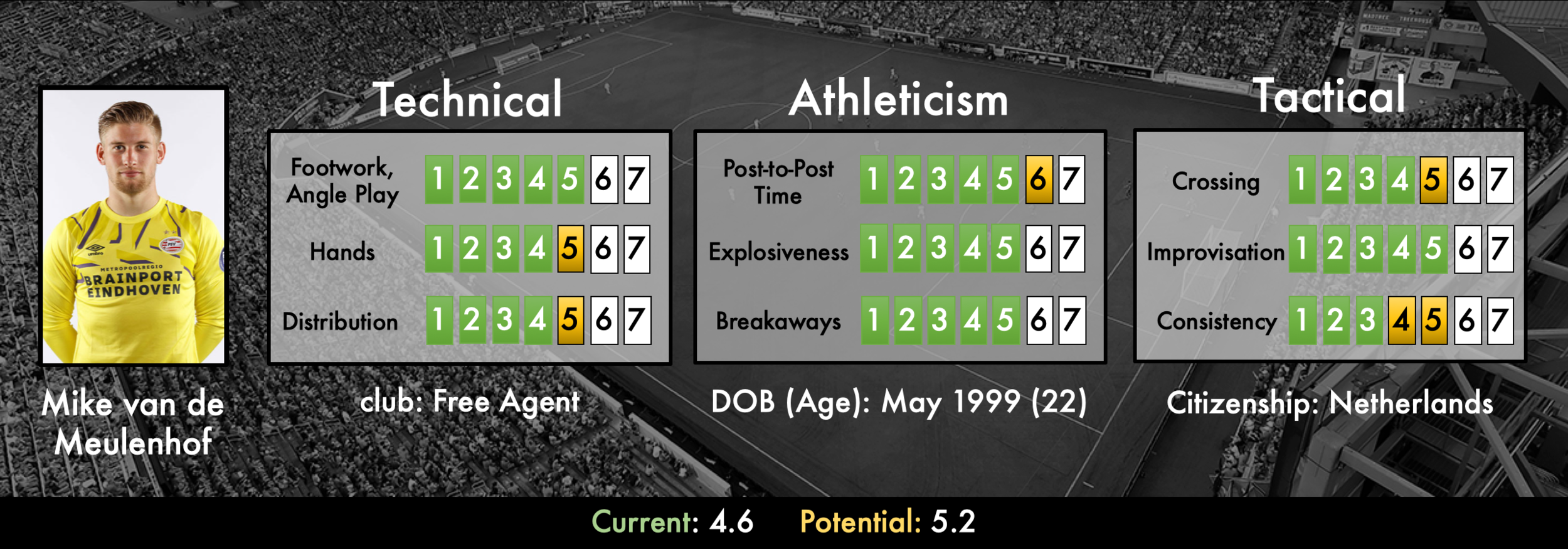
Each goalkeeper is ranked in nine different categories. Rankings are based on the ranking levels provided in the nearby graphic where 7 is an elite ability while 1 is extremely poor. A brief rundown on each goalkeepers’ style of play and relevant information is provided underneath the rankings. Lastly, each goalkeeper’s style of play - not overall ability - is compared to an MLS goalkeeper to give the reader an idea of how the goalkeeper approaches the position.


Phillip Menzel

Screen Shot 2021-05-12 at 2.15.57 PM.png

Notes: 6’4”, 182 lbs… average athleticism but otherwise above average in most other aspects of his game… feels comfortable collecting crosses with smooth approaches and clean hands… has a calming posture to him where he’s found a healthy mix of being patient yet knowing how to take forward space when need be… doesn’t seem to get overwhelmed when he needs to make a reflex or improv save, despite not having the athleticism of his peers… understated goalkeeper who can easily be overlooked but strong fundamentals will add up over the course of his career.

Similar style of play: Jeff Attinella

Transfermarkt listing: $220,000

Calvin Heim

Screen Shot 2021-05-12 at 2.15.59 PM.png

Notes: 6’3”, 165 lbs… solid foundations, methodical approach in most situations… sharp footwork… hands inconsistent but has positive moments, should come in time… cross management problematic… comfortable on the ball and will try ambitious passes… left foot has a noticeable dropoff but not completely unserviceable… doesn’t look to develop much more athletically but is far from poor in those areas… hasn’t played since July 2020… strengths are found in strong technical foundation and steadiness in goal.

Similar style of play: Brady Scott

Transfermarkt listing: n/a

Mike van de Meulenhof

Screen Shot 2021-05-16 at 5.21.46 PM.png

Notes: 5’11”, 174 lbs… hasn’t played since February 2020… confident with both feet but execution and decision making in question… quick yet smooth footwork allow for impressive acceleration and the ability to break out for an extension save… not afraid to attack a cross but, similar to distribution, can overplay his hand… utilizes speed and smart body shape to shut down 1v1s, but doesn’t play a high line… displayed several positive moments put lack of recent minutes is concerning.

Similar style of play: Tony Meola

Transfermarkt listing: $330,000

Moritz Nicolas

Screen Shot 2021-05-12 at 2.16.03 PM.png

Notes: 6’4”, 191 lbs… footwork is confident and well thought-out, but average speed likely means it’s about as good as it’s going to get… not poor but not great athleticism… has struggled in close range situations in knowing what tool is the right fit for the job, although he has shown different looks. Needs to find correct style for himself in that area… strong on crosses, reads the ball and executes well… distribution is mostly with right foot and simple but has adapted well when need be… an understated goalkeeper with little “flash” to his game, but the consistency should pay off in an environment that utilizes him.

Similar style of play: Stefan Frei

Transfermarkt listing: $275,000

Jay Gorter

Screen Shot 2021-05-12 at 2.16.05 PM.png

Notes: 6’3”, 174 lbs… sits incredibly deep when defending but has impressive speed to close down attacks… can be a little overly reliant on quickness on breakaways… difficult for him to defend 1v1s efficiently when heels sit on goal line… hands not great but adequate, could be improved… reliance on mobility makes for a “boom or bust” situation when plays break down… can get lost when patience is required… deep position makes coming from crosses tricky but compensates with a quick break off his line… can clip a ball well with both feet… doesn’t have the typical fundamentals down when considering MLS goalkeepers, but plays extremely front-footed and wants to be more than just a shot-stopper… upside could be higher if he finds a better complementary style, as deep line + speed don’t always mesh well.

Similar style of play: Steve Clark

Transfermarkt listing: $770,000

Martin Vantruba

Screen Shot 2021-05-16 at 5.24.10 PM.png

Notes: 6’5”, 176 lbs… lack of consistent play makes Vantruba’s upside difficult to gauge… has some mechanics and foundations to his game but every so often he’ll rely on brute force to solve a problem… weak hands… coming off his line isn’t the smoothest… has moments of brilliance when he can figure out his footing… comfortable on the ball, if not overambitious… Vantruba feels close but lack of consistent minutes likely inhibiting his ability to find consistency… would be a project for any team but the upside is there for the nimble, lanky goalkeeper.

Similar style of play: Alex Bono

Transfermarkt listing: $165,000

Remy Descamps

Screen Shot 2021-05-12 at 2.16.08 PM.png

Notes: 6’5”, 180 lbs… has the ability to make a game-changing save with the combination of frame and athleticism. However, nimble movement is difficult for him, which can show up in lateral movement or deflected shots… dominates crosses easily… distribution can be poor at times but does have a cannon with his left foot… excels in all the areas a tall goalkeeper would be expected to excel at and struggles in the areas tall goalkeepers typically struggle at.

Similar style of play: David Ousted

Transfermarkt listing: $880,000

Dominik Hladun

Screen Shot 2021-05-12 at 2.16.10 PM.png

Notes: 6’3”, 169 lbs… lanky, explosive goalkeeper who can cover the upper corners with ease… forward movement is cumbersome and can struggle when it’s more than a few steps to collect a ball… distribution average at best… plays fine when he lets the play come to him, but has a knack of inevitably running into situations he can’t solve with just having a big frame... would do well to play more within skillset and not shoehorn aggressive approach when he doesn’t have the quick footwork to match it.

Similar style of play: Michael Gspurning

Transfermarkt listing: $715,000