This article is supported by shared photographs from Ted Bondi’s family. Ted Bondi maintained a scrapbook of his athletic career, and, combined with newspaper clippings, Bondi’s goalkeeping career is pieced back together for this article. Thank you to the Bondi family for sharing the photographs. All pictures are from the scrapbook, unless noted as newspaper clippings.
Like many great American goalkeepers before him, Theodore “Ted” Bondi was a first-generation American. After his parents, Peter and Philomena Chiara Bondi, immigrated to the States in 1912, the Italian couple welcomed Theodore “Ted” Bondi in 1929. The young Italian-American grew up in Geneseo, less than an hour south of Rochester, New York and attended Geneseo High School from 1944-1947, lettering in basketball, baseball, track, and soccer.
Although he played multiple sports throughout his time at Geneseo High, Bondi developed a fondness for several sports but his development in becoming a top soccer player came from one of the least likely places: harvesting vegetables at the Birdseye Factory in Lester. Although Bondi was familiar with the sport at this time, it was there that World War II German POWs taught Bondi the finer details of the game through their skill with the ball, laying the foundation for many years to come.2
In a 1999 interview, Bondi explained how he eventually transitioned from playing in the field to goalkeeper: “Our goalie [at Geneseo High School] wasn’t too good so if we were ahead, my coach put me in goal in the second half to protect the lead.” Bondi tasted some early success in the sport. His junior year at Geneseo featured a 2-1 win over Spencerport before ultimately falling in the Class A championship game, losing 4-2 to John Marshall High School.1 During Bondi’s senior year, Geneseo ended in a close semifinal loss to Brighton in late October of 1946. But despite the setback, the 5’10” multi-sport athlete was just at the beginning of his storied athletic journey, one that Geneseo would proudly boast of for many years to come.
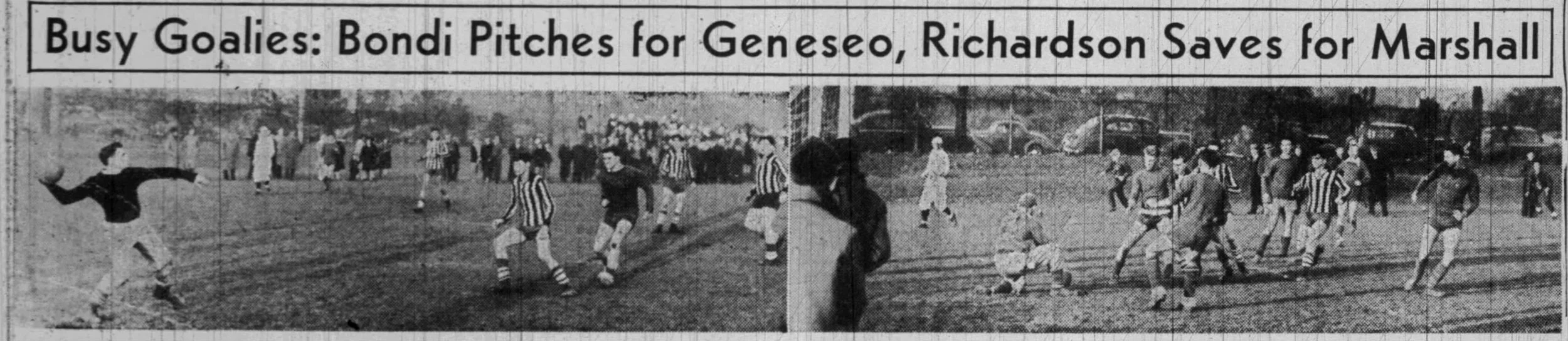
Bondi, bottom left, with Geneseo High. The Times-Union, November 6, 1945
Bondi (middle, back row) at Geneseo High, 1946
Bondi at Geneseo High. Likely 1947 or 1948.
Bondi Heads to Brockport State
Various clippings from Bondi’s first year at Brockport
Bondi attended Brockport State, just 30 miles north of Geneseo, and the school’s soccer team immediately welcomed the spry goalkeeper. Bondi was named the starter in his first year, replacing outgoing goalkeepers Joe Costello and Ed Stackwick. In his opening match, a 2-0 win over Buffalo State, Bondi was complimented for making “many nice stops, feinted deceptively, and kept himself out of trouble with long accurate boots and tosses.”3
In the third match of the season, Bondi seemed to have made a name for himself despite the team suffering a 2-1 loss to Cortland. “Ted Bondi’s sensational goal-tending feat will long be a favorite topic of discussion around college. Time after time he had the fans gasping as he made unbelievable saves, dashed out to intercept onrushing linesmen, and feinted past hard charging checkers. Yessir, Mr. Bondi was really terrific; ask anyone who saw the game.”4
Bondi and Whatford featured in the all-star game following their freshman years.
In the final match of the 1947 campaign, Bondi’s excellence was noted as something of common expectation. “Once again Ted Bondi was forced to demonstrate his good tending skill to the delight of the crowd.” Another article echoed the sentiments: “The Sampsonities [of Sampson College] broke loose to force Ted Bondi to again display his wares. To the delight of the fans, he gave another stellar exhibition of how a goalie should perform.”5
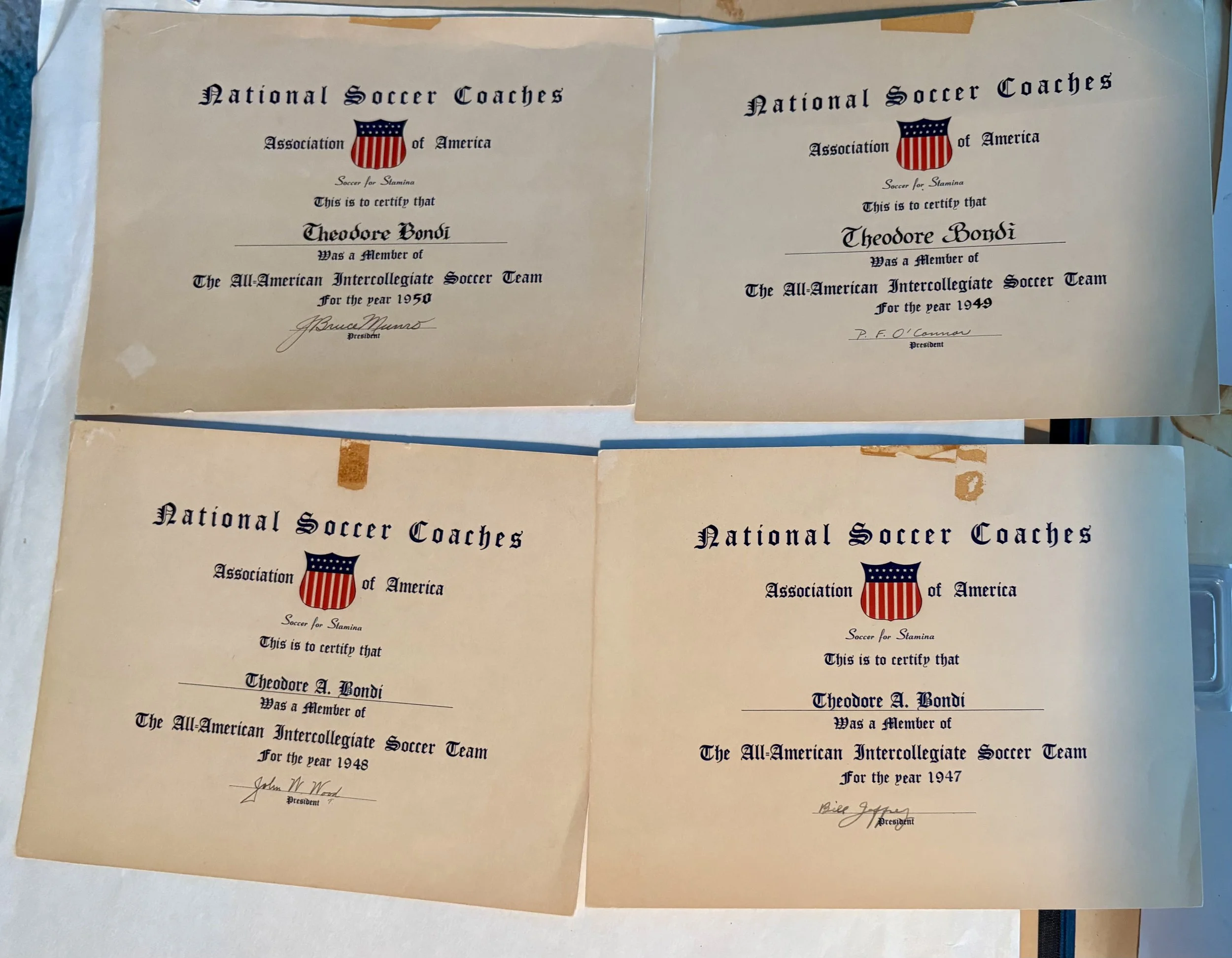
With his exploits on full display, Bondi was awarded the second-team All-American award in his freshman year, a rare award for any freshman player. But his goalkeeping wasn’t the only thing catching attention, as his character received high praise just a year later. “Not only should Geneseo be proud of Ted for his playing ability but also for the spirit of fair-play and sportsmanship which he displays on and off the playing field. He is a fine example of ‘All-American Youth’. Keep up the good work, Ted, and may a lot more deserving honors come your way.”6
The honors indeed continued to come Bondi’s way. On November 23rd, 1947, Bondi and teammate Howard “Weasel” Whatford - the college’s first two All-Americans in Brockport’s history - were featured in a collegiate all-star matchup between New England and New York. Despite hailing from the smallest school on the billing, Bondi and Whatford made Brockport proud as they were happy to punch up a weight class. Both players were thrilled at the opportunity, as well as their own performances. Whatford was quick to compliment his teammate, “All of the fellows on our team cooperated well and didn’t try to be ‘heroes’. Every one of the players was good. Bondi really played a swell game and made several beautiful stops.”7
1948 Olympic Tryouts
After an extremely successful freshman year, Bondi was invited to the tryouts for the 1948 Olympic team. The tryout process was a novel idea that matched small regions of teams playing one another. Regardless of the scoreline, the best individual players would “make the cut” and be invited to the next round. The following rounds would repeat the process until a final squad was assembled. Bondi was featured on the New England squad, which rolled the All-Connecticut Amateurs 7-0 on April 18th. As reported, the best players would “play the All-Amateur team from Massachusetts… This game will determine who will play on the All-North Team in a game at the Polo Grounds on May 8 against an All-South squad. From that contest will be determined the players who will be on the All-East team. That group will play an All-West aggregation (which has already been picked) and from that encounter the players for the Olympic team will be selected.”8
What happened next is hard to piece together, although Bondi’s ire, understandably, burned decades after. Reports of Bondi’s inclusion in the Olympic qualifying extend through April 20th, with Bondi and collegiate teammate Whatford both making the cut for the next round to face the representatives from Massachusetts. On April 30th, the North Adams Transcript reported a 2-1 win for the Massachusetts squad, featuring players from the heralded amateur side Ponta Delgada SC. Although Bondi was not named specifically in the matchup, his rival Morton “Mort” Thau of Springfield College and another goalkeeper, Tony Almeida (Gremio Lusitano), were listed as making the cut to the new round.9 A later matchup between an all-New York squad and an All-New England squad was held on May 8, 1948, with Bondi once again not listed.10
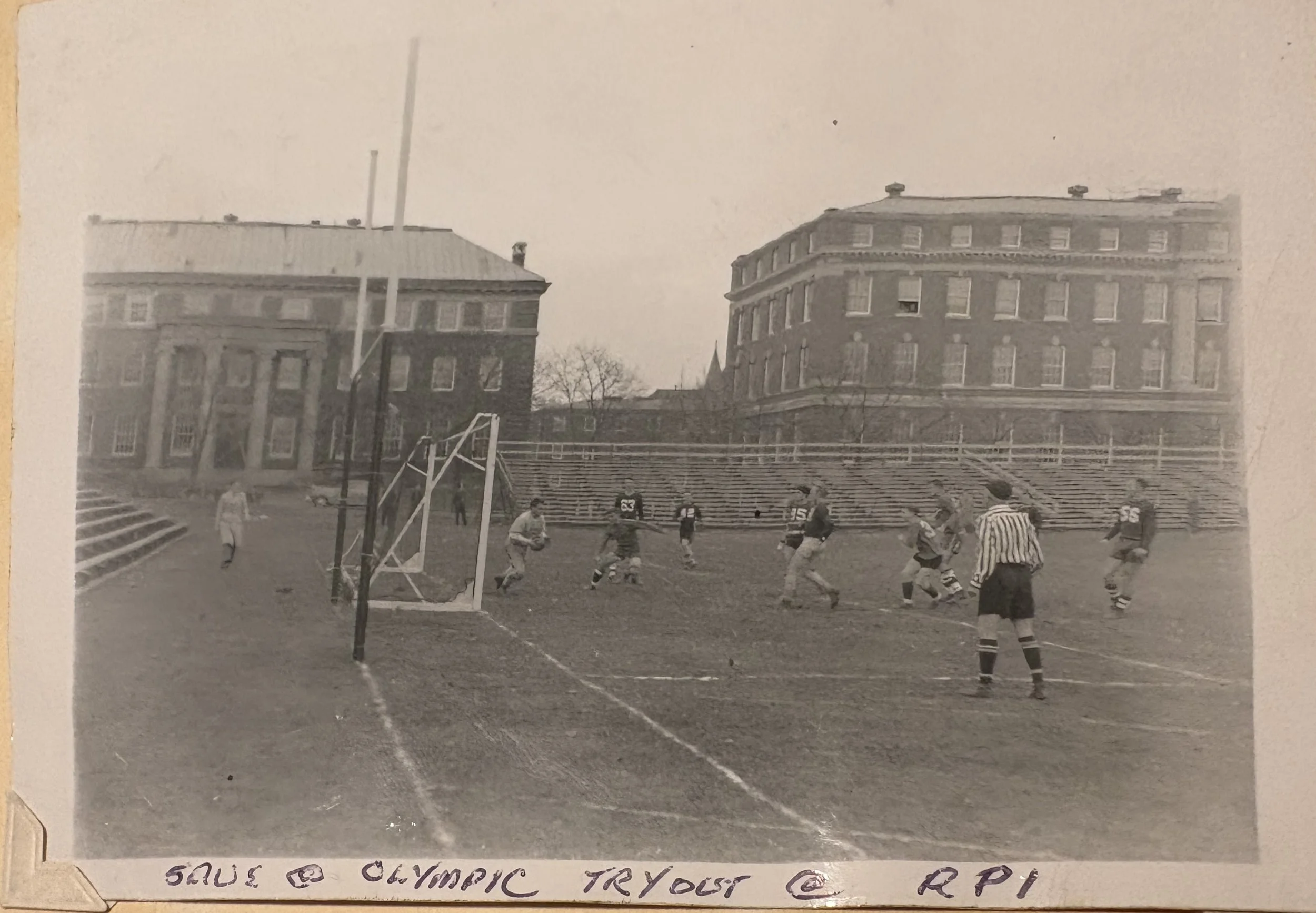
In a 1999 article, Bondi recalled being told he and several other college players had made the Olympic roster at one point, but ultimately the federation pivoted to non-collegiate amateurs, mostly from St. Louis and Massachusetts.11 Bondi’s exclusion is even more odd, as his peers who were featured in later rounds, such as Springfield’s Morton Thau and Navy’s Al Schaufelberger, were goalkeepers that Bondi was nationally recognized as at least on par with, if not better than. However, the final exclusion of nearly every collegiate player is the biggest head-scratcher, especially considering the Olympics’ focus on amateur athletes. While historically the common belief has been that the collegiate game was lagging behind the rest of the country’s semi-pro leagues, the final roster of America’s top amateurs excluded all collegiate players, including All-Americans Howie Whatford and Bill Sheppell (Seton Hall), both of whom would later play for the full national team before the end of the decade.
David Litterer wrote in his recap of the 1948 Olympic trials that the federation’s plans to bankroll the needed $14,000 for the tournament rested on ticket sales of the trials, which ultimately fell short by a significant margin. The miscue was yet another failed opportunity in a long line of errors by the federation. Whether it was the federation’s inability to move the needle in maintaining soccer in the 1932 Olympics, or the federation’s role in the American Soccer Wars leading to the dissolution of the country’s top league in 1933, or their fumbling of the momentum out of the 1950 World Cup, the federation was in a multi-decade-long stretch of underserving the player base, and 1948 was another chapter in that story.
The Olympic efforts came crashing down in August of 1948 when the US Olympic soccer team had an embarrassing 9-0 loss to Italy in their lone match at the tournament. Bondi’s frustration at a limited opportunity through qualifying - especially seeing the team fall on their faces at the London Olympics - would understandably still resonate 50 years later.
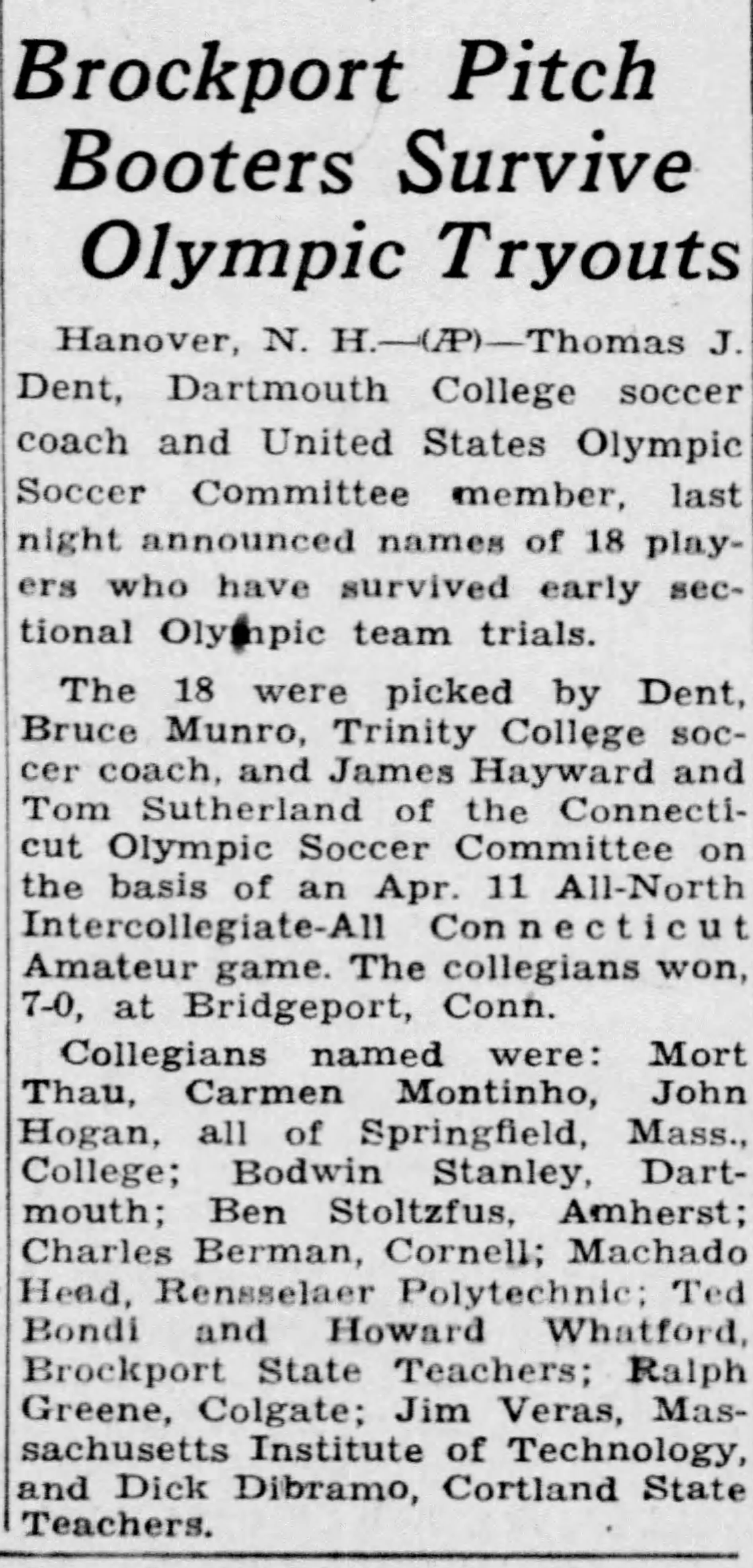
Democrat and Chronicle, April 20, 1948
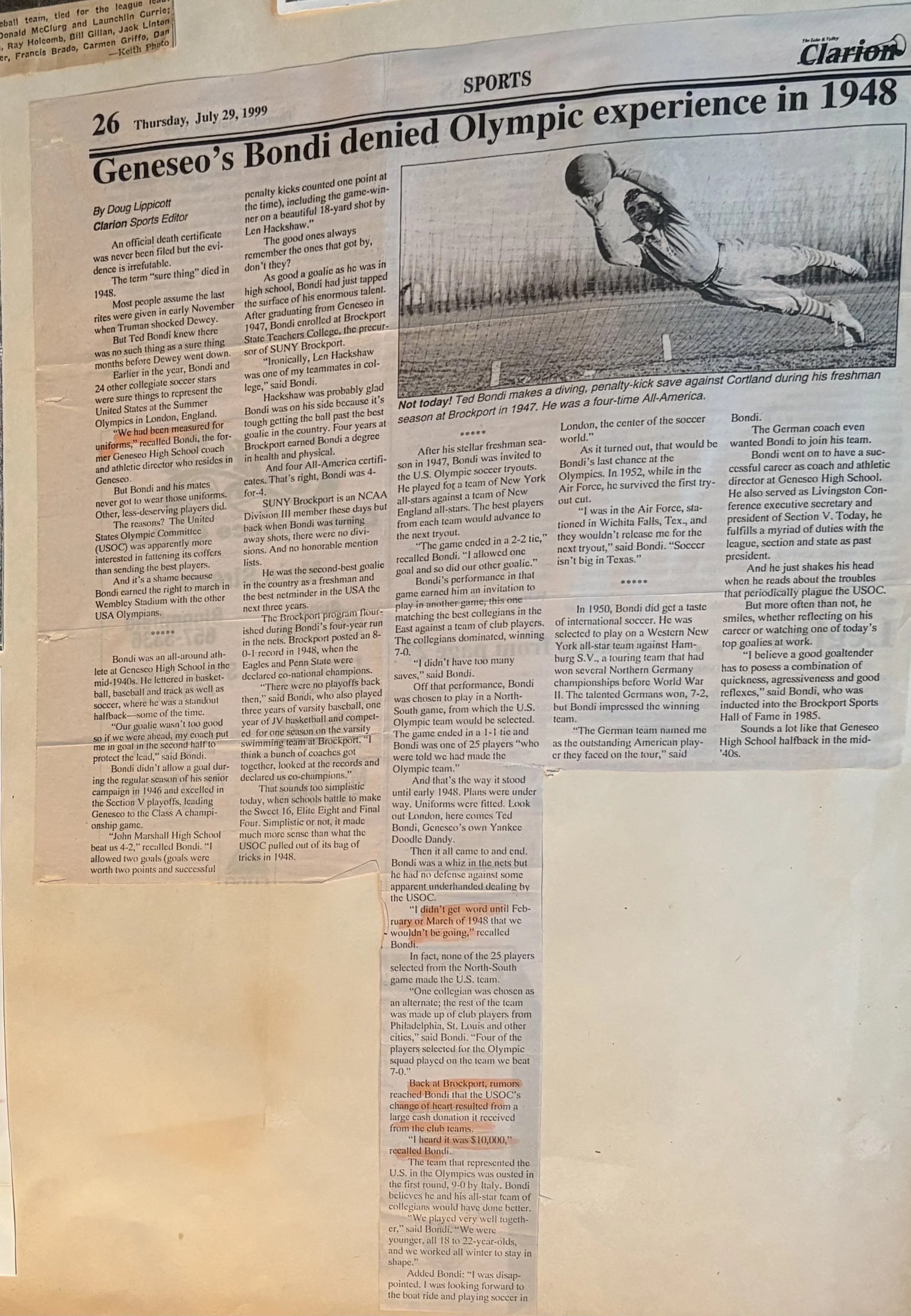
Bondi speaking on his experience in trying out for the 1948 Olympics (July 29, 1999).
Sophomore Stride
Never one to pout in a corner, Bondi’s persistence would pay off for the entire Brockport squad. The Golden Eagles kicked off their 1948 season in late September with a 6-0 win over Geneseo. On October 9th, Brockport won a match over the “Rochester All-Stars” 4-3, although additional reports on the match are unavailable. Brockport doesn’t cite the match in their official record for the year but the scheduled match gives a testament to the seriousness of the season. Head Coach A. Huntley Parker would later speak about the squad in a 1954 interview, “We would have played anybody then, and still will”.12
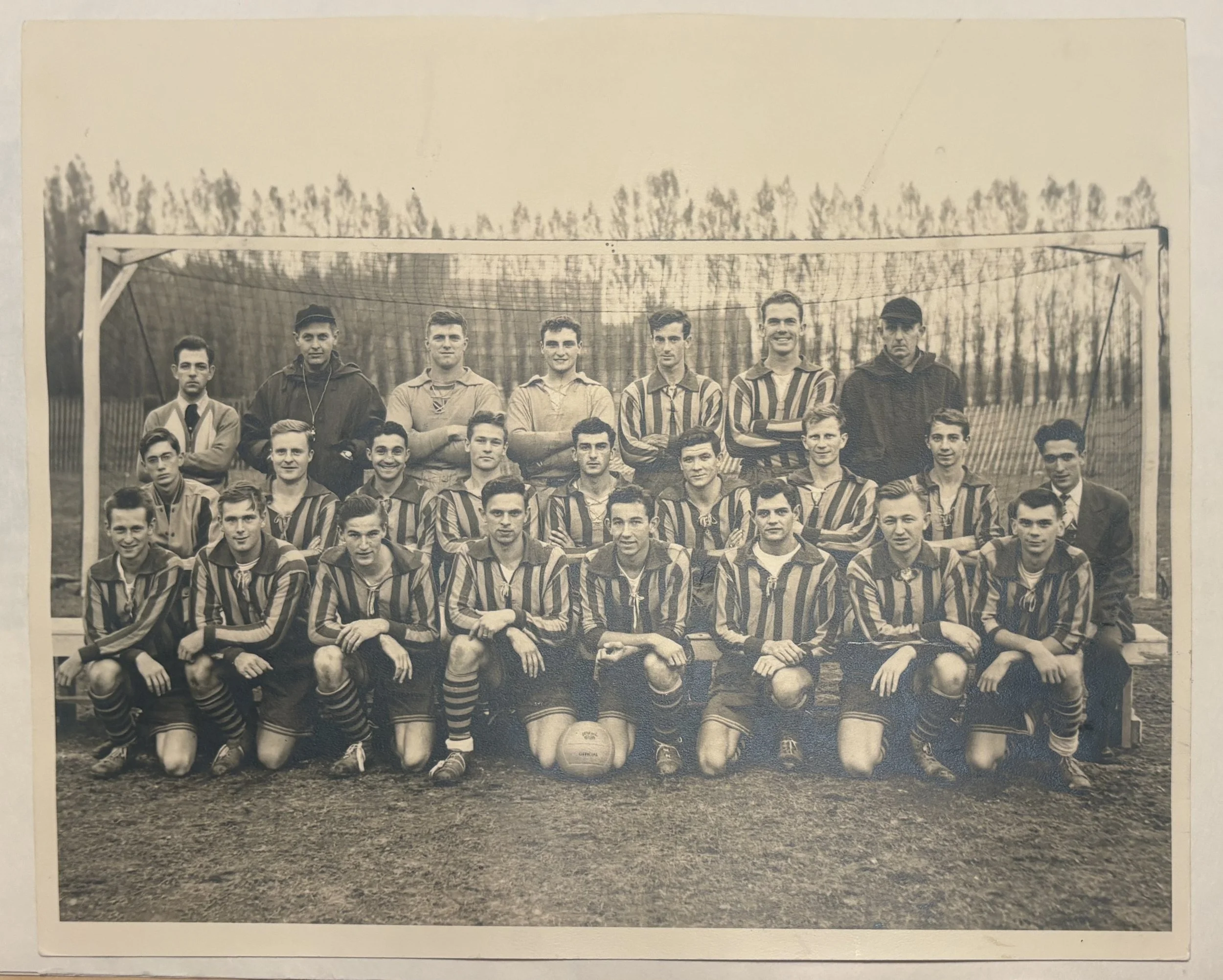
1948 Brockport State Soccer Team
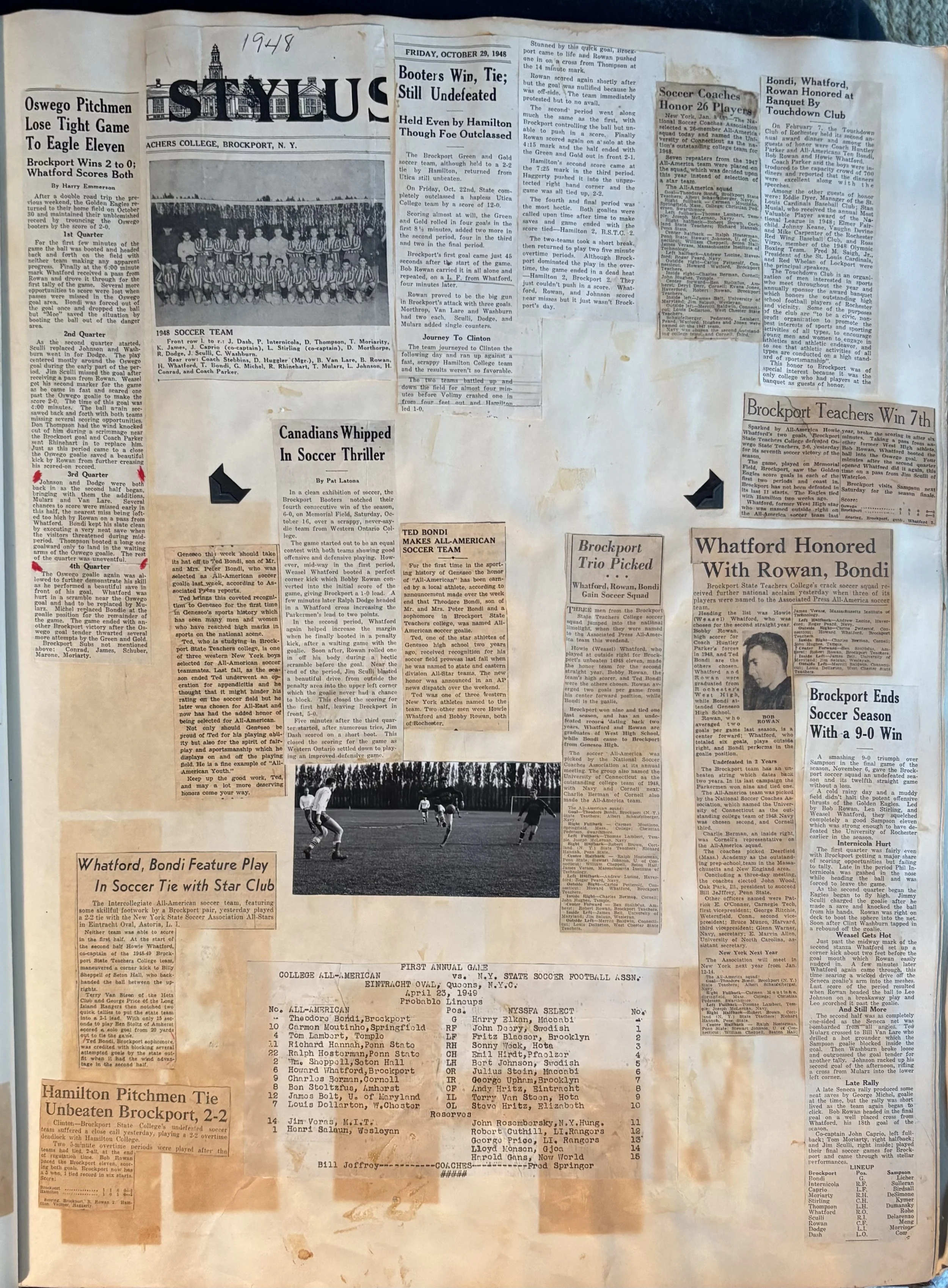
Various newspaper clippings mostly from Bondi’s sophomore year.
Brockport welcomed an international challenge for their third match of the season with Western Ontario coming down to play on October 16th. The Democrat and Chronicle did their best to hype up the international matchup. “The visitors [Western Ontario], reported to be the strongest collegiate team in Canada, will provide the first major college competition for BSTC."13 Unfortunately, the match did not live up to the billing as Brockport won the game handily, 6-0. However, the following schedule proved to be a tough ask for any college. With four games in eight days - all in different locations across New York - Brockport had a mountain to climb to challenge for the title of National Champion.
After a 12-0 drubbing over Utica College - which saw four goals in the opening ten minutes and the first string quickly getting pulled - Brockport’s perfect run hit a bump in the road with a 2-2 tie at Hamilton on October 23rd. The fourth game in eight days was filled with a fair amount of drama. “As the score indicates the first encounter was a complete rout, the varsity tallying four goals in the first 8 1/2 minutes before being yanked. However, a poor playing field, bad breaks and one questionable decision, a refusal to give the penalty kick to Brockport on an unnecessary roughness violation within the Hamilton penalty area, by the official told the story.”14
With maintaining an undefeated season still on the line, Brockport traveled two hours east to Cortland State to seek their first win against their in-state rival in program history, losing to the Red Dragons twice in the previous two years. On October 27th, Bondi’s booters earned a 3-1 win over one of their fiercest rivals. Brockport captured their final two victories of the season with relative ease, the finale featuring a 9-0 win over Sampson Air Force Base, where Bondi would later be stationed in just a few years.
As one of the few undefeated teams in the nation, Brockport was undoubtedly in the conversation as a potential national champion. However, an annual postseason tournament wouldn’t begin until 1959, and previously the ISFA (the governing body of the sport and precursor to the NCAA) would simply elect a national champion.15 The honors were given to the University of Connecticut after an astonishing 11-0 season, including a win over the previous year’s reigning champion, Springfield College. However, Brockport State shared many spoils as Bondi, Whatford, and Bob Rowan all notched All-American honors for their efforts in the season. The 1948 team finished with a 7-0-1 record with forty-four goals scored and only six conceded.
On April 23, 1949, Bondi and the College All-Americans took on an all-star squad from New York and held the all-star squad to a 2-2 tie with a goal by the collegians in the last thirty seconds to level the score. The spring and summer were otherwise quiet for Bondi’s soccer efforts, although it’s safe to say he was the first one cheering on Brockport teammate Howie Whatford during his first appearance with the US Men’s National Team. In June of 1949, during a 4-0 loss to Scotland in front of 17,000 fans, Whatford received his lone career cap with the senior national team, marking yet another collegiate player to eventually represent the US on the international stage.16
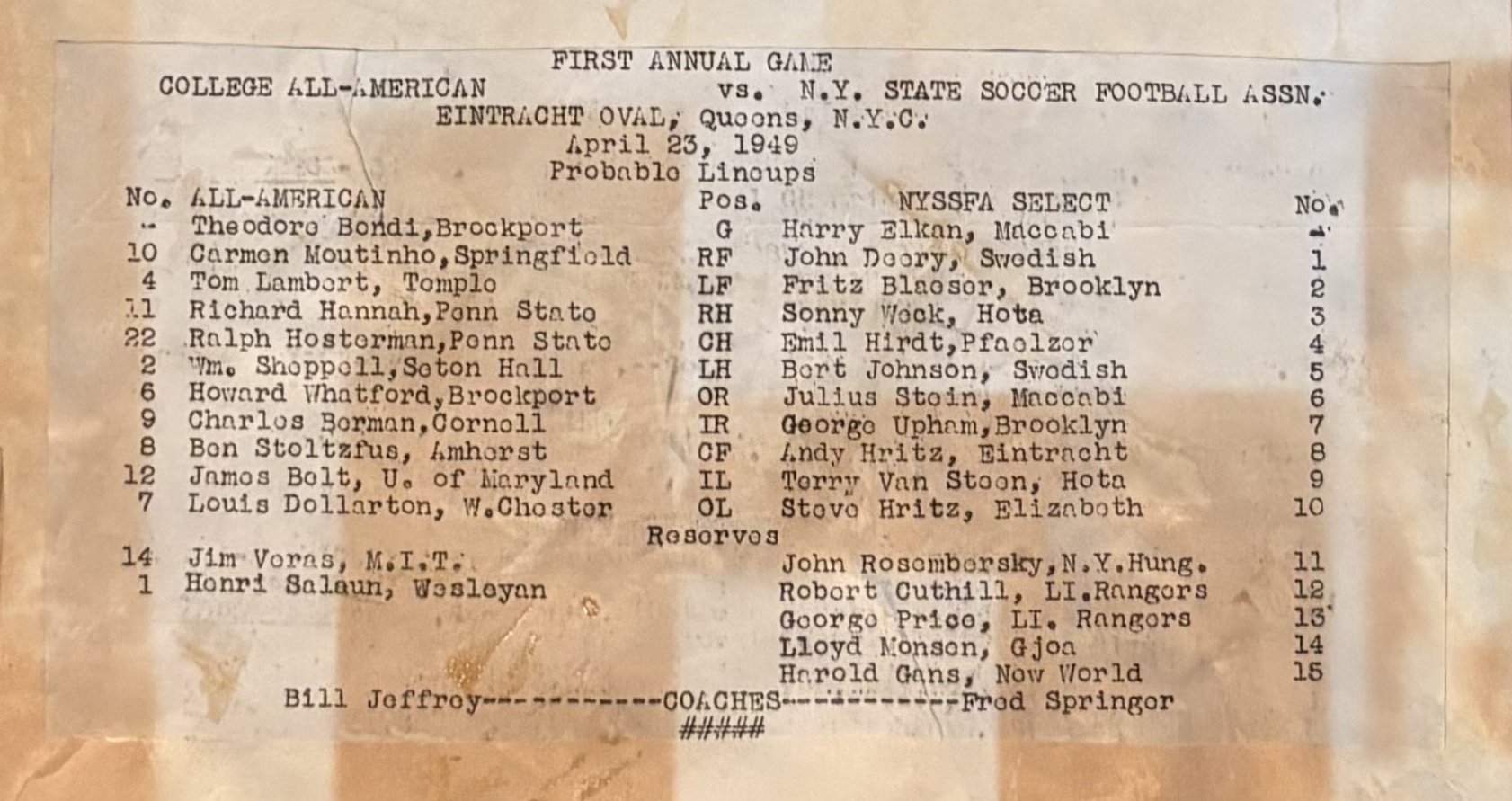
The College All-Americans tied the New York All-Stars 2-2 in the spring of 1949.
1949: Junior Year, 7-1, 0.38 GA
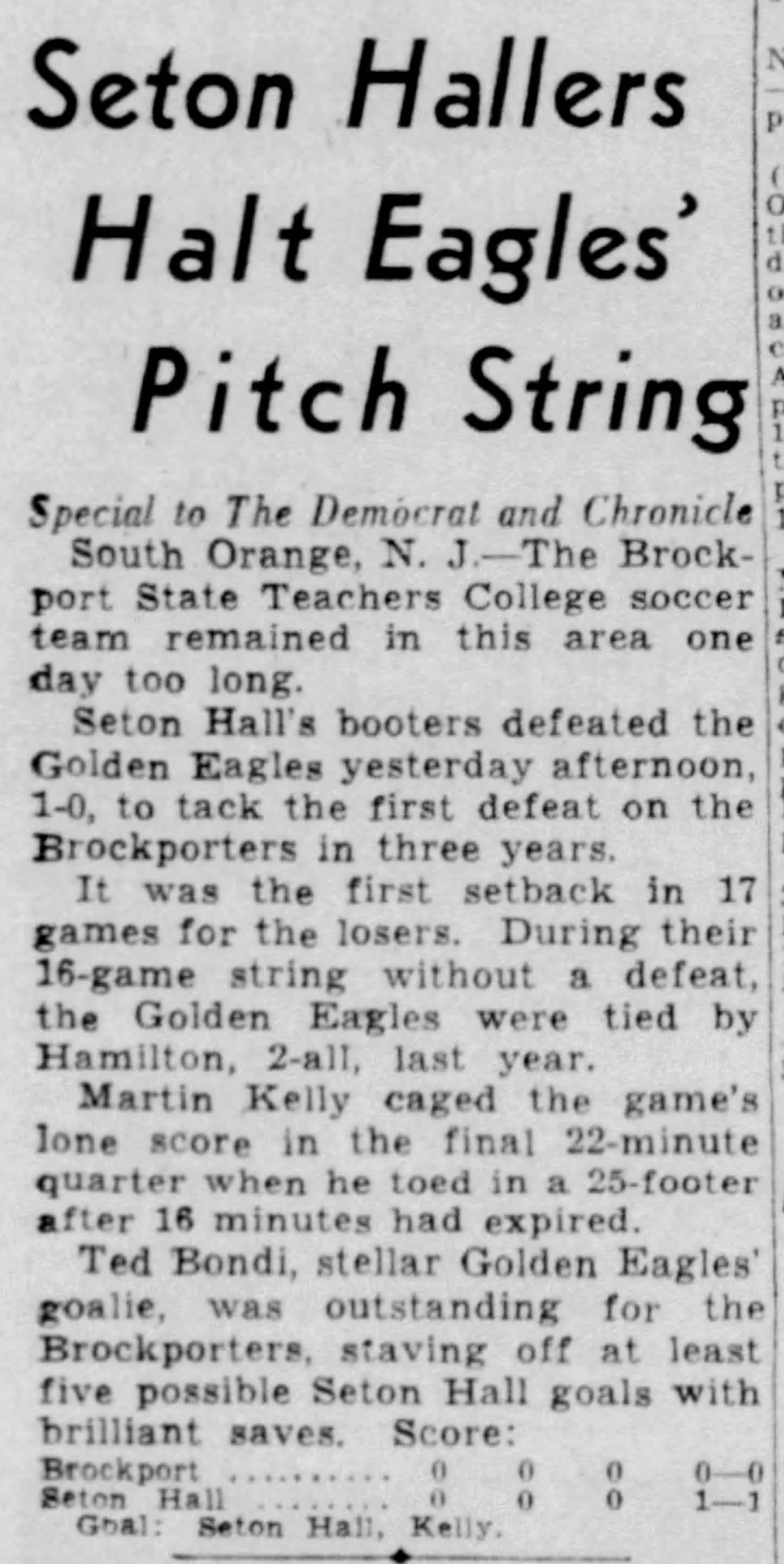
Eager to build off last year’s success, Bondi’s junior year kicked off with an 11-0 drubbing over Geneseo State Teachers College in late September. For Brockport’s second match, the Golden Eagles hosted Buffalo State in a 4-2 win, with Whatford only playing the final quarter due to a lingering knee injury. The two goals Bondi conceded in this match would account for 2/3rds of all the goals conceded in the entire 1949 season. After back-to-back 2-0 wins over Hamilton and Panzer, Brockport’s chance at a claim for the national championship would be put to the test.
Seton Hall boasted one of the few collegiate players who had been named to the alternate list in the 1948 Olympic tryouts, just a year and a half prior: Bill Sheppell. Sheppell would later earn 11 caps for the national team, playing for the US until 1954. The matchup of All-Americans proved to be in Seton Hall’s favor as the Pirates notched a 1-0 victory, scoring in the final minutes of the game. Unsurprisingly, Bondi was praised by the Democrat and Chronicle in the defeat: “Ted Bondi, stellar Golden Eagles' goalie, was outstanding for the Brockporters, staving off at least five possible Seton Hall goals with brilliant saves.”17
Brockport wrapped up three more shutout victories to close Bondi’s junior year with a 7-1 record, conceding only three goals across the eight competitions, with a 1-0 loss away at Seton Hall proving to be the only thorn in Brockport’s aim at a perfect season. Bondi was, unsurprisingly, awarded his third All-American award for his efforts with Brockport.
Following the fall season, Bondi quickly returned to the field, this time with the Rochester Thistles, on December 18th to face the Buffalo Becks in the National Challenge Cup, the precursor to the US Open Cup. The Thistles had tied reigning champions Morgan SC earlier in the year in a 0-0 draw, but with the addition of Bondi, fans’ hopes skyrocketed. “The Thistles are considered much improved this year and are expected to make a better showing. Milt Pierce, Ted Bondi, Len Hackshaw and Les Mort are wearing the Orange and Black this year for the first time and have strengthened the Thistles to the extent that team followers have high hopes of a national championship”18
Unfortunately, the Thistles faced difficult conditions in the early-round matchup. “The game was played in a sea of mud - on the Lexington Ave. Sports Club field. But despite the miserable playing conditions, it was a hard-fought battle, with tempers flaring on several occasions.” The heated match would feature a stoppage when a fight broke out, seemingly some time after the Becks gained an early lead when “Eddie Adams, left wing, caught Thistle goalie Ted Bondi out of the nets after staving off one Beck scoring attempt.”19 Although Rochester regained their composure to level the score, the Becks were awarded a penalty with six minutes left and recaptured the lead to win 2-1.
1950: A New Decade With New Foes
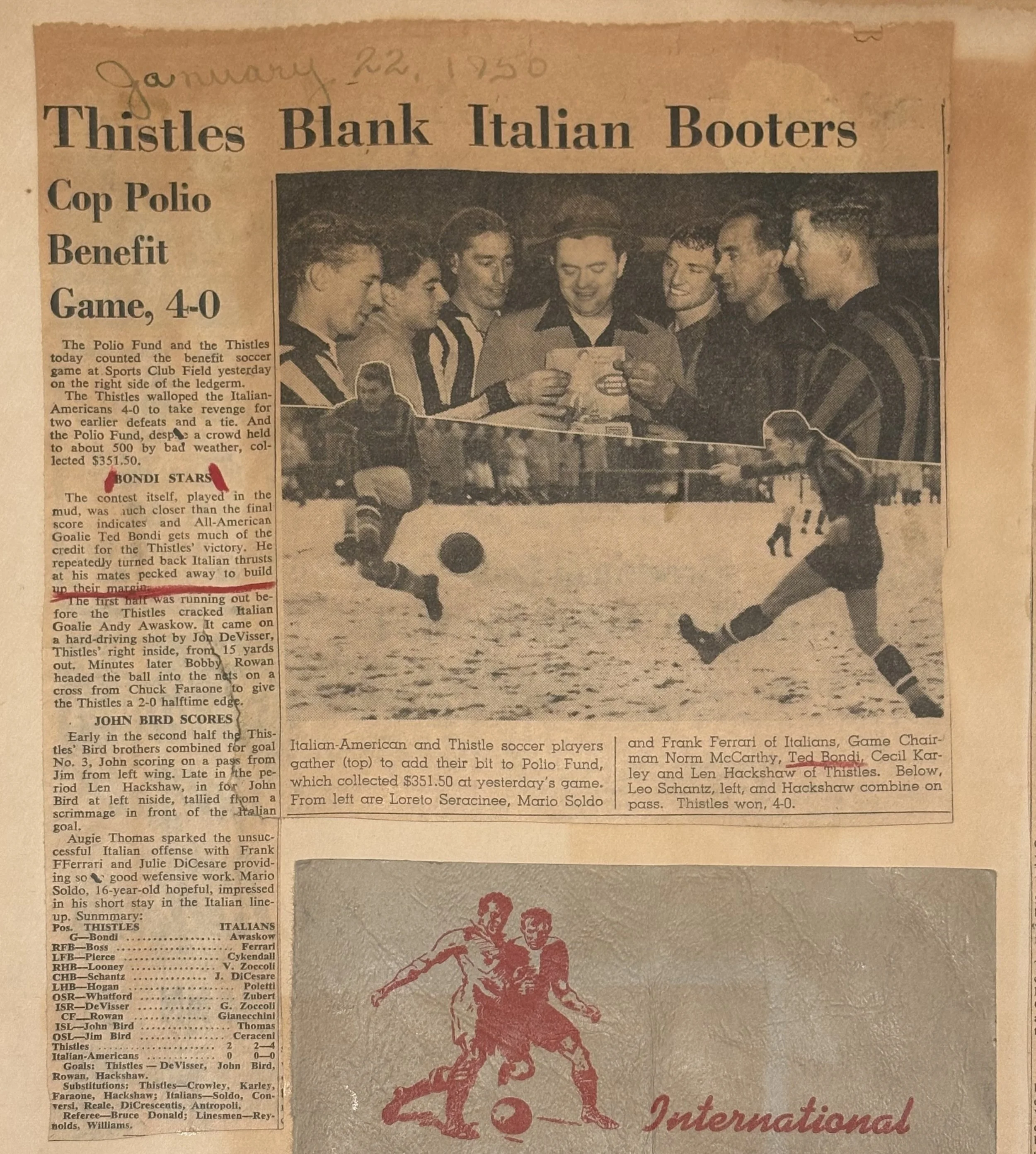
True to his nature, Bondi would kick off 1950 by playing whenever and with whomever he could. In January, Bondi and the Rochester Thistles raised $351.50 (nearly $5,000 in 2026) for the Poli Fund in a muddy matchup against the Italian-Americans. The Thistles won 4-0, but “the contest itself, played in the mud, was much closer than the final score indicates, and All-American Goalie Ted Bondi gets much of the credit for the Thistles’ victory. He repeatedly turned back Italian thrusts as his mates pecked away to build up their margin.”20
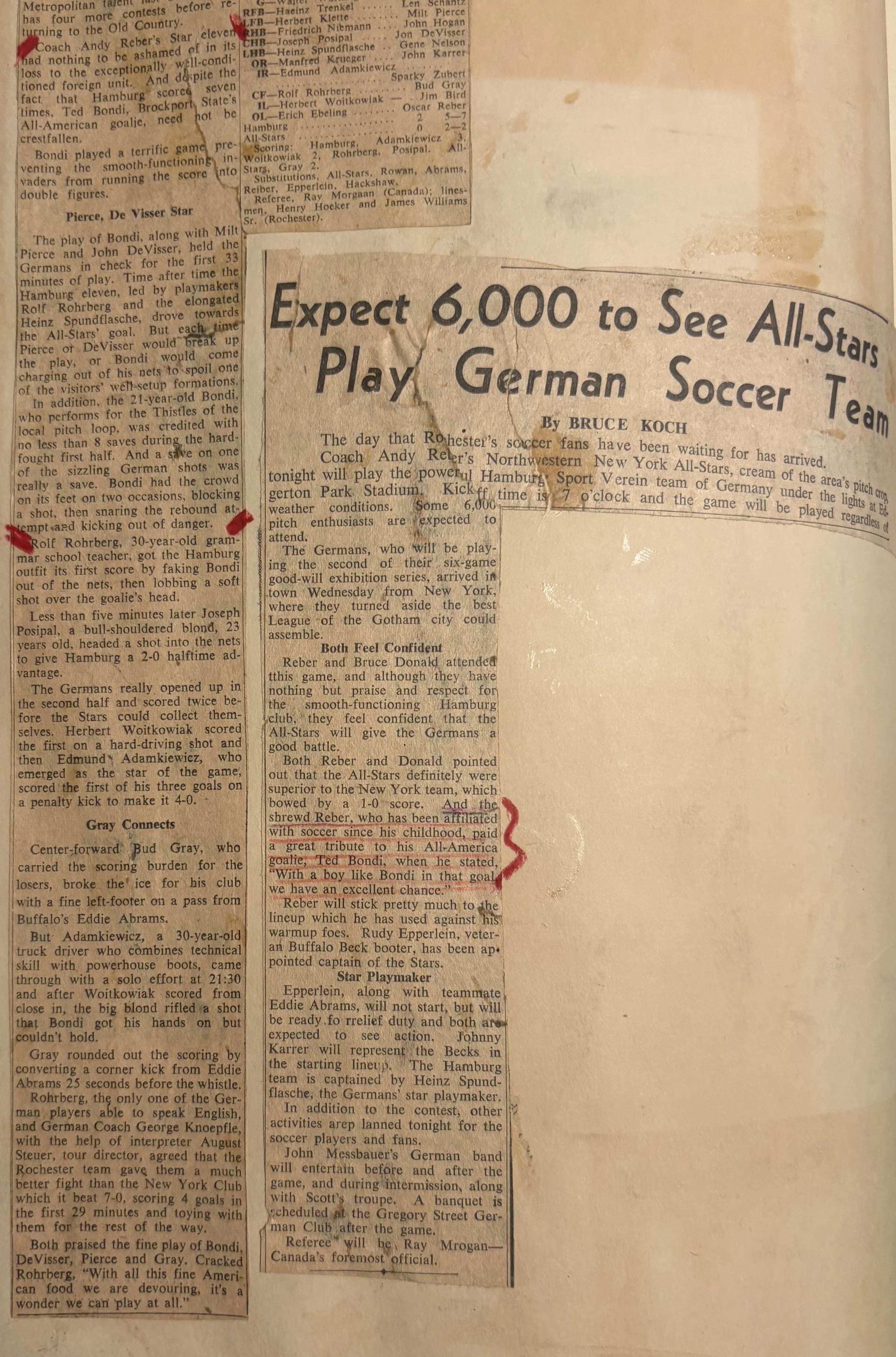
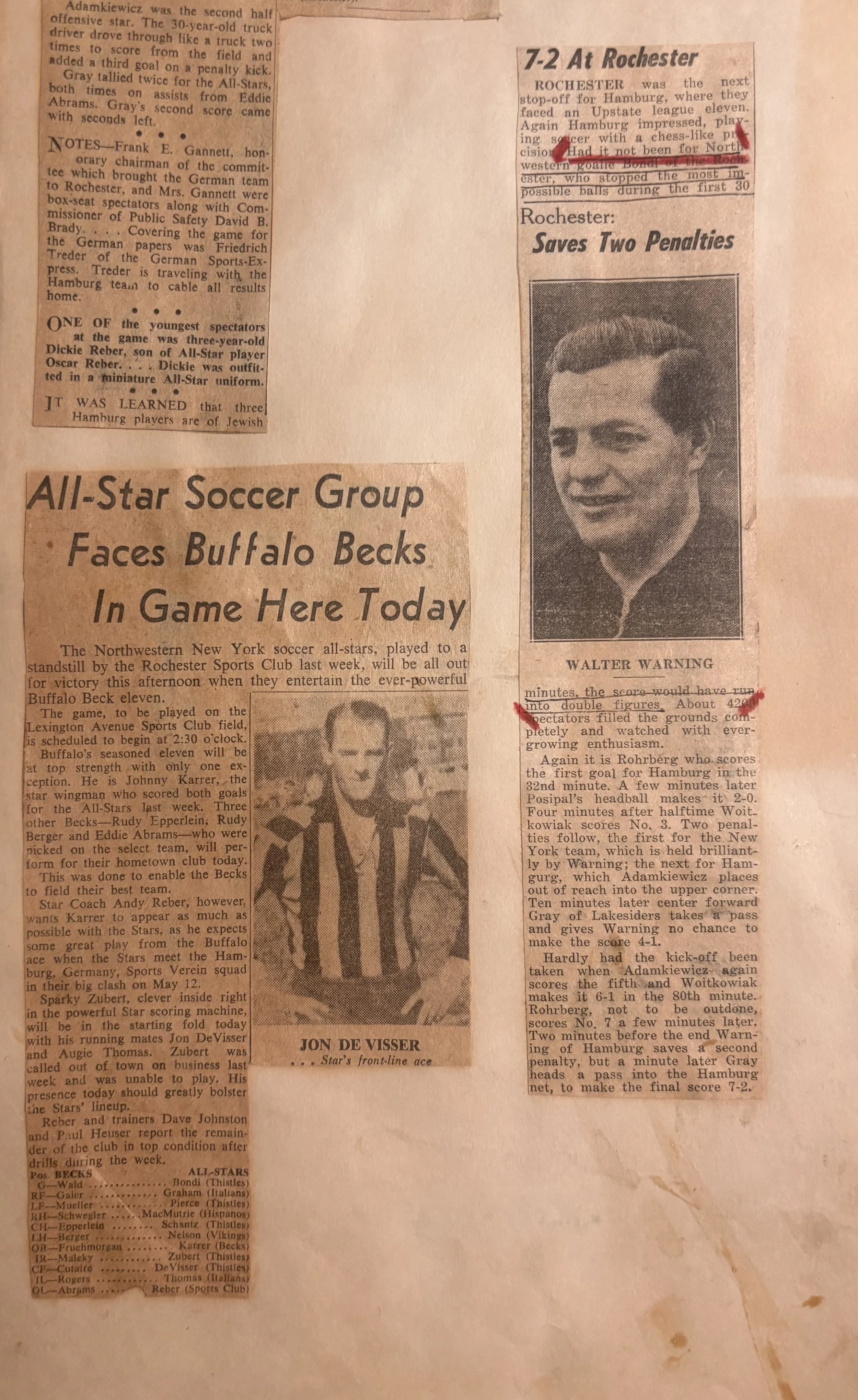
Then on May 12, Bondi received quite possibly one of his greatest compliments. The Brockport goalkeeper was selected to play on a Western New York all-star team against touring German squad Hamburg SV. Hamburg was not only the first German club to tour the United States after World War II, but they were a potent foe for any American or German squad. Hamburg had just steamrolled almost the entire competition in Germany, finishing top of the table in Oberliga Nord with a +62 goal differential, and reached the quarterfinals of the German Football Championship after a 7-0 drubbing of Union 06 Berlin. This was not any ordinary German squad, as Bondi and the all-stars quickly found out.
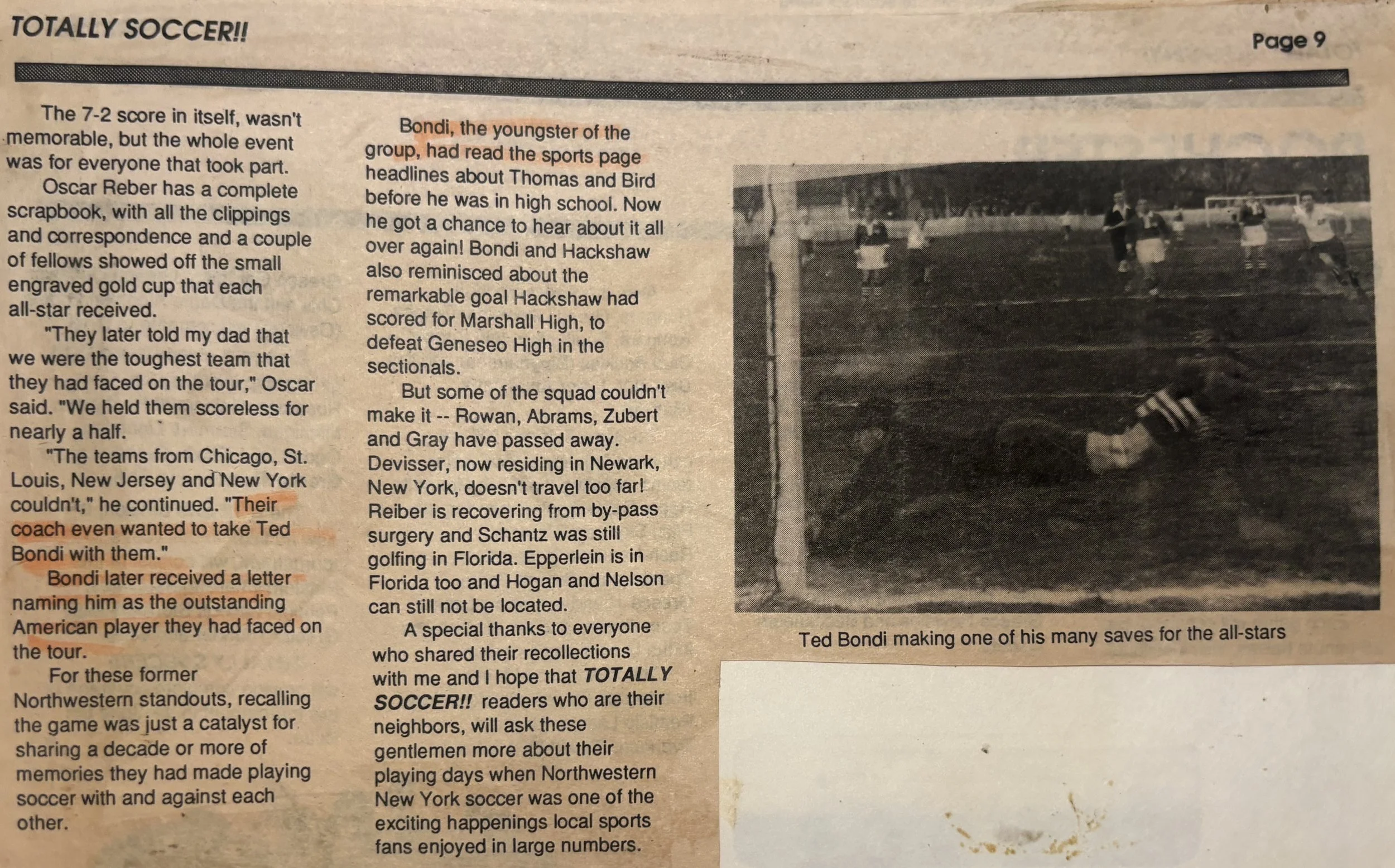
Hamburg’s top players included Josef Posipal and Edmund Adamkiewicz, both featured with West Germany’s national team, as well as Herbert Wojtkowiak, who would promptly score 40 goals in the upcoming 1950/51 Oberliga Nord season. The three players accounted for six of the seven goals scored in the 7-2 win for Hamburg, but not without Bondi making a name for himself. The Times-Union praised Bondi’s efforts, despite the high scoreline, “Now [scoring seven goals] is quite a trick, for Mr. Bondi is today one of the best goalies in the United States-in the opinion of local soccer officials and in the opinion of the Hamburg Sports Verein, which unanimously acclaimed his feats last night... The score could easily have gone into double figures had it not been for the terrific defensive play of Bondi.” Another newspaper praised Bondi for keeping the scoreline down as well, “Again Hamburg impressed, playing soccer with a chess-like precision. Had it not been for Northwestern goalie Bondi of the Rochester [Thistles], who stopped the most impossible balls during the first 30 minutes, the score would have run into double figures. About 4200 spectators filled the grounds completely and watched with ever-growing enthusiasm.”21
Just two years after being turned down by the United States Olympic team, Bondi was now playing with some of the best players in the world and not only being recognized as a top player, but the German coach reportedly wanted Bondi to join their team.11 Despite the US federation overlooking the Genesean, Bondi was rightfully lauded by some of the world’s top players and staff.
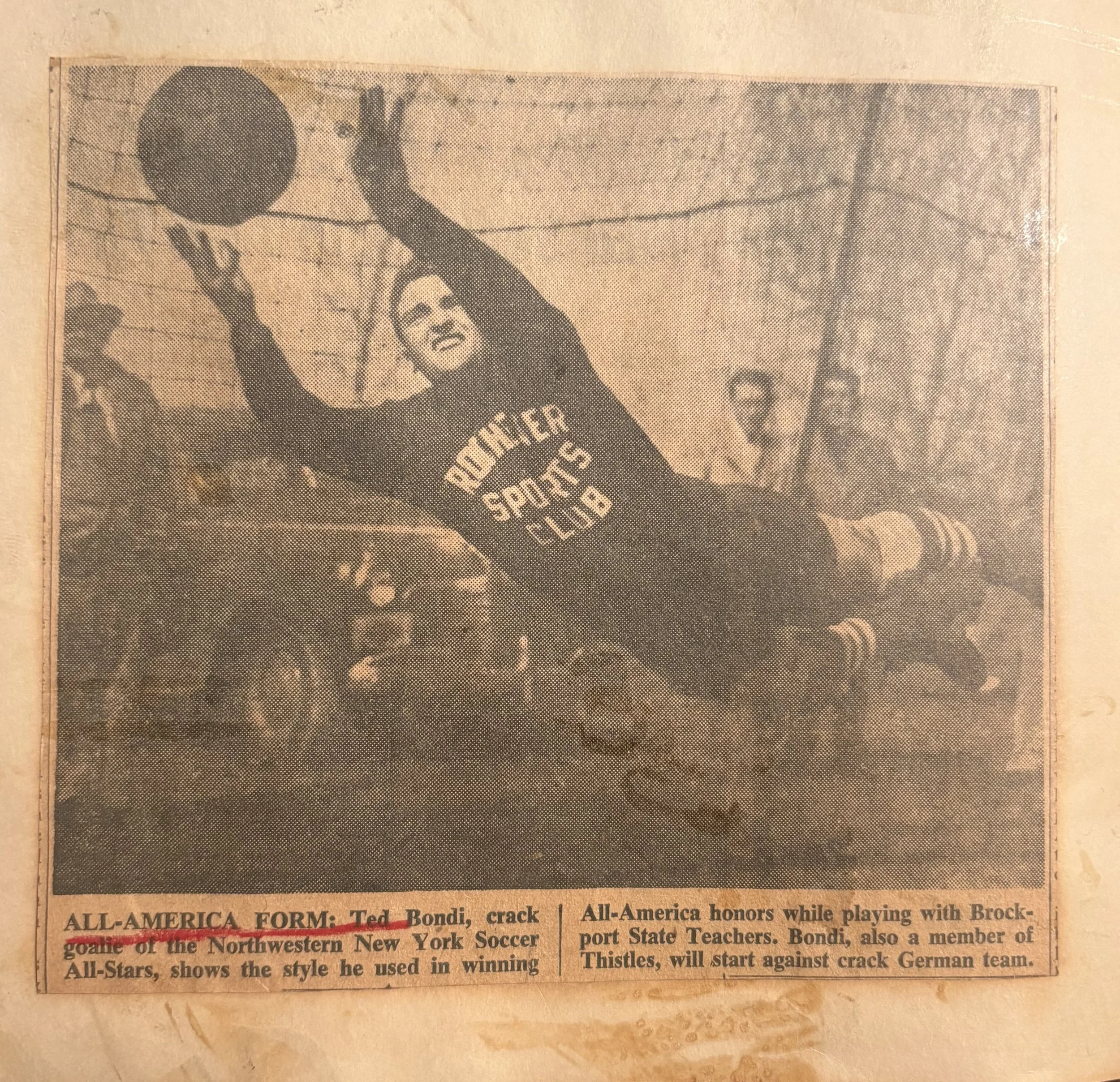
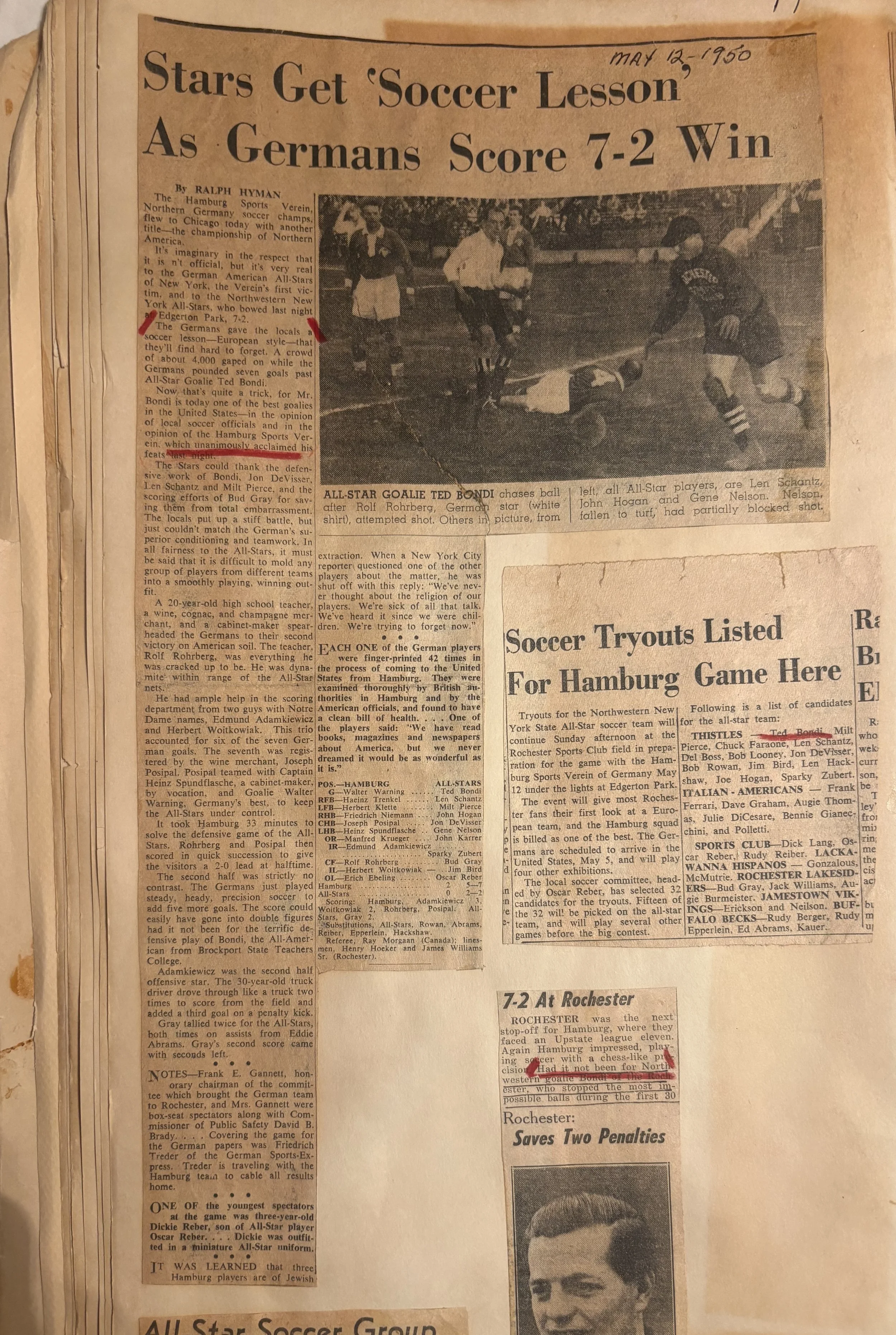
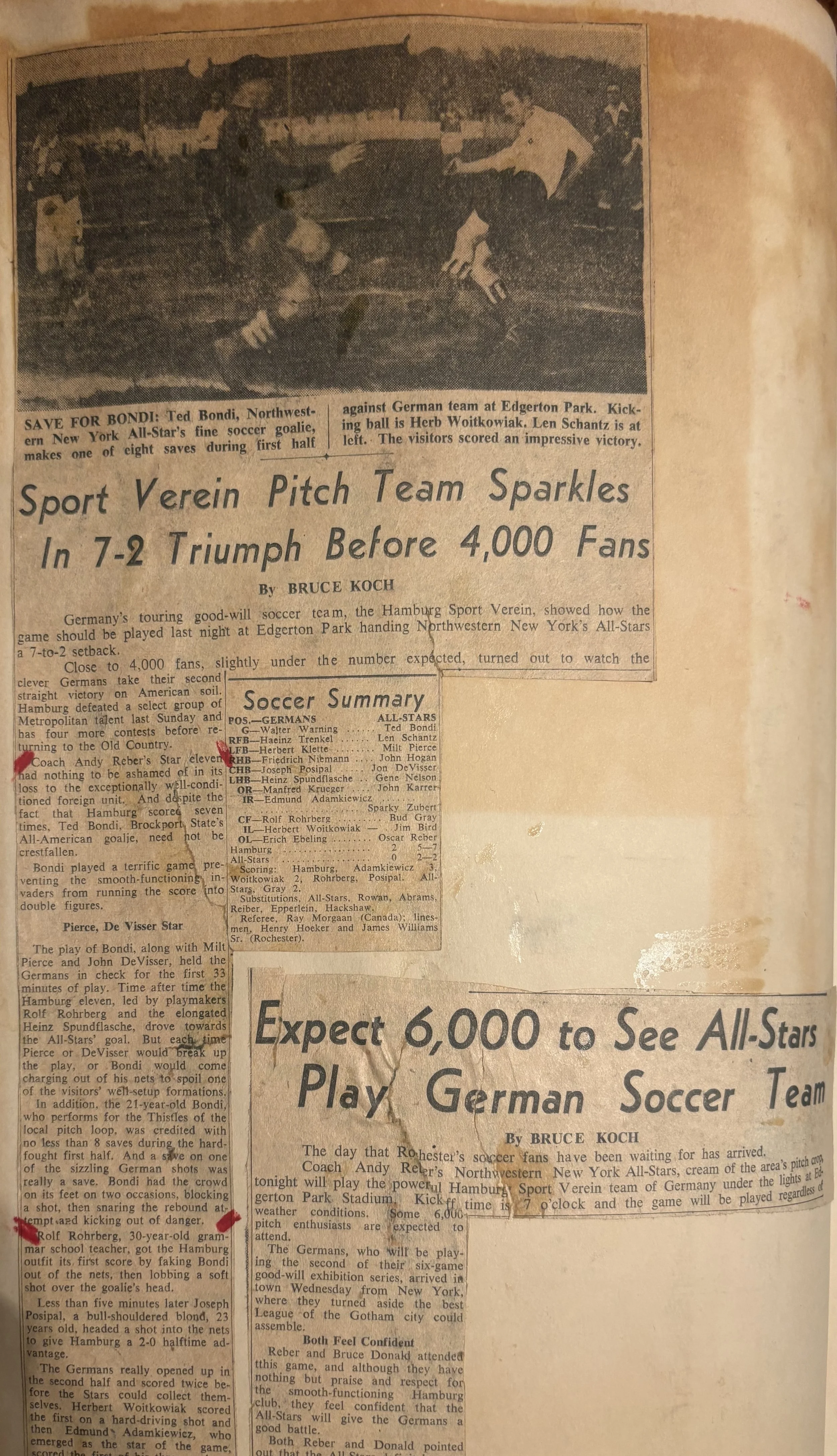
Bondi’s Senior Year: Four in Four
With excellent back-to-back years, it’s understandable that Brockport had some high expectations for the 1950 season. However, the team struggled with the graduation of three-time All-American Howard “Weasel” Whatford in 1949 and seemingly couldn’t quite overcome his absence, as well as mounting injuries throughout the season. After going 14-1-1 over the previous two years, the Golden Eagles fell to 3-2-3 (W-L-T) to cap off Bondi’s time with Brockport. The season started off strong with a 4-0 win over Albany State but Brockport would turn around a day later to drop a difficult 2-0 loss to Rensselaer Poly, a national contender of the era. Yet once again, Bondi’s efforts would not go unnoticed in the loss: “Ted Bondi at goal and left half Don Thompson were outstanding for Brockport in a losing cause.”22
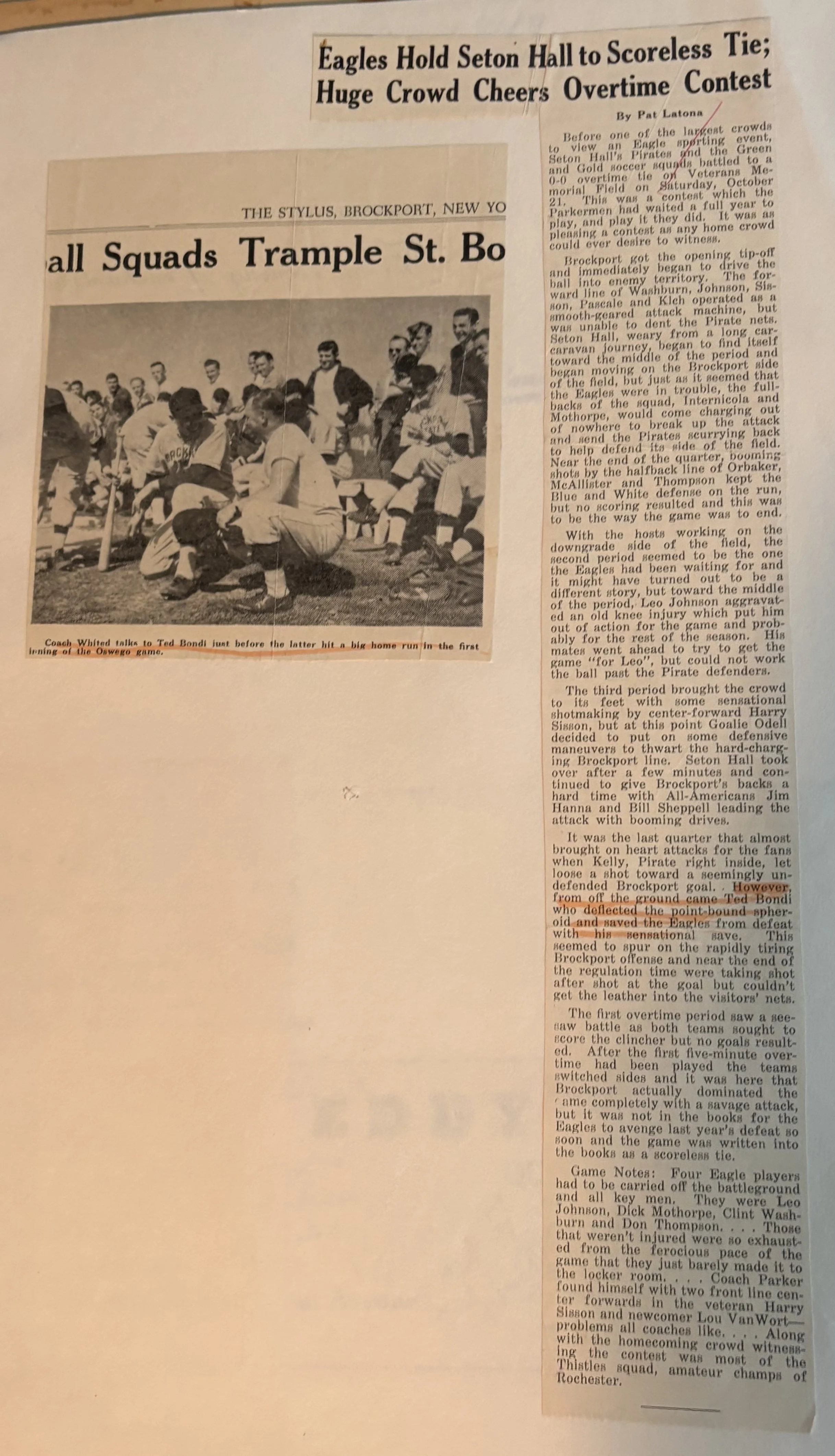
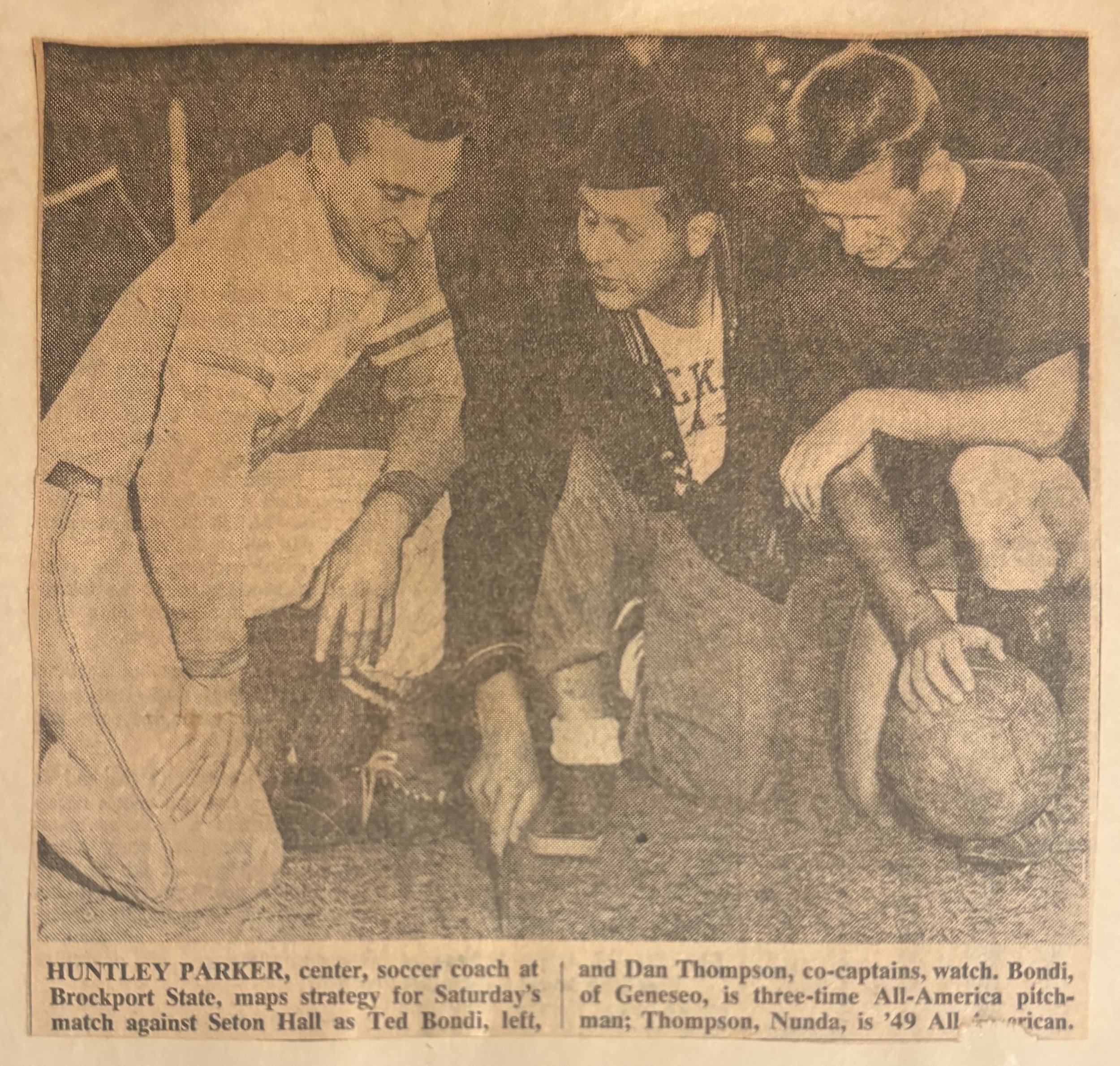
A newspaper clipping from the 1950 contest between Seton Hall and Brockport (right). On the left, a picture from a baseball game against Oswego.
The early loss seems to have derailed the team’s momentum as Brockport squeaked by their next two opponents (2-1 over Oswego and 5-4 over Buffalo State) before tying the next three matches and losing the final match of the season, scoring only four goals in the final four matches of the season. Brockport’s season felt like it was akin to rolling snake eyes repeatedly, as even their last four matches all went to double overtime, but the offense just couldn’t break the deadlock.
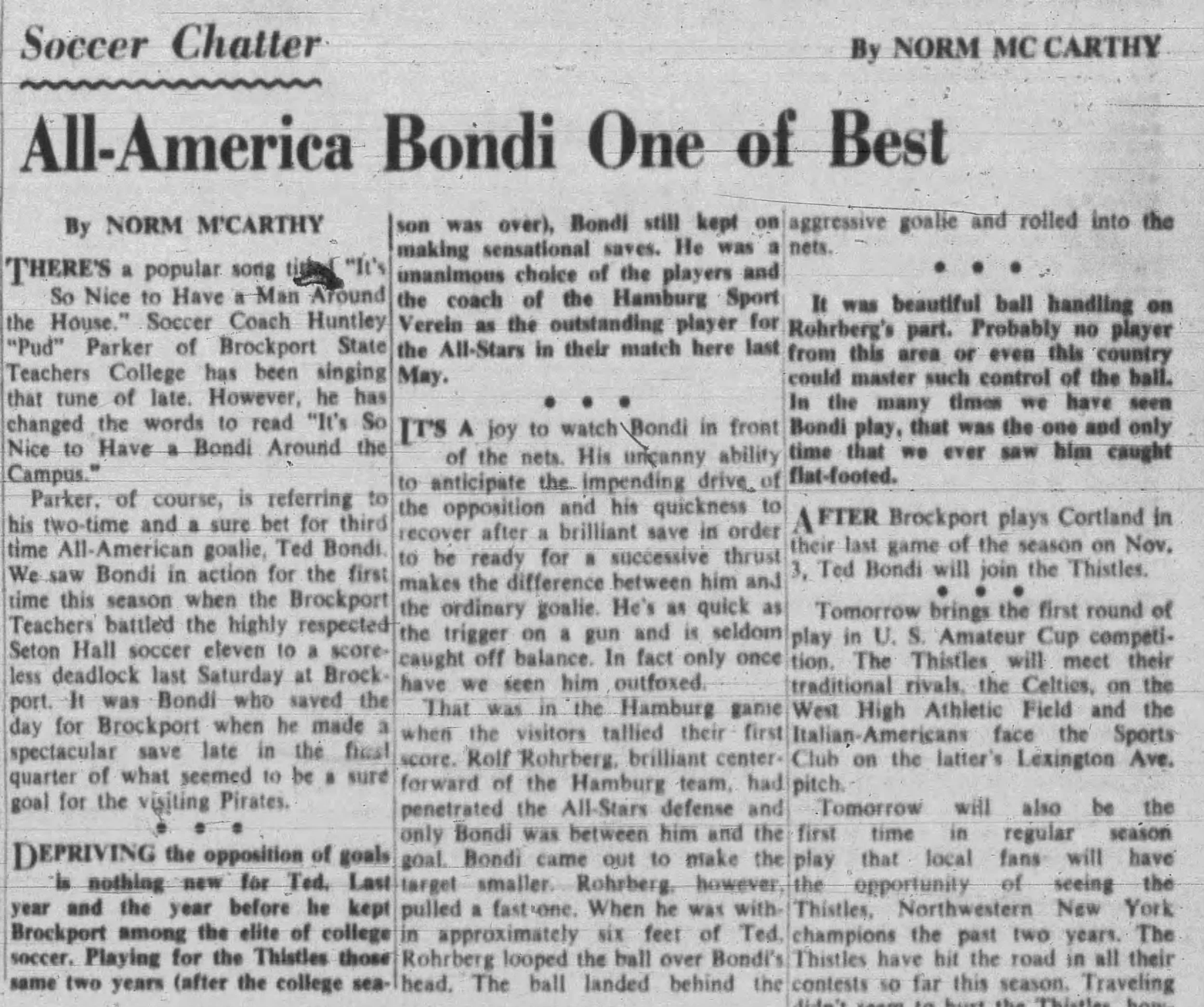
Despite struggling to notch their expected number of wins, Bondi would still receive compliments for his performance in net. Against Seton Hall, in a 0-0 tie, “Seton Hall was robbed of what looked like a sure goal midway through the fourth quarter when Brockport's All-American goalie, Ted Bondi, made an outstanding save of the shot that was earmarked for the net from the time it left the toe of Seton Hall Forward, Johnny Kelly.”23 The fierce battle led to many players being carried off the field, yet the Eagles were given life from the homecoming crowd, which featured most of Bondi’s teammates from “the Thistles squad, amateur champions of Rochester”.24 Seton Hall’s all-star player, Bill Sheppell, would go scoreless against Bondi in his two matchups, as Bondi was no stranger to rising to the occasion against a strong opposition.
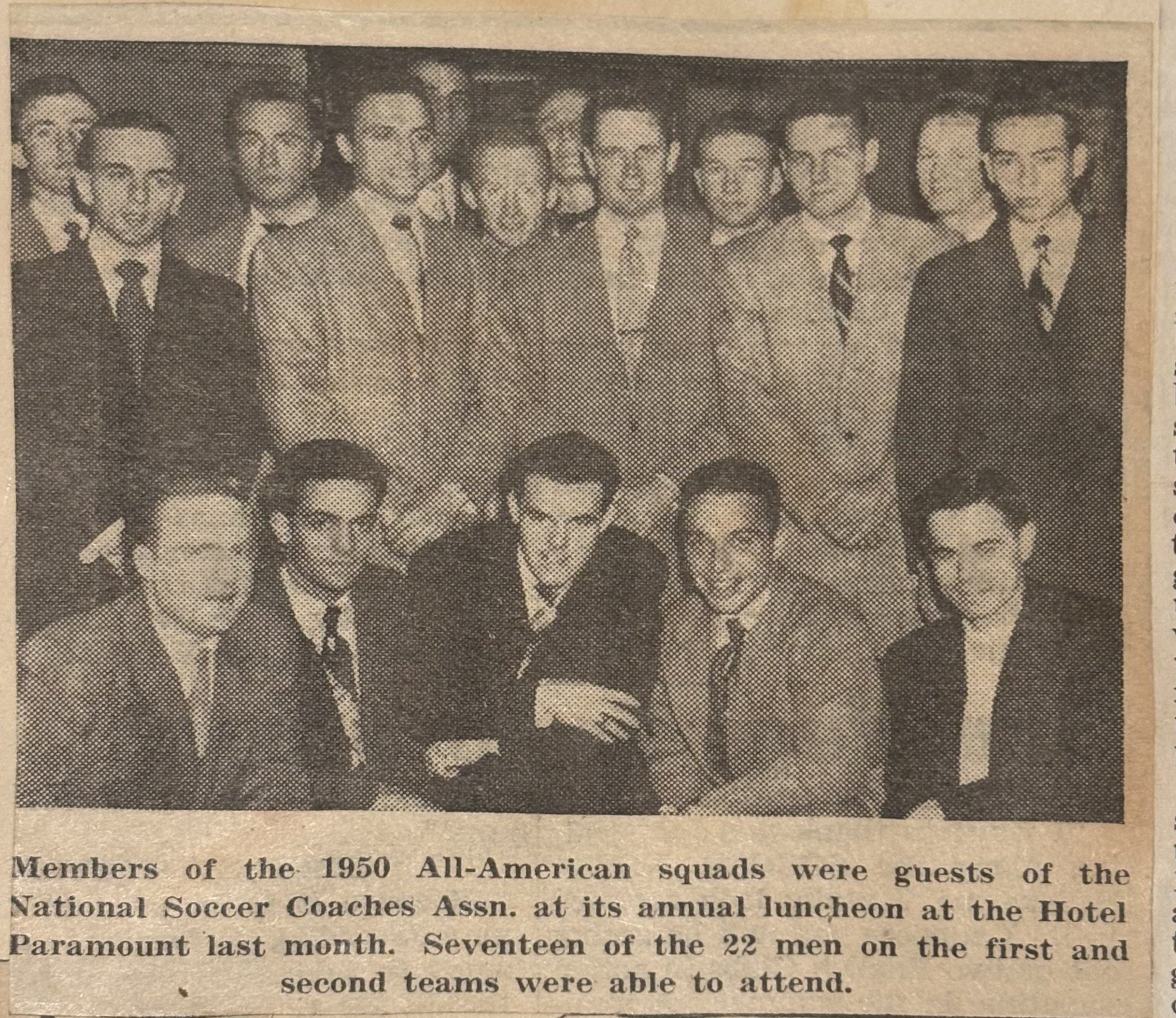
On November 3, 1950, Bondi played his last game with Brockport in a 2-1 loss to Cortland. However, the disappointing final chapter of his collegiate run didn’t stop Bondi from capturing more hardware for his trophy case. Most notably, Bondi captured his fourth All-American award, placing him into an elite category. Across all years of collegiate soccer, there have been nine goalkeepers who won three All-American awards (including Kasey Keller, Winston DuBose, Andre Blake, and J. Crossan Cooper), yet just one goalkeeper who has won four All-American awards: Ted Bondi.
In reflection on Bondi’s time with Brockport, Norm McCarthy wrote in the Times-Union, “It's a joy to watch Bondi in front of the nets. His uncanny ability to anticipate the impending drive of the opposition and his quickness to recover after a brilliant save in order to be ready for a successive thrust makes the difference between him and the ordinary goalie. He's as quick as the trigger of a gun and is seldom caught off balance."25
Bondi finished his collegiate career with a 77% win percentage and 16 shutouts and helped elevate the new program to the equivalent of a modern day top 10 side, as well as paving the way for Brockport to be awarded the 1955 National Championship.26
Life After Brockport
Bondi rejoined the Thistles in mid-November to capture the Northwestern New York State Championship over the Buffalo Becks. On November 19th - less than three weeks from his last game with Brockport - Bondi kept a 2-0 shutout against the Becks in the first of a home-and-home series. On November 26, 1950, Bondi captured another shutout in a 3-0 win to cement the Thistles as the area champs, marking their third successive year in capturing the trophy.
The Thistles returned to Open Cup play on December 3rd against Rochester Sports Club in a match with ankle-high mud, a fractured leg for Thistle left fullback Milt Pierce, and a 2-2 draw that prompted a replay to decide who would move on to the Western US Division Championship. A week later, the Thistles lost a 2-1 lead with a handball in the final eight minutes (culminating in a converted penalty) and a poor turnover by the Thistle defense, leading to a close-range shot for the final goal against Bondi to take a 3-2 win over the Thistles.
Bondi played with the Thistles in the Inter-City Soccer League through the spring of 1951, as well as featuring in another exhibition match-up against a German side (this time Eintracht Frankfurt) during the middle of his final baseball season with Brockport.27 In the fall, Bondi headed south to start his graduate degree in physical education at the University of North Carolina.
Despite the change in scenery, the near-lifelong New Yorker still circled back to the sport he had excelled so greatly at by coaching UNC’s freshman team. The young Tar Heels went 9-0, not conceding a single goal across their entire season. Bondi finished his degree over the two semesters at North Carolina, helping out with the swimming, baseball, lacrosse, and tumbling programs.
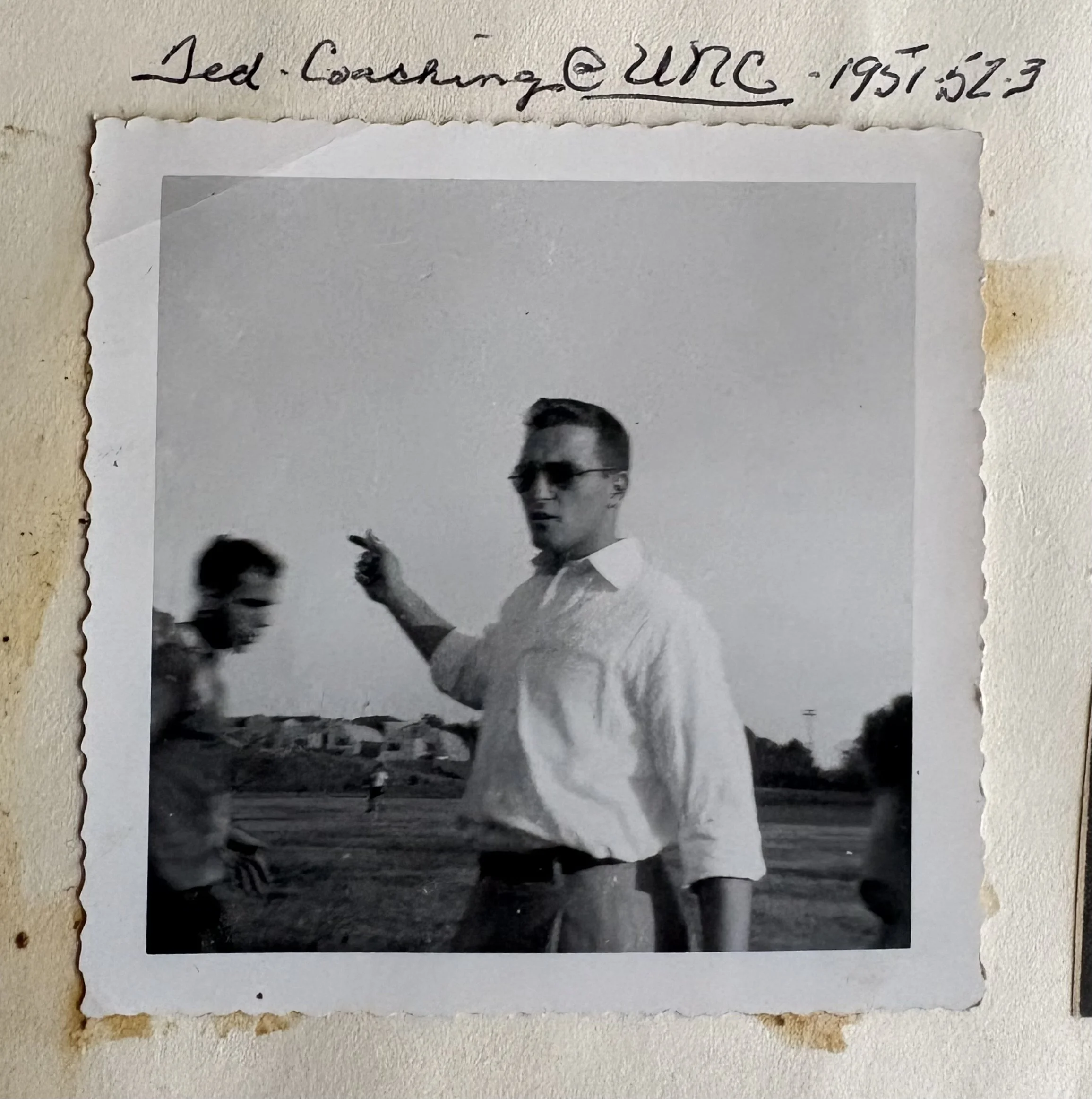
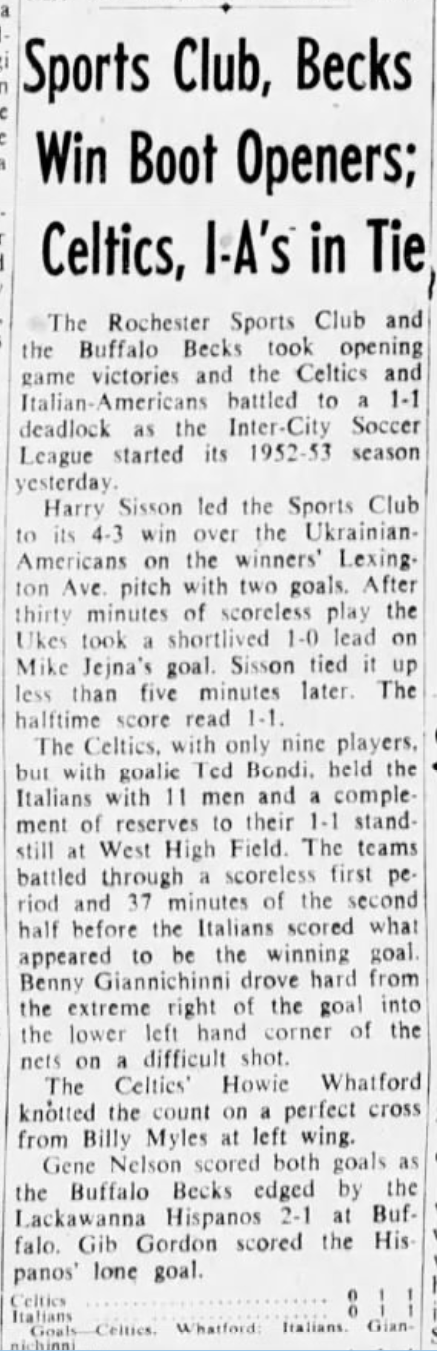
After a year at UNC, Bondi enlisted in the Air Force and returned to the Rochester area to briefly join the Rochester Celtics for the start of their 1952-53 season. In the Celtics’ first Inter-City Soccer League match, they could only field nine players, but with Bondi in net, the Celtics held the opposing Italian-Americans to a 1-1 tie in their opening match on September 14, 1952. A couple of weeks later, the Democrat and Chronicle praised Bondi for “again playing a whale of a game, including a save of a Sports Club penalty kick” in a 7-1 win in late September.28
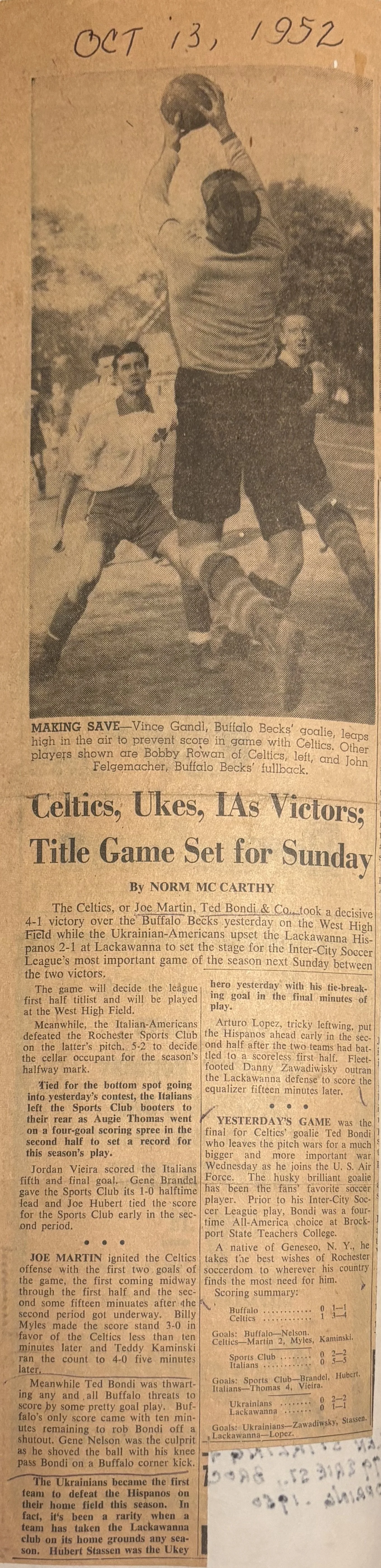
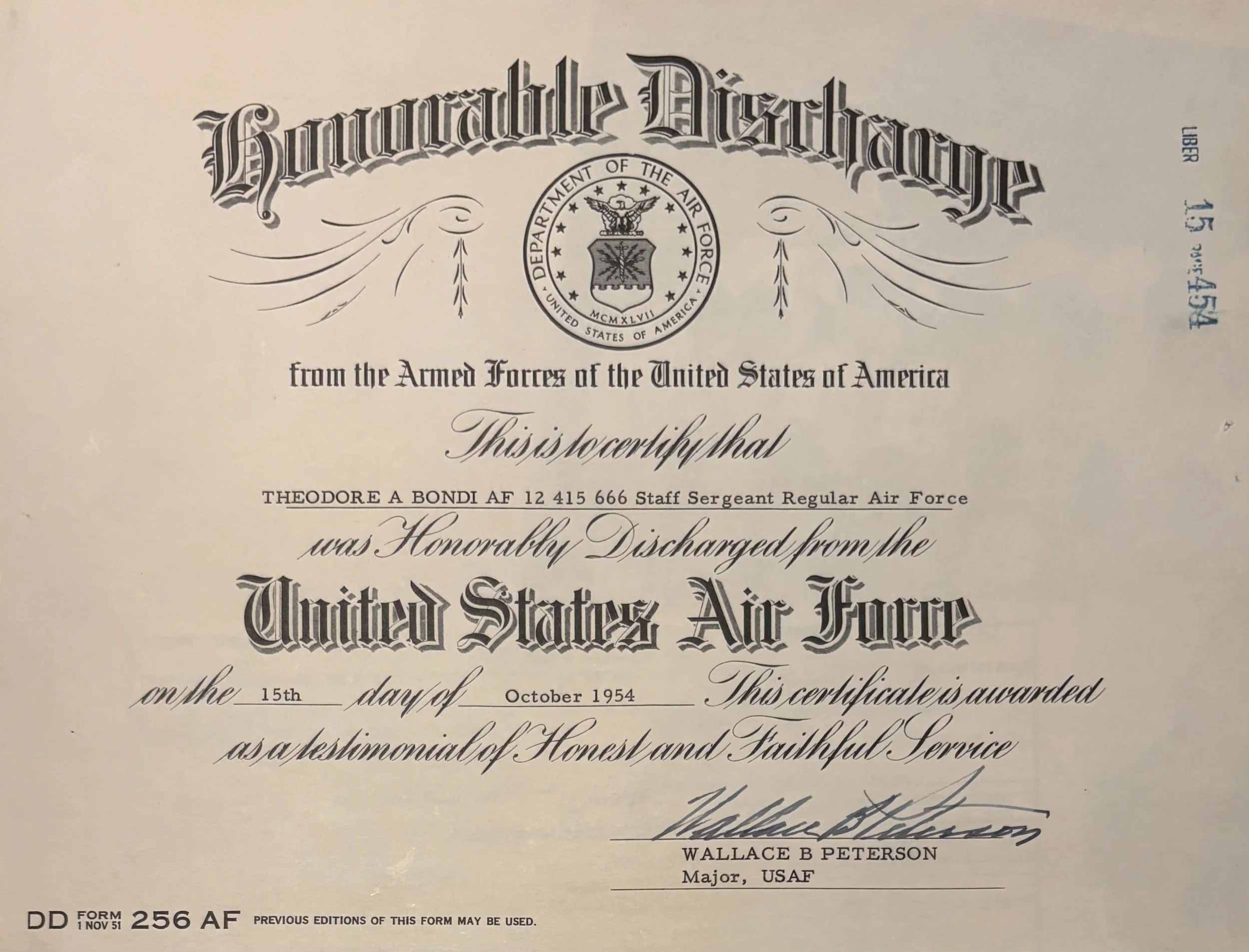
It was a short stint with the Celtics, as mid-October proved to be his last time with the team before joining the Air Force after a 4-1 win over the Buffalo Becks, where Bondi “thwart[ed] any and all Buffalo threats to score by some pretty goal play… [the match] was the final for Celtics’ goalie Ted Bondi who leaves the pitch wars for a much bigger and more important war Wednesday as he joins the U.S. Air Force. The husky, brilliant goalie has been the fan’s favorite soccer player… A native of Geneseo, N. Y., he takes the best wishes of Rochester soccerdom to wherever his country finds the most need for him.”29
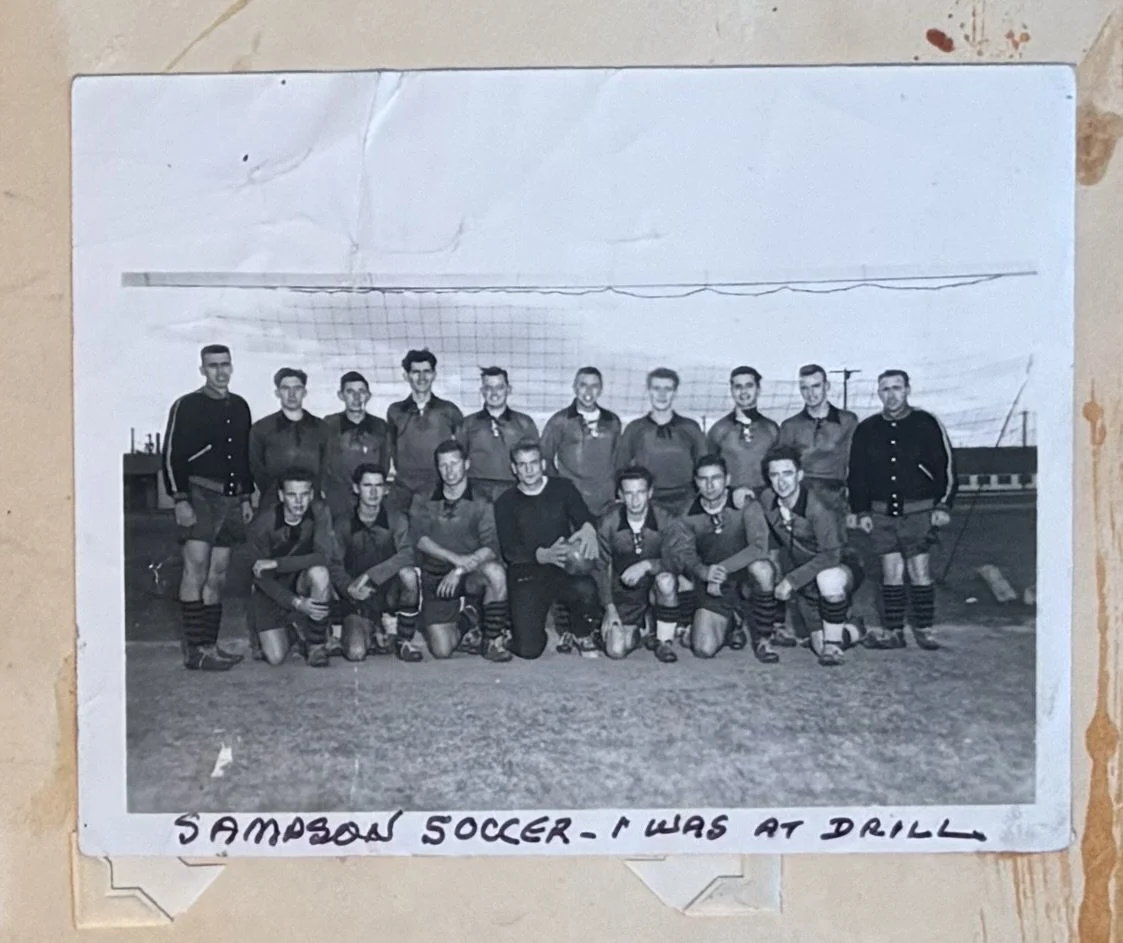
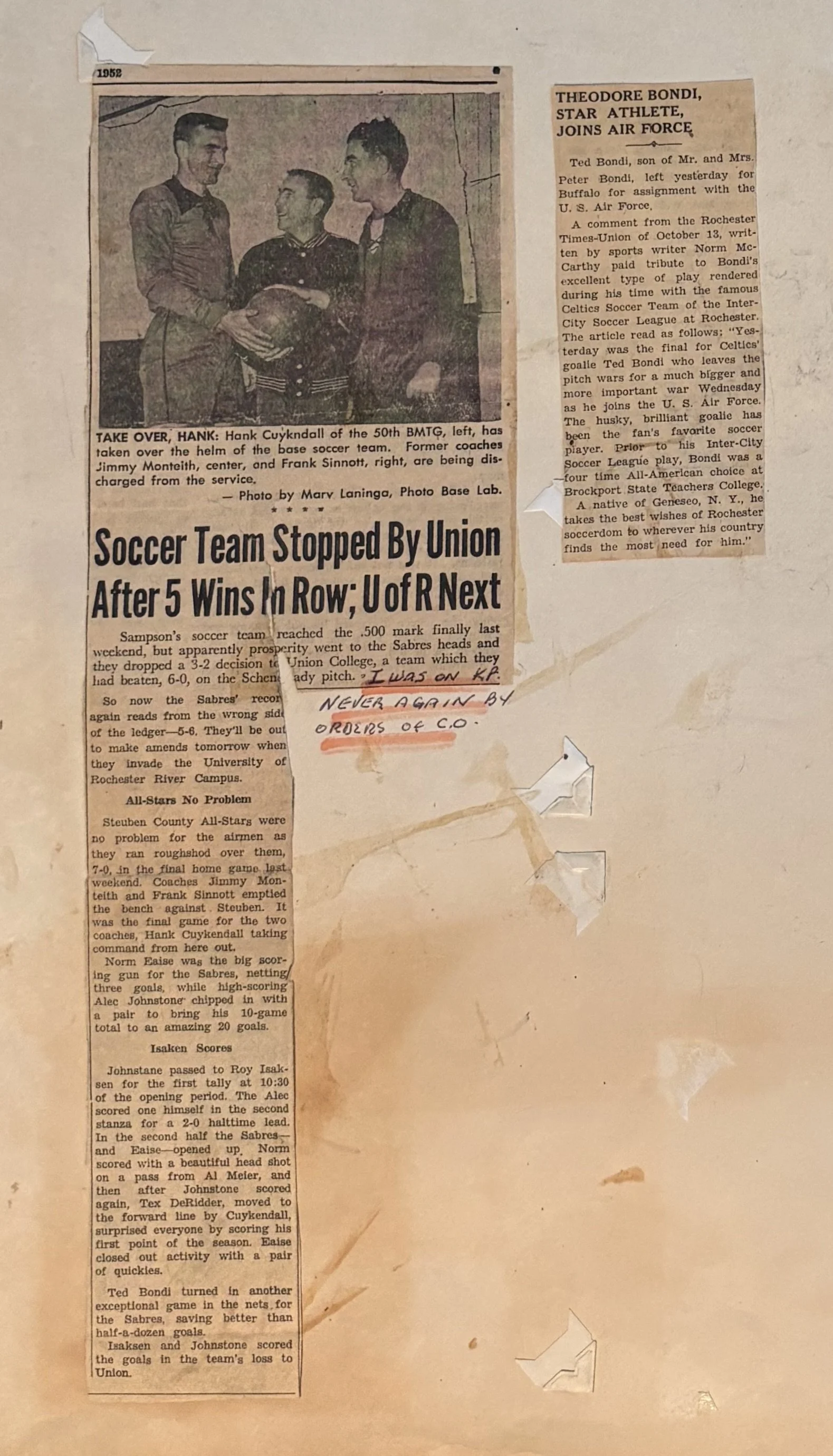
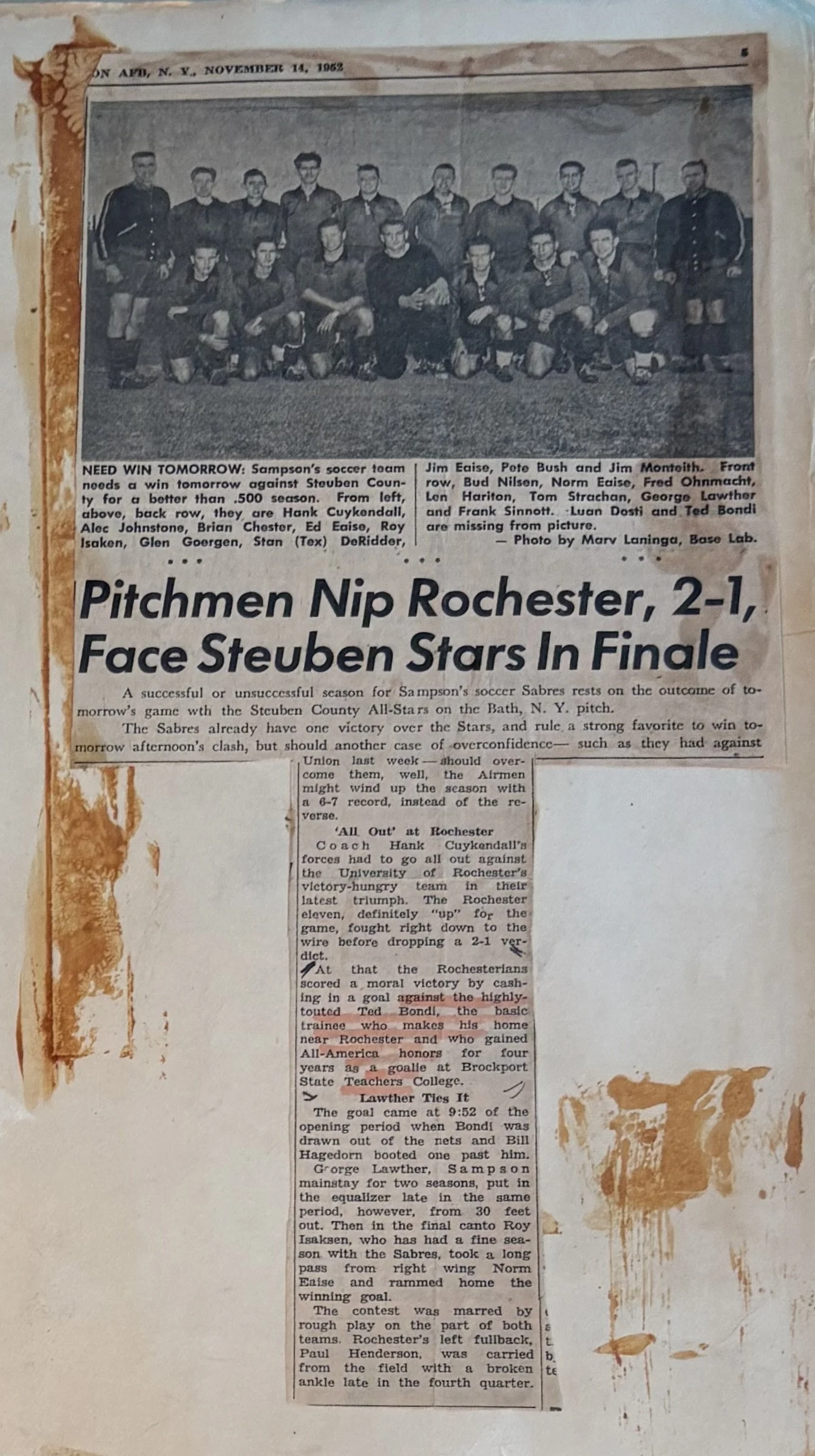
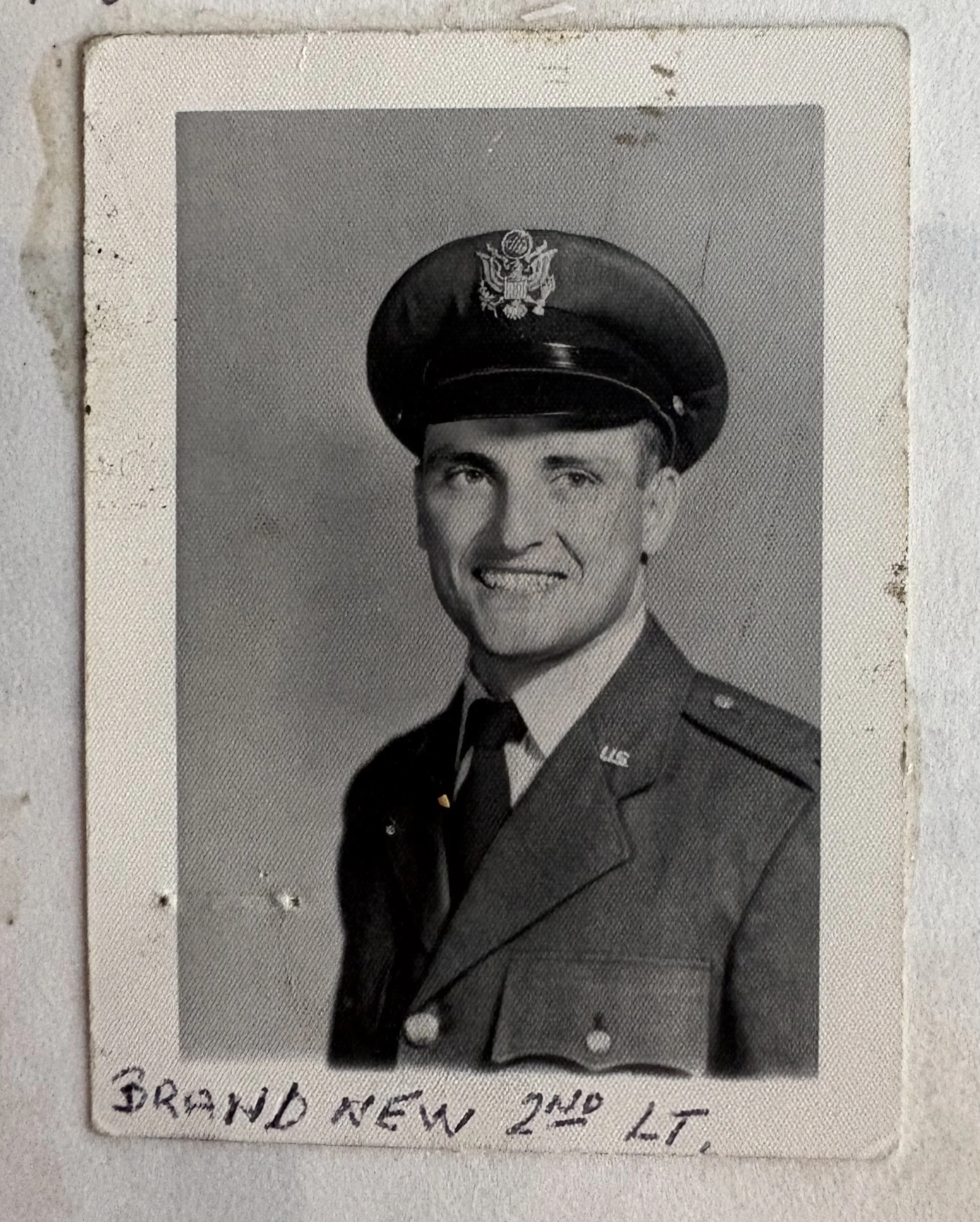
Being enlisted didn’t stop Bondi from playing whenever he could. On October 25, 1952, the Sampson Air Force Base soccer team topped Union College 6-0. Union’s offense “was stymied by the stellar work of the Sabres’ goalie, Ted Bondi”. A later matchup in the season featuring the same sides resulted in a 3-2 win for Union, with a personal note written next to the article in Bondi’s scrapbook explaining the loss, “I was on KP. Never again by orders of C.O.”30
Sampson topped the Steuben County All-Stars 7-0 as “Bondi turned in another exceptional game in the nets for the Sabres, saving better than half-a-dozen goals.” Bondi followed up the performance and led the team to a 2-1 win over the University of Rochester the following month as well.31
Although Brockport would face the Sampson AFB squad each year from 1951-1955, Bondi narrowly missed all the matchups against his alma mater, including Brockport’s 1955 National Champion squad. Joe Boorish, who played at Brockport from 1955-1958, recounts Bondi’s lasting legacy: “I played there from 1955 to 1958. The ’55 team was national champs yet all we heard about were the exploits of former goalkeeper Ted Bondi.”32
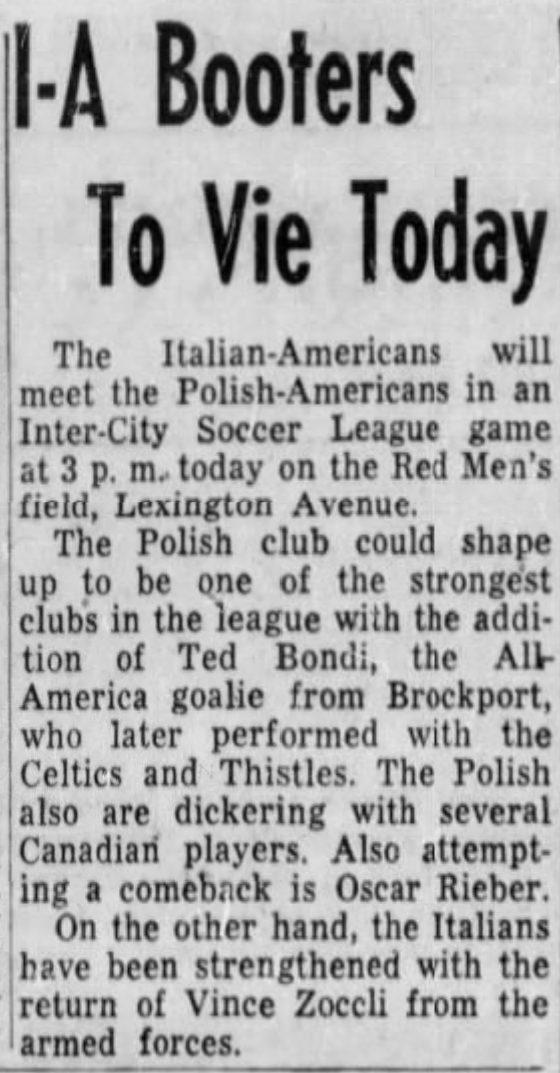
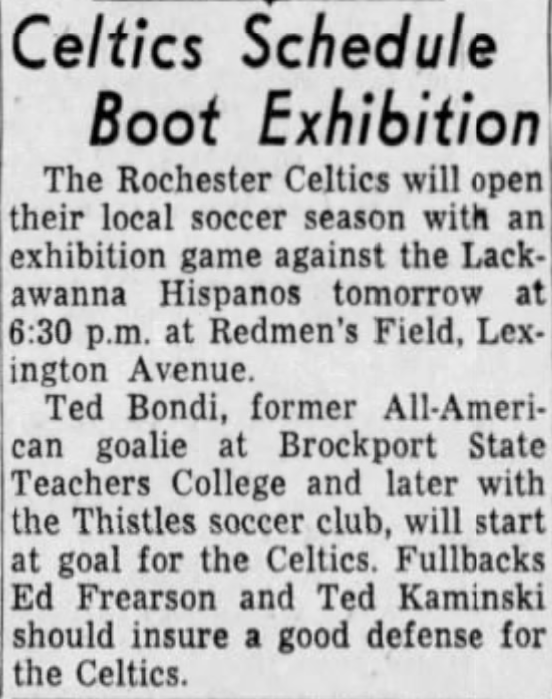
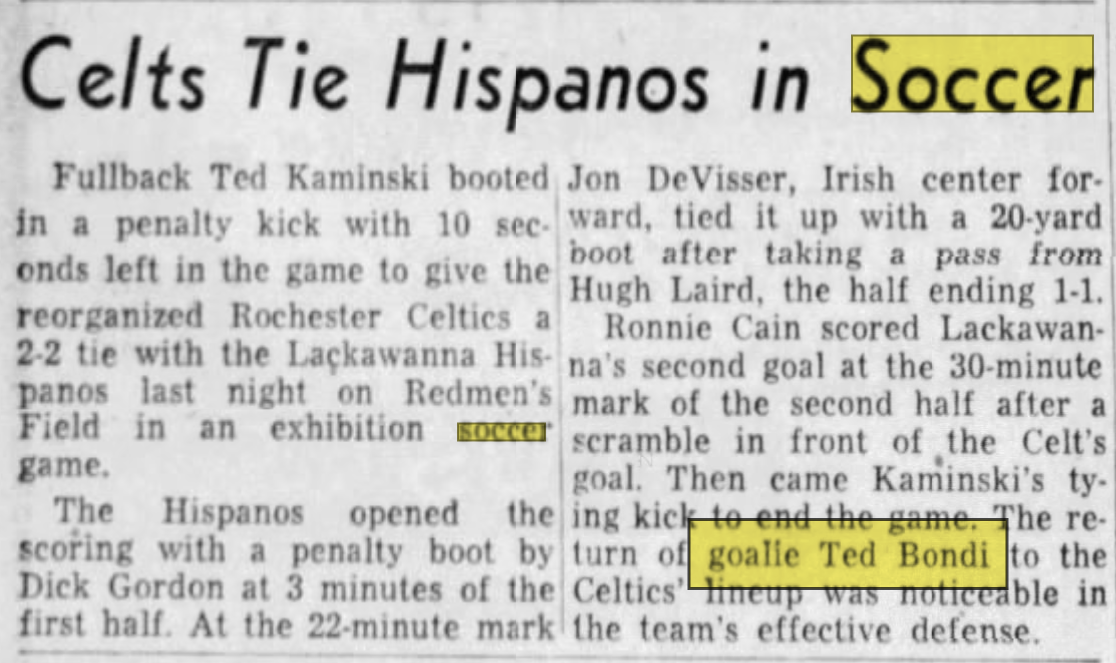
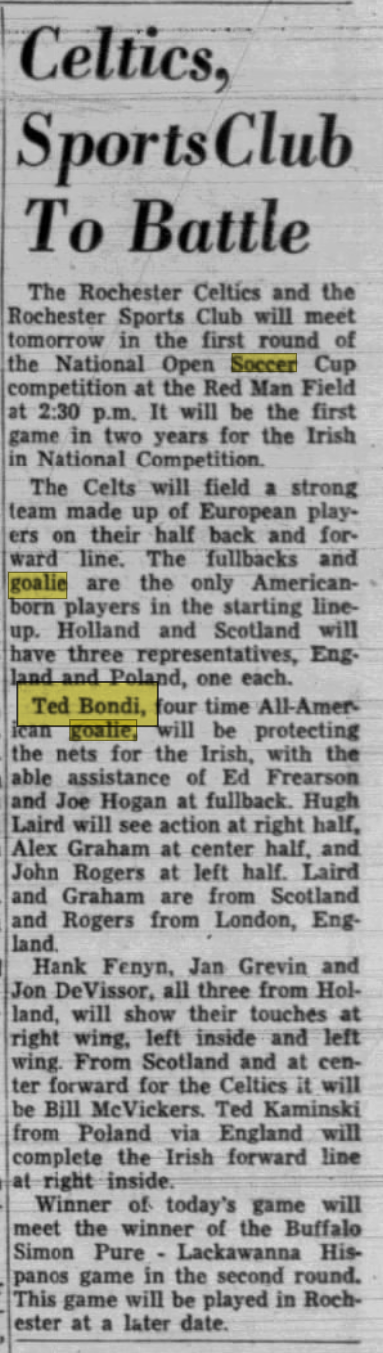
Bondi was honorably discharged in late 1954, and the following year seems to be Bondi’s last time in goal. In April, Bondi was reported with the Polish-Americans in both Inter-City Soccer League play, as well as the Northwestern New York State Soccer Cup Championship. Once again, the two All-American teammates of Bondi and Whatford were on the same side. But in August, Bondi was back with the Celtics in what looks like both Bondi’s and Whatford’s last season on the field together. But despite taking time off from regularly playing, Bondi would still be cited as having a positive impact on his team: “The return of goalie Ted Bondi to the Celtics’ lineup was noticeable in the team’s effective defense.”33
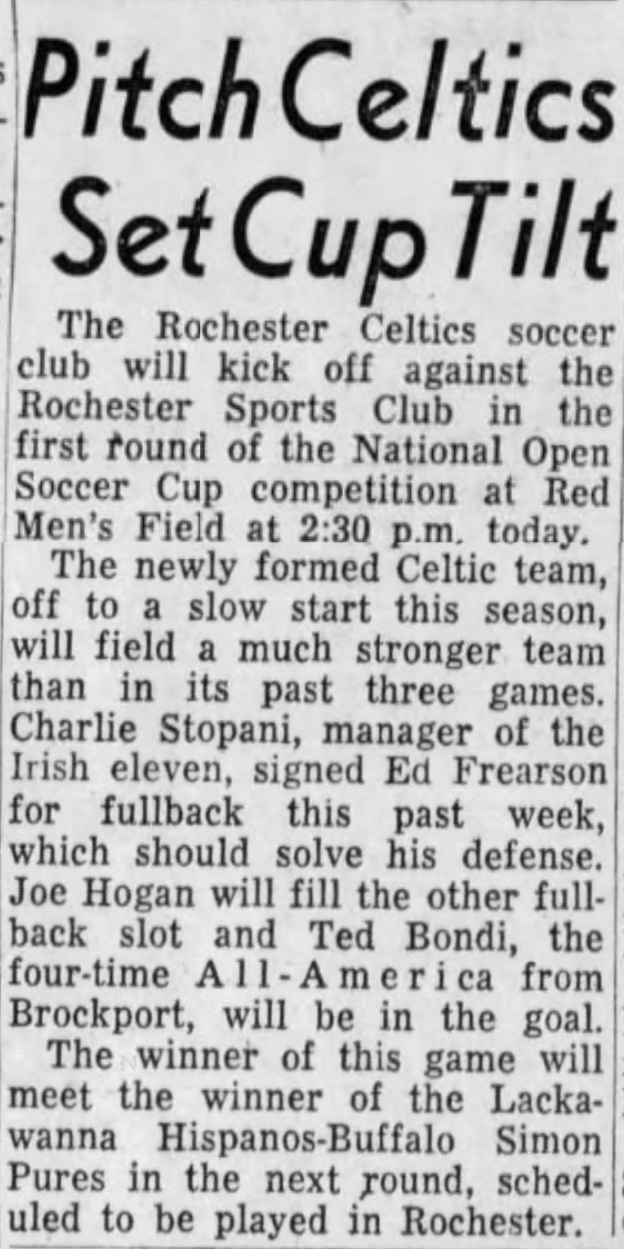
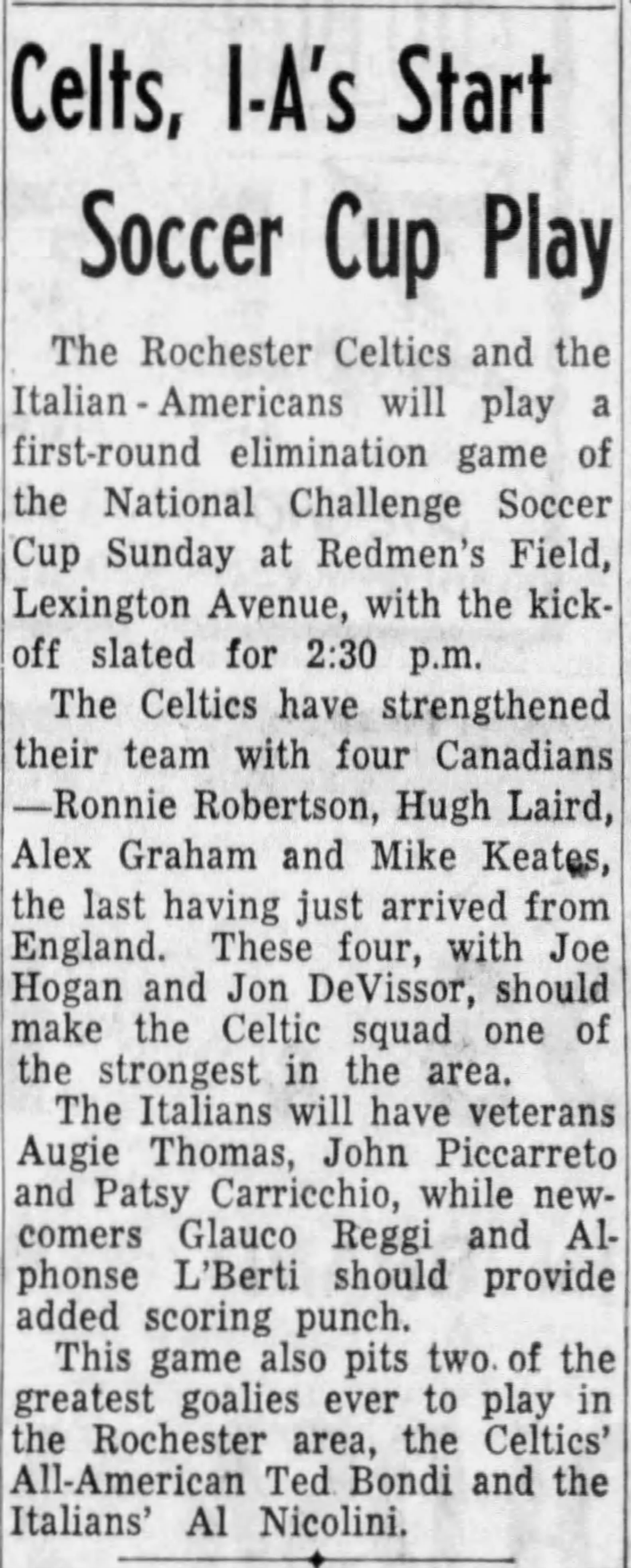
Bondi’s last recorded appearance in goal seems to be October 30, 1955, when the Rochester Celtics lost 1-0 to the Italian-Americans in the first round of the National Amateur Cup at Red Men's Field. The game was hyped as a defensive battle just days prior: “This game also pits two of the greatest goalies ever to play in the Rochester area, the Celtics' All-American Ted Bondi and the Italians' Al Nicolini.”34
However, as one chapter ended, another one began for Bondi. With 1955 being the last year he played, 1956 marked the start of his relationship with Mary Loud Darling, his future wife. Mary Lou recalls Bondi’s most outstanding qualities: “Confidence. He never thought anything was impossible. *laughs* He instilled that in his players when coaching. He was diplomatic and charming. Very enthusiastic. Any of those positive words you can think of, he fit into that slot.”2 Ted and Mary Lou would marry a few years later and raise four daughters in Geneseo who, unsurprisingly, wound up playing soccer and volleyball for Geneseo High.2
Lasting Impact and Continued Recognition
For most athletes, their story typically quiets down once they retire, but not for Ted Bondi. The length of this article could easily be increased tenfold if it simply discussed Bondi’s accomplishments once returning to Geneseo. With his playing days being a thing of the past for the 26 year old, Bondi quickly returned the town’s investment in him as he coached the football, basketball, wrestling, and baseball programs at Geneseo, in addition to being a science teacher.
Unfortunately, the school ended its boys’ soccer program in 1948, in favor of the school adding football, and it wouldn’t be until 1979 that the boys’ team would officially return. With Bondi’s efforts in the community, soccer fever once again blossomed, and he coached the first team back, while also serving as the school’s Athletic Director at this point.
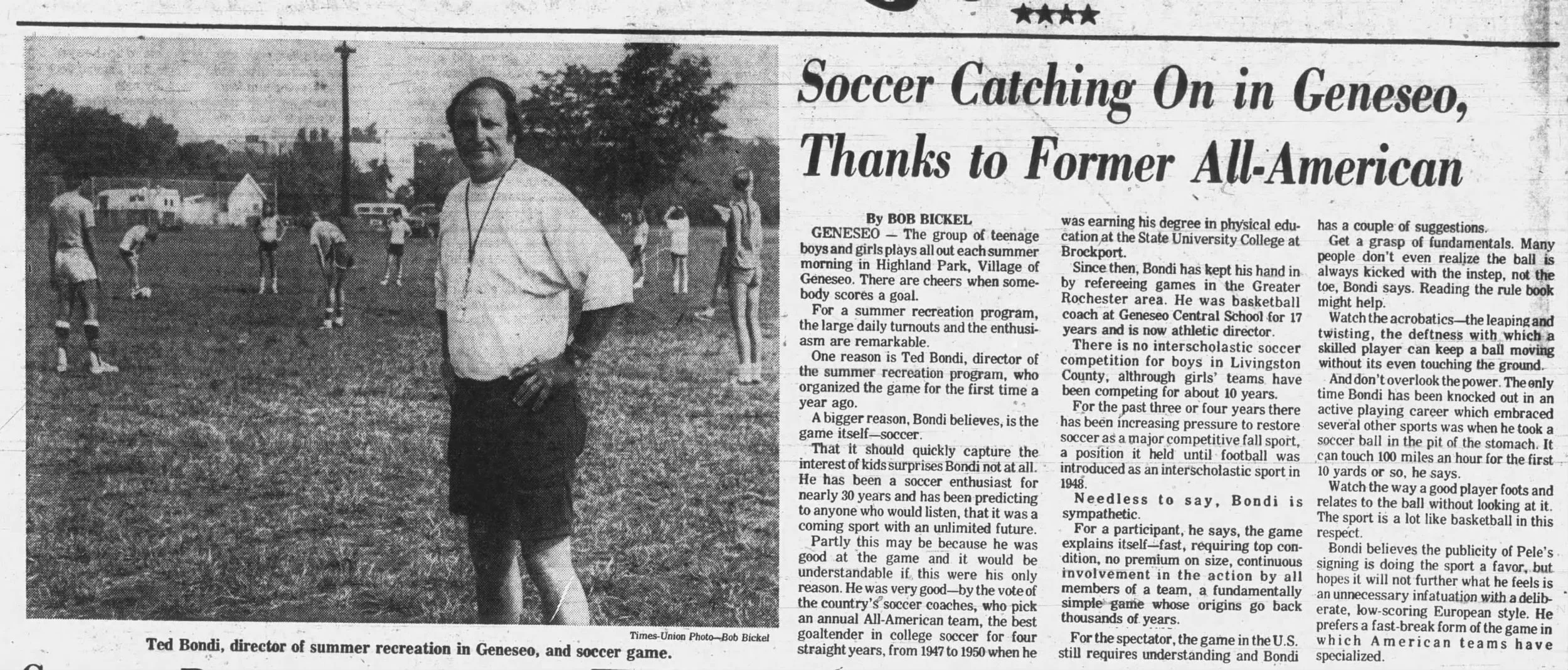
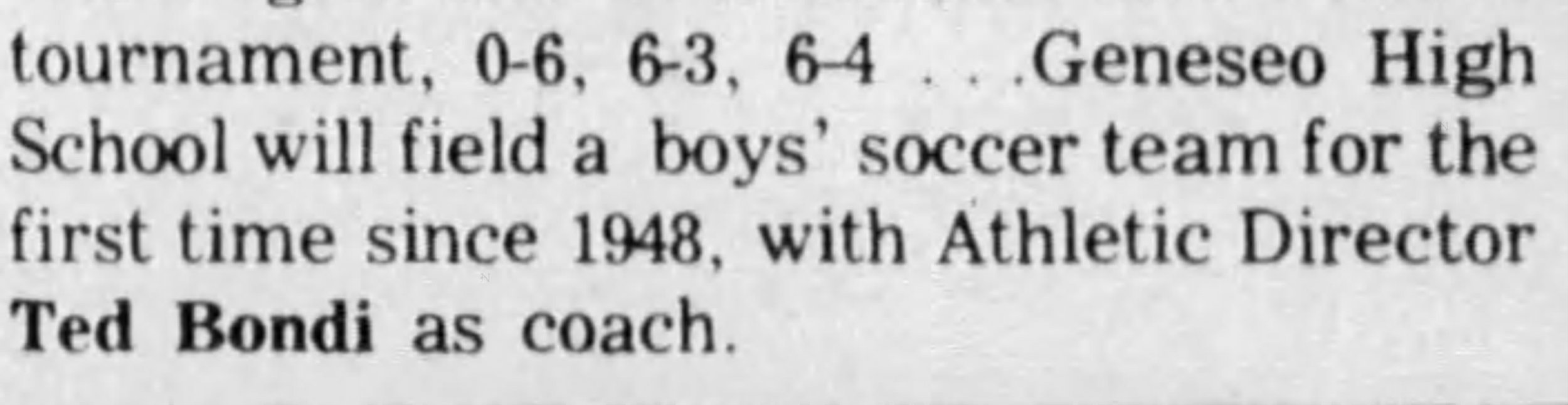
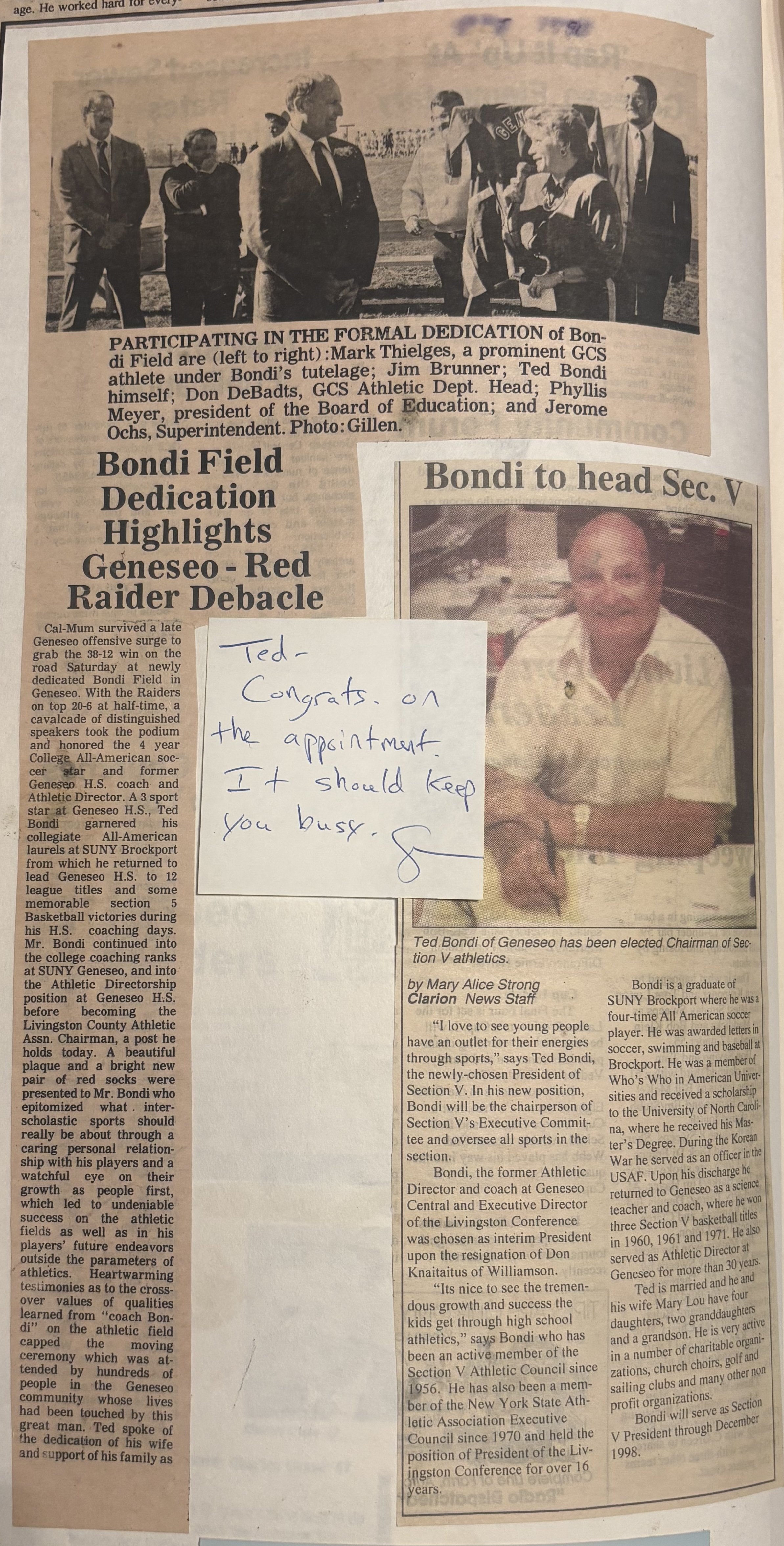
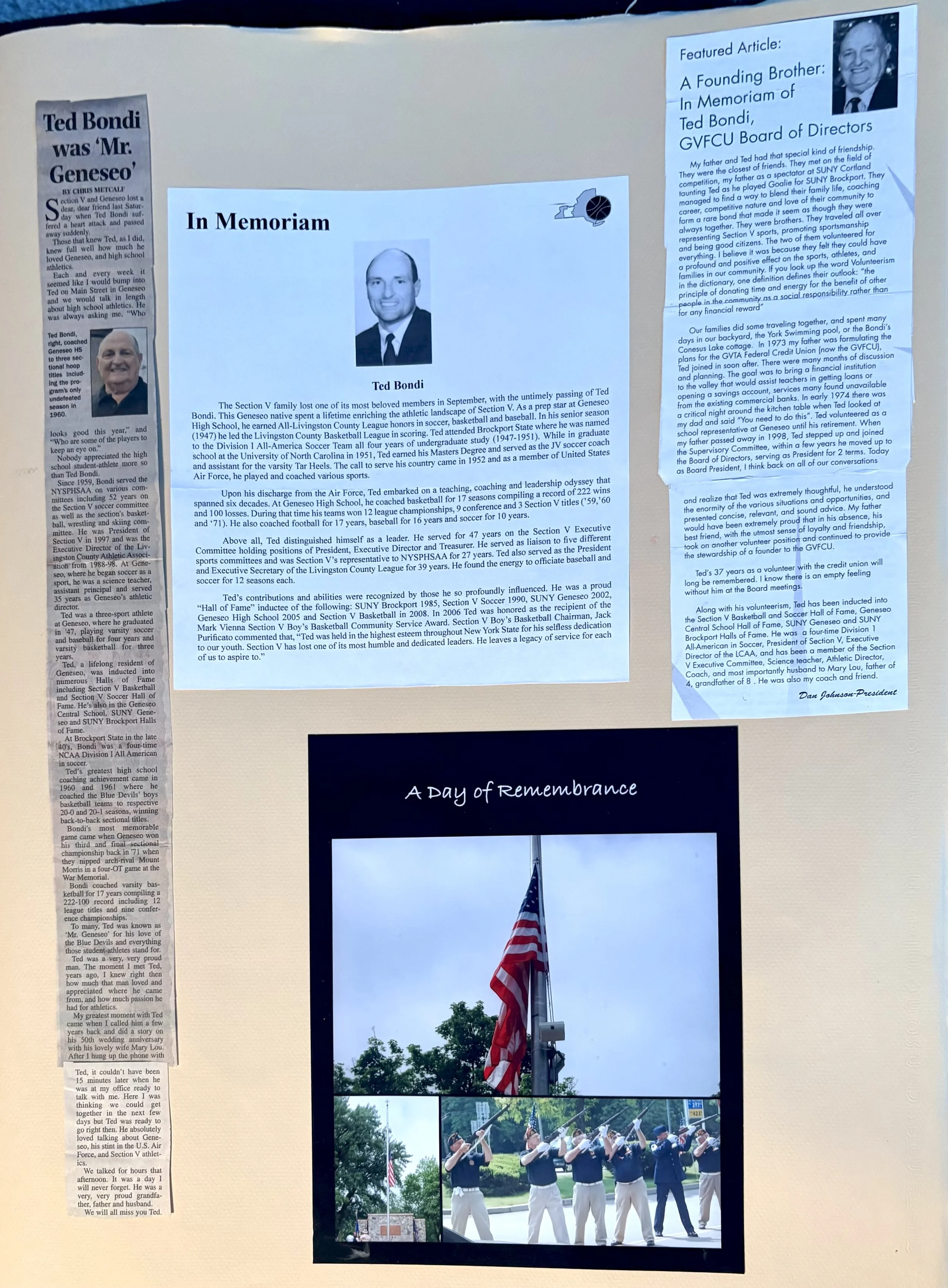
In addition to spearheading the return of the boys’ soccer team, Bondi expanded the sporting programs from three to thirty-three in his time with the school, as well as leading the high school basketball team to multiple county and sectional championships. Upon finishing his coaching career, he joined the Section V Athletic Council as well as being a part of the executive committee for the New York Public School Athletic Association to continue giving back to the community. In fact, Bondi’s off-field exploits were so extensive that simply naming all the accolades and Hall of Fames he was inducted into seems to best sum up his impact.
Brockport Hall of Fame, 1985
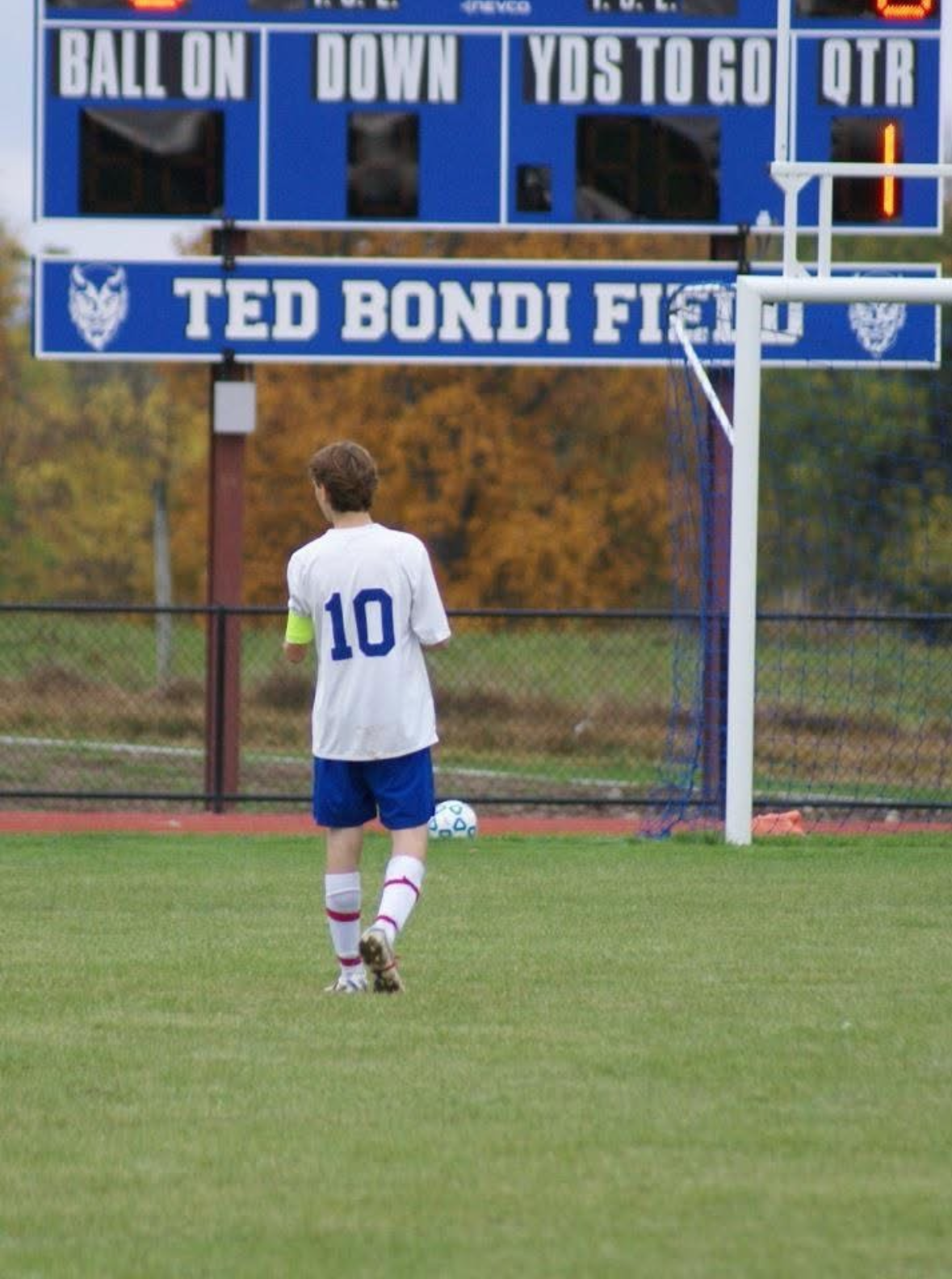
“Ted Bondi Field” dedication ceremony, October 20, 1990
Geneseo Sports Hall of Fame, 2002
Geneseo Central School Alumni Hall of Fame, 2005
Brockport Hall of Heritage, 2006
NY Section V Basketball Hall of Fame, 2008
NYSPHSAA Hall of Fame, 2009
NY Section V Athletics Hall of Fame, 2017
NYSAA Hall of Fame, 2018
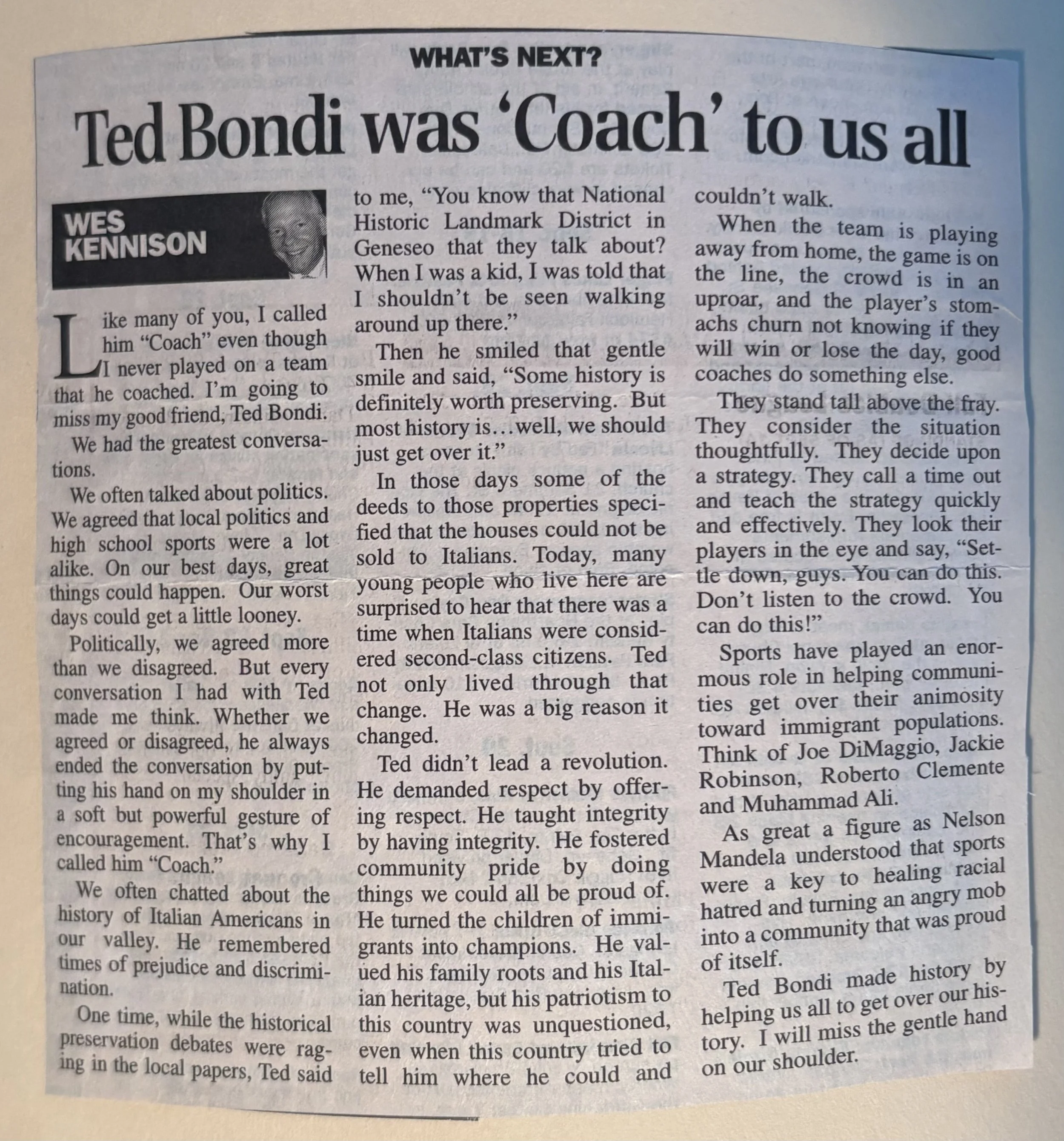
In September of 2010, Ted Bondi passed away at the age of 81. A lifelong resident of Geneseo, Bondi left an immeasurable impact on his community as a constant not only in the athletics scene, but in his community at large. Whether it was being a cornerstone for Geneseo athletics or being an inspiring leader off the field, Bondi would spend the majority of his life being affectionately known as “Mr. Geneseo” while serving as a steady force in dismantling long-standing prejudice against Italian-Americans.
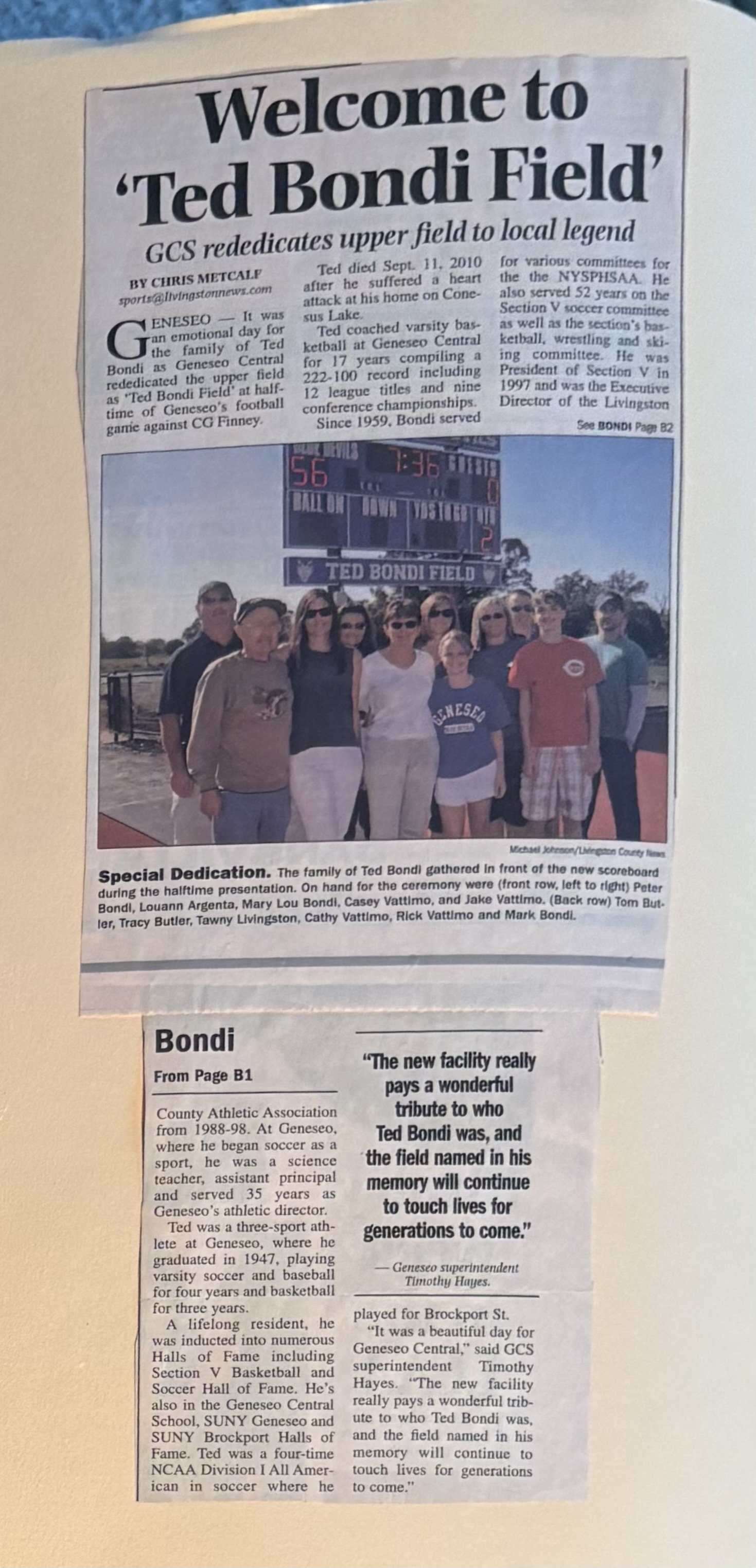
In October of 2011, the Ted Bondi Field was rededicated to Ted and his family, honoring Ted’s legacy as the local hero who climbed into a tier of his own. His continued dedication to those around him - spanning his service to the country, as well as his commitment to his teammates on the field - not only makes him one of the greatest American goalkeepers to have ever played, but one of the most relatable goalkeepers as well. His loyalty to those who first supported him still resonates decades after he concluded the greatest career any goalkeeper has ever had in men’s college soccer.
References
[^] 1. Goals scored (excluding penalties) counted as two goals, and Len Hackshaw scored the game-winner before joining Bondi at Brockport State.
[^] 2. Details drawn from conversations with the Bondi family.
[^] 3. Quotes from newspaper clippings taken from Ted Bondi's scrapbook. Quotes can be found on the picture with the subtitle, "Various clippings from Bondi’s first year at Brockport".
[^] 4. Ibid.
[^] 5. Ibid. Sampson College was two-year institution operating from 1946 to 1949.”
[^] 6. Quotes from newspaper clippings taken from Ted Bondi's scrapbook. Quotes can be found on the picture with the subtitle, "Various newspaper clippings mostly from Bondi’s sophomore year".
[^] 7. Quotes from newspaper clippings taken from Ted Bondi's scrapbook. Quotes can be found on the picture with the subtitle, "Bondi and Whatford featured in the all-star game following their freshman years".
[^] 8. The Republican, April 20, 1948.
[^] 9. Tony Almeida and Chicago-based goalkeeper Joe Silovsky were named as alternates to the eventual Olympic squad. Walter Romanowicz, who featured twice for the USMNT in 1947 turned down the invite to participate in the Olympic trials, despite winning three National Amateur Cups with Ponta Delgada from 1946-1948 due to not wanting to travel. He would turn down an invite for a chance at the 1950 World Cup squad as well, citing work being a barrier.
[^] 10. Thau and Almeida faced goalkeeper Irvin “Buzz” Seymour (West Chester) and Al Schaufelberger (Navy) at the Sterling Oval. Schaufelberger and Almeida were selected to represent the East team in Saint Louis on May 18th. The West team featured Archie Strimmel (Pittsburgh) and Joe Silovsky (Chicago).
[^] 11. Quotes from newspaper clippings taken from Ted Bondi's scrapbook. Quotes can be found on the picture with the subtitle, "Bondi speaking on his experience in trying out for the 1948 Olympics (July 29, 1999)".
[^] 12. Democrat and Chronicle, February 14, 1954.
[^] 13. The Democrat and Chronicle, October 15, 1948.
[^] 14. The Times-Union, October 27, 1948.
[^] 15. After 1935, the ISFA had grown so large yet without enough common ground, the ISFA stopped electing national champions from 1936-1940 and instead named a list of "outstanding teams" to reward undefeated - or nearly undefeated - teams from the season. However, World War II and enlistment led to dwindling teams. (By 1945, there were only 22 teams left.) So from 1941-1944, no national champion was named due to these reasons. By 1945, the National Soccer Coaches Association (NSCA) named national champions, despite no playoff occurring until 1959. Cornelius R.P. Cochrane Jr.'s thesis, A Study of Intercollegiate Soccer Data in the United States From 1905 to 1961, details the ISFA's struggles to name a cohesive national champion over the decades, especially in the 1940s. No voting totals for the national champion were retained.
[^] 16. 1949 matchup against Scotland featured Howie Whatford starting for the USMNT

[^] 17. Democrat and Chronicle, October 20, 1949.
[^] 18. Democrat and Chronicle, Dec 14, 1949.
[^] 19. Democrat and Chronicle, Dec 19, 1949.
[^] 20. The Times-Union, January 23, 1950.
[^] 21. Quote from a newspaper clipping taken from Ted Bondi's scrapbook. Quote can be found in the gallery of six pictures on the match against Hamburg SV.
[^] 22. The Times Record, Oct 2, 1950. In addition to the rough season, Bondi received ACL reconstruction surgery prior to the 1950 season. It's unclear how much it played a role in the season, if at all.
[^] 23. Democrat and Chronicle, October 22, 1950.
[^] 24. Quote from a newspaper clipping taken from Ted Bondi's scrapbook. Quote can be found on the picture with the subtitle, "A newspaper clipping from the 1950 contest between Seton Hall and Brockport (right)".
[^] 25. The Times-Union, October 28, 1950.
[^] 26. Brockport became a Division III program in 1973.
[^] 27. The match against the Western New York All-Stars and Eintracht Frankfurt took place on May 11, 1951 in front of "some 3500 huddled under glistening umbrellas in the steady night rain". The match finished 13-1 to the German side as Bondi was subbed in when the game was around 6-0 after less than 20 minutes. At halftime, "while the All-Stars rested on the bench and caught their breath after 45 minutes of futile chasing, the Eintracht team scampered around the field, polishing shots and holding an impromptu practice session." (The Buffalo News, May 12, 1951)
[^] 28. Democrat and Chronicle, September 29, 1952.
[^] 29. The Times-Union, October 13 1952.
[^] 30. Quote from a newspaper clipping taken from Ted Bondi's scrapbook.
[^] 31. Ibid.
[^] 32. Taken from an email correspondence with Joe Boorish.
[^] 33. Democrat and Chronicle, August 28, 1955.
[^] 34. Democrat and Chronicle, October 28, 1955.