What Can the USWNT Learn About the USMNT's Goalkeeping Lull?

cover photo from USA Today

After hosting their second annual SheBelieves Cup, the US Women's National Team suffered a last place finish. The cup ended with a resounding 3-0 loss to France and while there was plenty of blame to share, many were left scratching their heads when looking at the goalkeeper position.

2017 could mark the start of the post-Hope Solo era. Solo amassed 202 caps and over a hundred shutouts dating back to 2000. But over the last decade, there has been little room in the USWNT for any other goalkeeper but Solo. The ever-reliable backup Nicole Barnhart earned 54 caps while Alyssa Naeher and Ashlyn Harris have now combined for a dozen appearances each. However, as we enter 2017, Alyssa Naeher is the only goalkeeper under thirty with any caps under her belt.

For both the men's and women's programs, the US has a habit of going all-in on a handful of goalkeepers, without worry that they'll need to strengthen the rest of the pool. While clubs are the bigger factor in developing a player, the national teams offer a gauge for just how well those players are being developed. If a national team isn't bringing in young players periodically, it isn't preparing for the next cycle as adequately as it should.

How the USMNT Got Here

In similar fashion, USYNT teams rarely bring in new competition for their starting goalkeepers. Goalkeepers will regularly start and finish a cycle, with little competition brought in to up the level of play. For every other goalkeeper in the US, they're left to play and practice as they wish. However, as the men's team is starting to realize now, focusing solely on a few goalkeepers for each U20 World Cup cycle isn't enough to create a steady stream of elite goalkeepers. Right now, the USMNT team should be turning to Brian Perk, Sean Johnson, or any other retired USYNT goalkeeper, but they aren't panning out. Colleges have picked the slack for years now, producing several top goalkeepers over the years, despite many not spending time with USYNT programs.

Another issue the USMNT faced was getting collegiate players to transition into MLS. Until five years ago, there wasn't much of a stepping stone between college and MLS. In 2015, the USL exploded, doubling the size of their league and offering more space to recent graduates. This created a nice progression for young goalkeepers to go to college, USL, then MLS, all the while getting playing time and appropriate competition. Players can skip certain levels if they're good enough but the bigger point is that the pyramid is fleshed out to give a variety of playing levels. Now the USMNT must figure out how to take players from MLS and place them into elite leagues. Europe isn't the solution for every player, nor will MLS ruin everyone's career, but in the last five years we've seen more players return to MLS instead of using it as a stepping stone elsewhere.

The women's game has a similar issue, although they aren't missing the elite league. The NWSL serves as the correct end piece but they don't have the appropriate stepping stone for seniors coming out of college.

NWSL Shortcomings

It's hard for young players to get playing time in the NWSL. The ten team league will always start a veteran over a young goalkeeper, as premier leagues should. On top of that, roster space is still very limited within the NWSL. Each NWSL signs only two goalkeepers while perhaps keeping an additional one in training, offering only housing and food to cover their time spent with the club. For the goalkeepers who don't make the cut as one of twenty goalkeepers in the NWSL, there isn't much left for them. There are over a hundred teams in amateur leagues (WPSL and UWS), but the summer leagues are best suited for collegiate athletes looking for a few games in the off-season. Even the quality of players in those leagues are often underwhelming, with the majority of the American-based players coming from Division II, Division III, or NAIA schools.

Some may look to NWSL expansion as a solution to getting more roster spots for goalkeepers. If the league were to double in size, goalkeepers would perhaps benefit then. As of right now, the league is slow to expand, only adding two teams in their five years. Right or wrong, steady expansion will do little to aide goalkeepers without clubs.

No Vacancy

Unfortunately the US isn't the place to develop goalkeepers. Graduated seniors don't need more training, they need playing time. Perhaps in five or ten years down when there are more teams for goalkeepers to fill, but in the meantime goalkeepers need clubs. Over the last couple years we've seen a number of collegiate seniors head to the land of opportunity: Europe.

Lindsey Harris (UNC '16) - FH, Iceland
Kelsey Brouwer (Middle Tennessee '16) - Apollon Limassol, Cyprus
Emily Dolan (FGCU '16) - Zaccaria, Italy
Morgan Stearns (UVA '16) - Sundsvalls, Sweden
Megan Kufeld (Washington '15) - Sundsvalls, Sweden
Madalyn Schiffel (San Francisco '15) - Avaldsnes, Norway *
Bryane Heaberlin (UNC '15) - Turbine Potsdam, Germany *
Alyssa Giannetti (Cal Poly '15) - Arna-Bjørnar, Norway
Kate Scheele (Colorado '15) - Kungsbacka, Sweden **

* - returned stateside
** - retired

Europe provides two important aspects in helping goalkeepers continue their development to become USWNT-ready. First is playing time. Goalkeeper development in Europe is still fairly thin for the women's side and every year the NCAA is producing hundreds of collegiate seniors, many of which are more than proficient enough to play somewhere in Europe. They would get the playing time that the NWSL can't promise them. Secondly, playing abroad strengthens a goalkeeper in a way playing domestically does not. Ask any professional overseas, playing abroad brings unique challenges on and off the field. It's easier to play in the US but if goalkeepers are looking to become elite, it won't be an easy road. Europe might not be the ideal place to develop goalkeepers, but it's better than what the US currently has to offer.

Realistic Solutions

If the USWNT wants to continue to develop elite goalkeepers, the focus shouldn't be on expanding the NWSL. Although there are many positives to expansion, it would create only a few more roster slots and ultimately do little to bolster the goalkeeping position. More professional teams in the US would be ideal, but it's far down the road from 2017. The USSF needs to find a solution to fill the gap between NCAA and NWSL. NCAA is producing at least a dozen goalkeepers every year that could make the jump to the professional ranks, but too many hang up the cleats after their collegiate career ends.

Currently Europe is in need of goalkeepers and we have too many to know what to deal with. If the USSF focused on placing ten collegiate seniors every year (2-4 in NWSL and 8-6 overseas) then keeping the depth chart full won't be an issue, not to mention crafting more elite goalkeepers. For players going overseas, they would only need to play overseas for two-three years before either coming back to the NWSL, or gaining a larger paycheck in a higher league in Europe.

The USSF can't let the NWSL solve all their developmental issues. It's a great league, but it has its limitations. The men's national team once held the world standard for goalkeeping but they're now left with zero elite goalkeepers. For the USWNT, there is much to learn about the men's situation, which could quickly become theirs if they're not paying attention.
Residency Program Closes After Little Success With Goalkeepers

US Soccer will be closing the doors on their U17 residency program after 18 years. The program is noted for their first class that featured multiple future World Cup players, but has been a polarizing institution since. The program boasts 33 of their 450+ residency players to later earn a cap for the USMNT, unfortunately none of them being goalkeepers.

The residency program produced 43 goalkeepers of 18 years. Despite being the premier academy in the US, only a handful of goalkeepers have become moderately successful throughout the residency's history. Of the first twenty to go through the program, only four have earned 30 starts in a first division. Perhaps Slyvestre will join the crew but a 20-25% rate of turning goalkeepers into a one year starter in MLS is far too low for the elite developmental program in the US.

There are some promising goalkeepers that are still playing and I would expect around another eight to become a starter in MLS at some point, but ultimately that's not the goal of the residency. Youth national teams are about producing a pipeline for getting goalkeepers to the senior national team, which doesn't appear to be changing any time soon. There's still a lot of time left for a number of these goalkeepers, but if history has anything to say, expect outside sources to be producing our top goalkeepers, not the residency program.

History of Residency Goalkeepers

1. DJ Countess (s99 - f99)
2. Steve Cronin (s99 - f99)

3. Adam Schuerman (s00 - f01)
4. Zachary Riffett (s00)
5. Ford Williams (f00 - s01)
6. Phil Marfuggi (f01 - s03)
7. Adam Hahn (s02)
8. Steve Sandbo (f02 - s04)
9. Marcus Rein (f02 - s04)
10. Bryant Rueckner (f03 - f05)

11. Evan Newton (s04 - s05) *
12. Brian Perk (f04 - s06)
13. Joe Bendik (s05) *
14. Diego Restrepo (f05) *
15. Brandyn Bumpas (f05 - s06)
16. Josh Lambo (f05 - f07)
17. Larry Jackson (s06 - s07) *
18. David Meves (f06 - s07)
19. Zac MacMath (f06 - s08) *
20. Brian Sylvestre (f07 - s08) *

21. Earl Edwards (f07 - f09) *
22. Samir Badr (f07 - s09) *
23. Spencer Richey (s08 - f09) *
24. Jon Kempin (f08 - s09) *
25. Keith Cardona (f09) *
26. Fernando Pina (f09 - s11)
27. Kendall McIntosh (s10 - s11) *
28. Wade Hamilton (s10 - s11) *
29. Santiago Castano (s10)
30. Alek Gogic (f11 - s12) *

31. Evan Louro (f11 - s13) *
32. Paul Christensen (f11 - s13) *
33. Marius Heislitz (s12)
34. Jeff Caldwell (f12 - s13) *
35. Carter Richardson (s13) *
36. Will Pulisic (f13 - f15) *
37. Kevin Silva (f13 - f15) *
38. Abraham Romero (f13) *#
39. Eric Lopez (s14 - f15) *
40. Alex Budnik (s16) *

41. Justin Garces (s16) *
42. Quantrell Jones (s16) *
43. Hunter Pinho (s16) *

bold - reached 30 appearances in first division (MLS or abroad)
* - active
# - played for Mexico's U17s in the 2015 World Cup

Five Plays From Week Three You Probably Missed

cover photo from Denny Medley-USA TODAY Sports

1. The Wrong Kind of OG

Play starts at 2:28

Okay, okay, everyone probably saw this play. But what they missed was Bingham's approach. The ball takes an awkward spin off a deflection yet Bingham tries to catch the ball with both hands on either side. For any low trickling ball, a goalkeeper wants to use his hands to ramp the ball up into his chest for this specific reason. Bingham received some really positive feedback after the poor outing, but it's important to know the play is a product of poor technique, not a lapse in concentration. When you're lazy with the little things, you open yourself up for more mistakes.


2. Forward Step Puts Hamid Behind

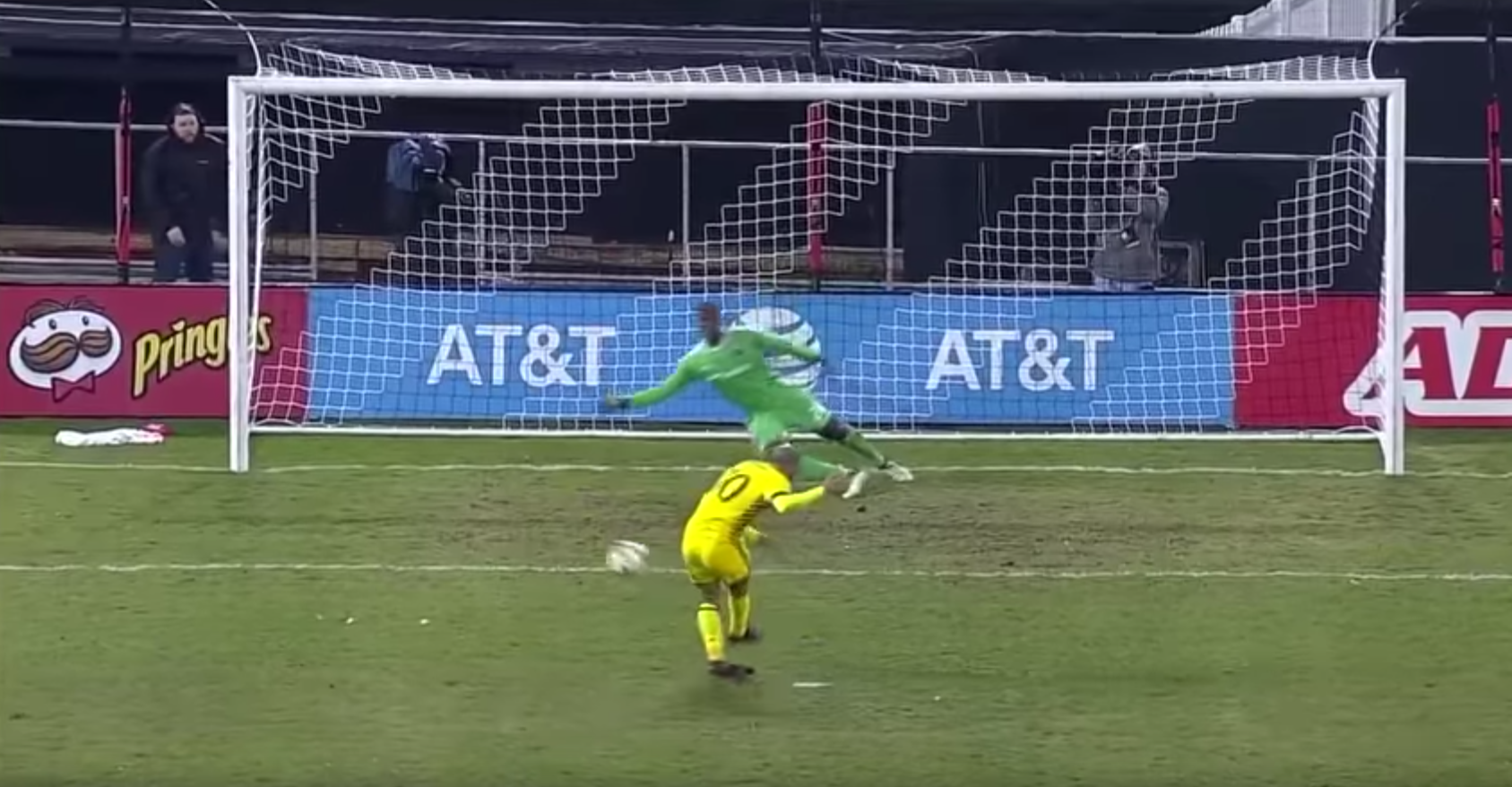
In the 38th minute DC United are called for a foul in the box. (Watch the penalty here.) As Columbus' Federico Higuain winds up to take the shot, Hamid utilizes the popular forward step approach to cut down the angle. While the idea behind the practice makes sense, more times than not it puts the goalkeeper at a disadvantage because it is down incorrectly. Notice how Hamid has not only lost time on shot (the ball is about a quarter of the way to the goal before Hamid plants his foot) but his step has actually put him farther away from the ball. His right foot is behind the midway point because of his awkward "forward" step. Needless to say, Hamid did not make the save despite diving the correct way.


3. Lending a Hand

Steffen hasn't been great in the air since day one and this part of his game still plagues him today. For whatever reason (perhaps he is thrown off by the passing attacker?) he tries to catch the ball with one hand and drops a goose egg in front of goal. Nothing more than a corner comes from it but for a young goalkeeper trying to show his team he's ready to take over the reigns, the small things can't be an issue. MLS is a cross-heavy league and while he makes a great low save in the 70th minute, reaction saves come second to being able to handle crosses in MLS.


4. Bendik Bails Out Orlando

Late game heroics are always a lot of fun, especially when it's the goalkeeper. Last week I was critical of the starfish approach as the goalkeeper is typically better suited for staying back to make the simple save there. However a save is a save and there's nothing critical to say here. Bendik saved the win for Orlando, not another goalkeeper doing something different. But what really stood out on this play was his awareness to chase the ball down after making the save. He doesn't just throw his body out recklessly, he lands on his feet to be able to move. He corrals the ball to stop another chance on goal, putting the game to sleep right before he grabs some bedtime pizza.


5. Penal o No Era Penal?

Play starts at 0:45

In the first half, Robles concedes a penalty on trying to bail out a teammate for a poor pass. Robles shows up just a second too late and tackles Jordan Morris. It was the correct call and fans were probably more frustrated with the poor pass instead of Robles' attempt to save it. However just minutes later, Frei shows us an alternative approach to a tight 1v1. Frei realizes he is going to be second to the ball and twists his body to avoid contact. Robles play is probably a little trickier as he is leading with his feet instead of hands, like Frei is, but the bigger point is that goalkeepers must be able to adjust in the middle of 1v1s. They can't always just make one decision from the get-go as the landscape is quick to change.

U20 World Cup Advancing Odds and Elo Ratings

cover photo from US Soccer

Earlier this week the U20 World Cup draw was revealed, slotting twenty-four teams into six groups of four. The top two will automatically advance into the knockout stage while the top four 3rd place teams will fill out the final spots. USA was given a favorable group and are looking to follow up last cycle's positive performance, where they reached the final eight before losing to eventual champions Serbia in penalty kicks.

Below are advancement percentages and Elo ratings for all the U20 World Cup teams. With 16 of the 24 teams advancing, all the percentages are fairly high. Obviously these ratings should be taken with a grain of salt, as teams are quick to change from one year to the next, but they do offer a general guide to where teams are. The Elo ratings include all World Cup matches and date back to UEFA's first youth tournament in 1949.

Group F is the most even between all four teams, making first place the most reachable but also holding a realistic last place finish for all four teams. Groups A and D contain multiple powerhouses and will be a fight to the last minute in each of those matches.

The 2017 U20 World Cup, hosted in South Korea, starts May 20th. The US opens their first match against Ecuador on the 22nd at 4am eastern time.