
Image by Sofia Lindgren
Anyone who watches enough MLS or Premier League football knows the moment. The ball is rolling toward the back post, the centre-half is nowhere near it, and the goalkeeper either reads it three seconds early and sweeps it up like a relay runner, or he reads it three seconds late and the striker has a free header from six yards. That gap, between the keeper who is in form and the keeper who is not, is one of the most underweighted variables in match preview writing on this side of the Atlantic. American soccer coverage tends to lead with the attacking name on the team sheet, the shape of the back four, the recent away record, and a quick line about whatever the trading desks at FanDuel, DraftKings, BetMGM, Caesars or ESPN BET are currently hanging on the fixture. The keeper, meanwhile, is treated like a piece of furniture: present, important, but rarely the headline.
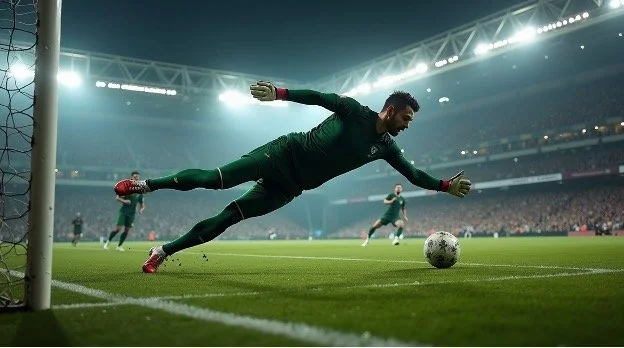
Photo by Matthew Caldwell
That treatment is a habit, not a tactical truth. A goalkeeper in real form alters the expected goals total of the team facing him by a margin that often exceeds anything a striker hot streak does at the other end. The same is true in reverse. A keeper who has lost his line, his footwork on a back-pass, or his confidence on crosses can quietly cost his team a goal a game across a five-match window, and that swing is rarely fully priced into the early-week numbers that show up on screen Monday morning. For the American soccer fan who likes to read the analytical signal before deciding what he thinks of the published line, the goalkeeper section of the team news has become the most useful single paragraph in the preview.
Readers who want a wider view of how US sportsbook desks discuss soccer week to week, including how the trading floors at FanDuel, DraftKings and BetMGM frame their MLS and World Cup qualifier numbers, can find that ongoing coverage here on Gaming Today, which tracks the operator side of the conversation in close to real time. The rest of this article stays on the analytical side of the touchline, looking specifically at why the goalkeeper position deserves more weight in any serious soccer preview written for an American audience in 2026.
The goalkeeper as an underweighted variable in American soccer previews
Pick up almost any MLS or Premier League preview written for a North American audience and count how many words address the keeper compared to how many address the front three. The asymmetry is striking. A typical 700-word preview in 2026 spends 350 words on the attacking matchup, 150 on midfield control, 100 on injuries, and maybe 40 on the goalkeeper, often only as a postscript noting whether he is fit. That distribution is a holdover from an era of soccer writing in which keepers were assumed to be roughly interchangeable above a certain level. The modern data picture contradicts that. Across a Premier League season the gap between the league's best and worst shot-stoppers, measured against post-shot expected goals, can run as wide as plus or minus eight goals, the same magnitude as a striker scoring fifteen versus seven. Treating that variable as a postscript leaves a lot of signal on the floor.
What we mean by form when we say a goalkeeper is in form
Form for a goalkeeper is not a single number. It is a stack of three connected things, and pulling them apart is most of the work. The first layer is shot-stopping, which the public-facing data captures through post-shot expected goals minus goals conceded, a stat that asks whether the keeper saved more or fewer goals than an average keeper would have, given the placement and pace of the shots he actually faced. The second layer is distribution, harder to see on broadcast but living in pass progression, average pass length, and the rate at which his goal kicks survive the opposition's first press. The third layer is command of his box on crosses, set pieces and back-passes, which still mostly lives in the eye test and in clip work. A keeper in real form tends to be moving the right direction across all three at once. A keeper said to be in form on the basis of one televised highlight save is often only in form in one of the three, which is a different and much more fragile thing.
How shot-stopping data quietly diverges from the eye test
A useful Sunday morning exercise is to compare a keeper's shot-stopping record across the last five matches against the prevailing perception of him on Twitter and talk-radio. The two often diverge sharply. A keeper can post a negative post-shot expected goals number, the convention for keepers performing worse than average, while looking commanding on broadcast because his side has been protecting him. Conversely a keeper can post a strongly positive number while being mocked as unreliable, because the two highlight errors he made were both televised in primetime. The arithmetic of perception favours the visible mistake over the invisible save, and the underlying data corrects for that. Andre Onana's run at Manchester United in 2024 and 2025 became the textbook example. The British press dissected his performances in detail, tracing how a small set of high-profile mistakes had reshaped public perception faster than the season-long underlying numbers warranted.
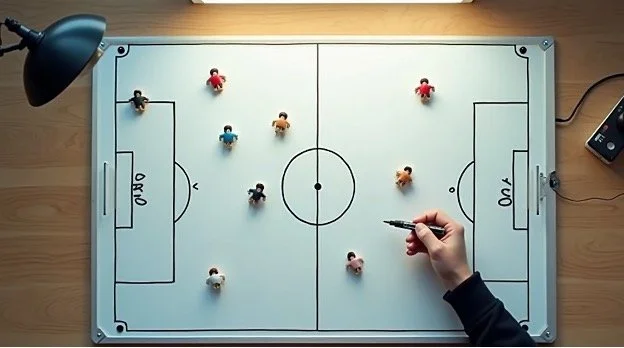
Photo by Rachel Donovan
USMNT and USWNT goalkeeping depth as a case study in form variance
American soccer offers a particularly clean test case because the two senior national teams have followed almost opposite goalkeeping trajectories over the last decade. The USMNT pool has been visibly thinner than the European peer pools, with a small group of fully proven Premier League level options at any given time, while the USWNT pool has been historically deep, often with three keepers in the world top fifteen all under contract simultaneously. The contrast and what it tells us about development pipelines is laid out in detail in a USWNT goalkeeper depth piece on Everybody Soccer, which compares the route from college soccer to senior international football for keepers on each side. The contrast matters because depth flattens variance. A federation with three internationally experienced keepers can absorb a single one losing form without conceding more goals. A federation with one and a half keepers cannot, which is why a single bad month from a USMNT first-choice between 2018 and 2022 had so much more downstream impact than a comparable month from a USWNT first-choice.
Distribution and the back-pass as the modern keeper's second job
Distribution has stopped being optional. A keeper in 2026 who cannot play a clean ten-yard pass under pressure is functionally a man down for the first phase of build-up, and most modern coaches will not put up with that for long. The shift began at the very top of European football in the late 2010s, when Pep Guardiola's Manchester City started building from the keeper out as a default, and it has now reached MLS academies, where keepers as young as fourteen are taught to receive on the half-turn and play the diagonal to the far full-back. The form layer this creates is huge. A keeper whose pass progression numbers slide can quietly turn his team's first phase into a coin flip, with goal kicks routinely failing to clear the opposition's first press. That outcome rarely shows up as an obvious mistake. It shows up as the team conceding territory and shots from positions that would not exist if the first ball out of the back had been calm. American match writers are starting to catch up, but the analytical preview that integrates pass progression with shot-stopping is still rare enough to be a real edge.
Set pieces, command of the box, and the hidden cost of indecision
The third layer of goalkeeper form is the hardest to digitise but in many fixtures the most match-decisive: the keeper's command of his own box on set pieces and crosses. A keeper who comes for crosses and claims them changes the geometry of his defensive third because his centre-halves can hold a slightly higher line and the opposition's most dangerous routine, the inswinging delivery from the right, becomes a much lower percentage play. A keeper who hesitates on crosses creates the opposite incentive, which shows up across whole matches in opposition corner counts and second-ball recoveries in the six-yard box. The Guardian breakdown of Onana errors at United is again instructive here, because most of the moments that defined his perception problem started not as shot-stopping failures but as moments of indecision in the air, with the keeper caught between coming and staying. American soccer writing has historically dealt with this purely through narrative and the eye test, but a small group of analytics-led match previews are starting to fold opposition corner conversion numbers and the keeper's claim percentage into their fixture writeups, and those are the previews most worth reading.
Why MLS schedule density makes goalkeeper form the most volatile in world football
MLS sits inside a calendar that does not exist anywhere else. Three competitions running concurrently in a single ten-month window, transcontinental travel from Vancouver to Miami inside a 36-hour turnaround, summer heat in Houston, January cold in Toronto, the playoff format, and the Leagues Cup mid-season disruption all combine to make MLS goalkeeper form one of the most volatile in world football. The implication for analytical previews is direct. A keeper's last five Premier League matches are usually a reasonable indicator of his next five, because the schedule is comparatively even, but a keeper's last five MLS matches can include a midweek Concacaf Champions Cup leg in Costa Rica, a Saturday road match in San Jose, a Wednesday Leagues Cup match against a Liga MX side, and a return to Atlanta in 90 degree heat. Form across that sample is not a smooth signal. The analytical question is closer to how the keeper has performed in this particular block of fixtures than to his last five outings, full stop.
Photo by Daniel Pereira
What three matchups looked like once the goalkeeper read was added
To make the abstraction concrete, here are three relatively recent fixtures across MLS, USL Championship, and the Premier League where the published preview consensus shifted noticeably once the keeper layer was integrated, illustrating how form translates into a different read of the match.
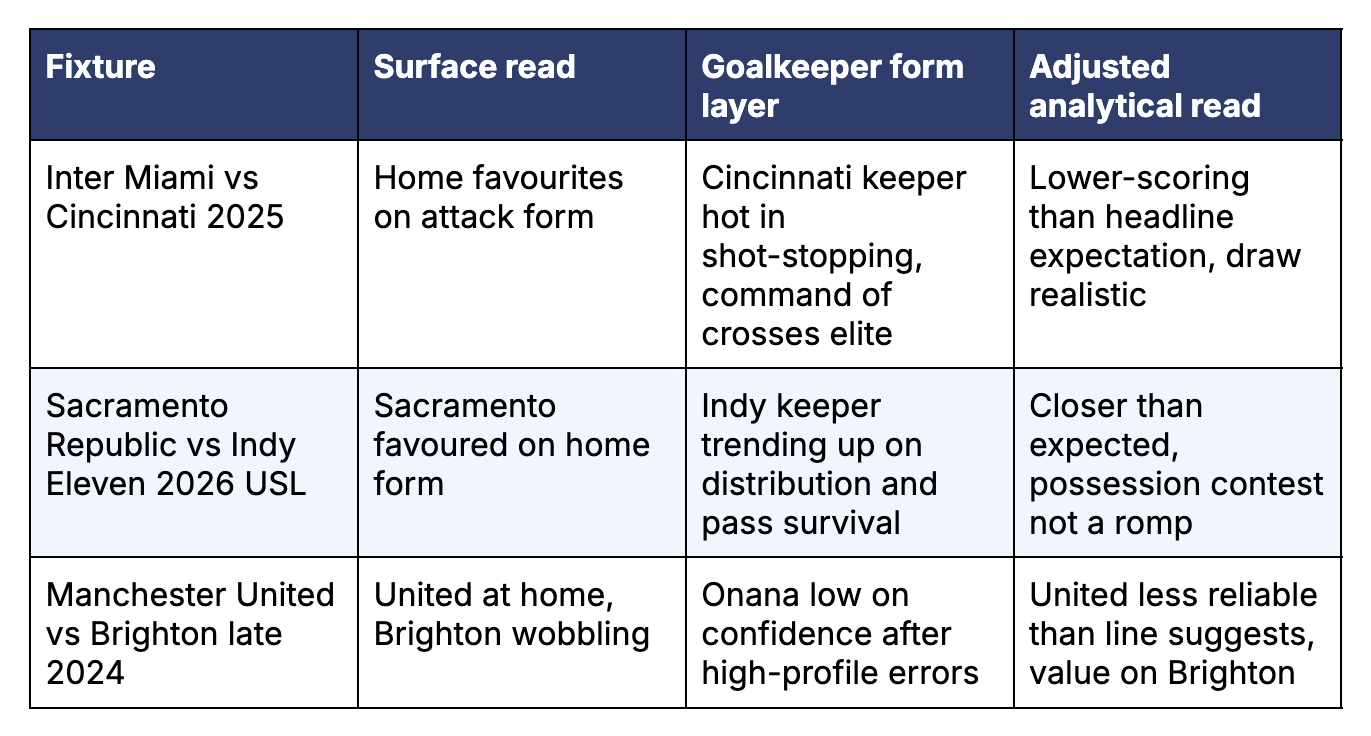
None of these reads was a guaranteed outcome. Soccer remains the lowest-scoring of the major team sports, and a single deflection can rewrite any match. But across a season of analytical previews the goalkeeper form layer pulls the reader closer to the underlying probabilities that drive the result, and away from the surface narrative built mostly out of attacking names and home form.
How to build a goalkeeper form read into a weekly American soccer routine
The practical version of all this is a short Sunday morning checklist any reader can run before forming a view of the upcoming fixture. The first item is the keeper's last five matches measured by post-shot expected goals minus goals conceded, available on most public analytics dashboards. The second item is his last five matches measured by goal kick survival, harder to find but now published by the better stats sites. The third is a short clip review of his last two matches focusing only on cross deliveries and back-passes under pressure, where indecision in the air shows up most clearly. The fourth is the schedule density question: has the keeper played three matches in seven days or a single match with a full week of preparation. The fifth is whether his back four is the same back four he has been training with all year, because keeper-defender chemistry on the back-pass and the high line is rarely portable. Run that checklist for ten minutes before reading any preview, and the published narrative starts looking like one input among several rather than the master signal it sometimes pretends to be. That is the analytical posture the American soccer reader of 2026 has the tools to take, and the goalkeeper position remains the single largest available source of edge for anyone willing to do the work.